


Welcome back to The Snow Report! Today, I’m sharing the final chapter of my book Dream Teams. If you’ve enjoyed reading along, please forward this to someone else you think will enjoy it, too!
If you missed the previous chapters of Dream Teams, read them here:
Chapter 3: Chrysler, Wu Tang & The Subtle Art of Productive Conflict
Chapter 4: Depressurizing “Teams”—or—How Soccer Curbs Religious Hate
Chapter 6: When Is Different Too Different? (The Tale Of The Black Square)
Chapter 7: Welcome To Pirateland (How Diversity Saved America In 1814)
Chapter 8: Intellectual Humility, or How Malcolm X Changed His Mind

Oxytocin, A Love Story
1.
Fumiko Nakamura and her husband Takekuma would have never guessed, at the time they were thrust out of their Los Angeles home at gunpoint, that their son George would someday be a massive celebrity.
The odds of this would have seemed remote even if the young family and all of their Japanese neighbors weren’t being rounded up like cattle, forced to live in stables, then prison camps. Truth was that 1942 wasn’t just the height of Japanophobia in California. It was the high-water mark of anti-Asian prejudice in America generally.
The law at the time said that Asian-born people were not allowed to become US citizens because of their race’s alleged inability to assimilate. Asian children born in America were natural citizens by default, but they rarely attained white-collar jobs or even worked outside their own communities. A few decades before, California had been the site of the biggest mass-lynching in US history. The victims were Chinese immigrants. Since the mid-1800s, the Chinese and the Japanese had occupied the bottom rungs of California’s social ladder, alongside Koreans, Filipinos, Vietnamese, and East Indians.
Stereotypes were abundant. The year 1913 saw the debut of the fictional arch-villain “Fu Manchu,” brainchild of British novelist Sax Rohmer. Scheming, soulless, crafty-yet-primitive, Fu Manchu embodied every Western suspicion toward the inscrutable East.
And there was Charlie Chan: a fictional Chinese American detective who delivered ornate sentences in garbled syntax. Pudgy and nonthreatening, Chan is frequently and profusely apologetic for the fact that he happens to be Chinese. Part hero and part stooge, Charlie Chan represented the white ideal of the deferential minority every Asian American ought to be.
Then on December 7, 1941, the empire of Japan attacked the US fleet at Pearl Harbor and awakened the sleeping giant that was America’s war machine. A flood of anti-Japanese propaganda followed. Japanese men were simian, “yellow,” subhuman. Japanese women were either concubines, geishas, or maids—the unthinking attachées of their male overlords.
On the heels of Pearl Harbor, President Roosevelt made the mistake of a lifetime. He signed Executive Order 9066, permitting the military to lock up of over 120,000 people of Japanese ancestry without trial or due process of law.
Most of those imprisoned were natural-born US citizens. Half were children. The reason given—unconstitutional on its face—was that Japanese Americans might “sympathize” with America’s new enemy. But a congressional commission would later admit that the Order was “motivated largely by racial prejudice.” White business owners were happy to see Japanese American competitors rounded up and incarcerated, and California’s powerful agriculture lobby was particularly eager to uproot Japanese American farmers and replace them with whites.
Fumiko was a US citizen, born near Sacramento. Takekuma was born in Japan, but he’d immigrated to San Francisco at age sixteen. The United States wouldn’t allow him to become a citizen even though he’d lived in the country more than two decades and was working hard to provide for his family. Now forty, Takekuma, who went by “Norman,” had saved money to buy a home. But Norman’s American dream was torn away when the US military stormed his neighborhood. He and Fumiko, aka “Emily,” and their three small children were “relocated” to the Rohwer War Relocation Center: a prison camp situated in a virtual swamp in rural southeast Arkansas.
George was five years old when Norman told the kids they were “going on a vacation.” He was old enough to realize that this vacation was not a choice. Inside the camp he would play with friends outdoors while guards in surveillance towers trained machine guns on them. At the camp school the children recited the Pledge of Allegiance. Little George could see barbed wire through the window.
With liberty and justice for all.
Three years later the family was released. Their home was gone. “It was a devastating blow to my parents,” George later recalled. The only job Norman could get was washing dishes in Chinatown.
Back at school in LA, young George was ambitious. He wanted to be an architect. Maybe even an actor! One day he might even go into politics. Become a public speaker. Get married . . .
He was too young to know how long the odds were. In postwar America, the average Asian American worker made less than the average African American—which was itself a third lower than the average white. Young George had an uphill battle ahead.
Asian American Fortune 500 CEOs? Zero.
Asian American movie stars? Zero.
Asian American senators and congresspeople? You guessed it. Zero.
Race wasn’t the only obstacle George faced. He had something else going against him when it came to fulfilling his dreams.
Something he hadn’t told anyone.
2.
Let’s pause here for just a moment. I want you to read something.
The following quotations are from five different world-class athletes. I want you to read them, and then I’ll have a few questions for you:
“No one can ever brainwash me to make me believe that Sugar Ray Robinson and Muhammad Ali was better than me.”
“Bask in my glory . . . I am the greatest athlete to live.”
“I run New York. I run this whole city.”
“I see me being a designer. I see me being a model. I see me being a TV star.”
“If you want to win, sometimes you have to have a difficult conversation with people . . . You know they are not going to like you, but you do it because you want what is best for the team.”
From these quotes alone, which of these athletes would you rather have as a teammate? As a boss?
Which do you think is the better team player?
Even athletes that compete alone are part of a team. The best boxers and swimmers and sprinters in the world have coaches and helpers and trainers and nutritionists and managers that help them break records. But as you may have guessed, the last quote is the only person on the list who actually plays a team sport, and coincidentally the only one of these five pros who is particularly humble. Her name is Carla Overbeck, and she’s the former captain of the world-champion US women’s soccer team that dominated the sport in the 1990s. The others, in order, are Floyd Mayweather Jr., Usain Bolt, Conor McGregor, and Ryan Lochte. Each is famous for his arrogance and attitude.
Floyd Mayweather? Incredible boxer. And he’s right! He’s probably better than Ali. He’s probably better than Sugar Ray Robinson.
But he’s not a better collaborator. Floyd Mayweather may have a team, but he doesn’t play well with others.
Overbeck, on the other hand, wasn’t just a star athlete. She’s also a star mom, co-coach of college soccer teams, and an inspiration to her players. When she was playing soccer herself, she was notorious for personally carrying their luggage on the road, for being the last team member to hit the showers. Mayweather and the boys may be great athletes, but you wouldn’t really want to work on a group project with them.
In his book The Captain Class, Sam Walker, the Wall Street Journal sports editor whom we mentioned earlier, discovered that every one of the world’s greatest sports dynasties had something surprising in common: their players, and in particular their team captains, had a whole lot of humility.
For example, the Boston Celtics basketball team that dominated the NBA in the late 1950s through the 1960s, “never had any individual member whose isolated performance ranked among the best in history. In seven of its eleven championship seasons, it didn’t place a single scorer in the top ten” of the league—yet, it destroyed its opponents. Team captain Bill Russell in particular, Walker points out, was a crucial collaborator, and he led his team to so much victory precisely because he didn’t seek his own glory. Overbeck, when captain of the US women’s national soccer team during its famous winning streak in the 1990s, posted only seven goals in her international career, yet she led her team to dominate the world. This pattern of humility holds in rugby, volleyball, cricket, you name it.
We see this in the way that our Soviet hockey players interacted with each other, compared to their North American counterparts. The Russians described their job on the ice as that of being “servants” to the puck. And the player who held the puck was not out for his own glory, but to serve the other players. Nobody was trying to maximize his statistics, nobody cared who scored the goal. Nobody was sad when the plan had to change and the crowd cheered for someone else’s smart move.
A team is more likely to become elite, Walker’s research shows, “if it has a captain that leads from the shadows.” And crucially, every Dream Team in sports, as Walker defines it, “had open, talkative cultures in which grievances were aired, strategies discussed, and criticisms leveled without delay.” Humility allows these teams to have hard conversations without blowing up. You do it because you want what is best for the team.
Does this remind you of our friend Robert Diggs, captain of the Wu-Tang Clan? The RZA’s primary role was to make beats and create an environment where his team members could battle productively and thrive. Wu-Tang was unafraid to spar, and when necessary, RZA put family before ego.
Jean Laffite and General Jackson? Same idea, for a brief time. ULT and WebCT? Bly and the New York government? Same pattern. Malcolm X and Martin King demonstrate it, too. In each case, the team members sacrificed their pride and self-interest to the overarching goal of climbing higher together.
This isn’t just humility; it’s intellectual humility. It requires being open to and willing to change when change is hard.
Our complexity as individuals is what gives us the chance to do amazing things together. But we have to be willing to change our hearts and minds or it won’t work. The more IH a group’s individuals have between them, the better the chances they have of harnessing their tension, because they are able to actually adapt in light of new perspectives and heuristics and information.
IH, in other words, is the thing that puts us at the top of The Zone:
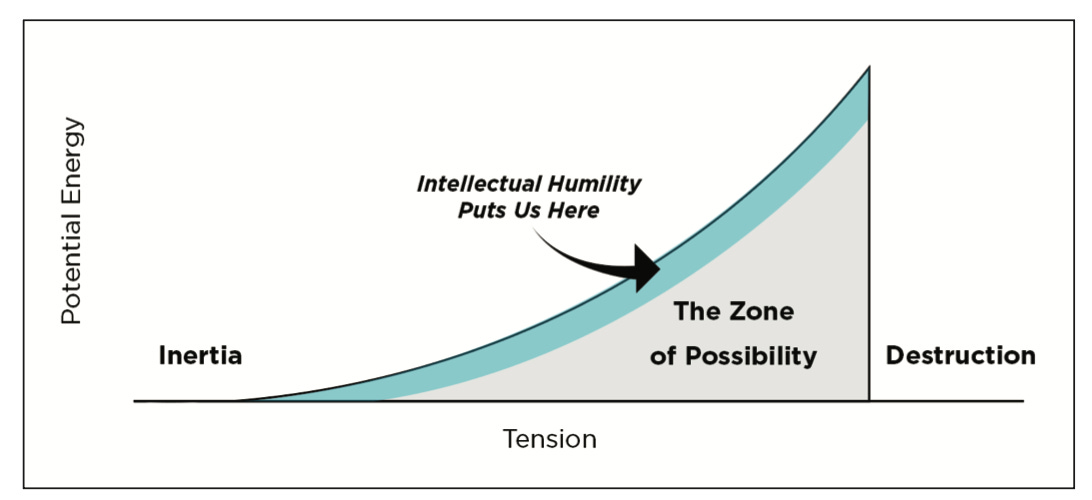
In this final chapter of Dream Teams, we’re going to dig into one of the most powerful tools for making the human brain become more intellectually humble. We’re going to unlock the kind of open-mindedness we need to become dream collaborators.
3.
A strange thing happened in the thirty years that elapsed between the start of World War II and the end of the Vietnam conflict: the wage gap between white men and Asian American men disappeared. At the time of the Japanese internment, Asian American men made 30 percent less on average than their white counterparts. But by the time Saigon fell to North Vietnamese forces in 1975, white men and Asian men in America earned roughly the same.
Asian Americans had become a fantastic case study in the American Dream. Their collective economic outlook had gone from dishwasher-slash-suspected-saboteur to white-collar professional. Now there were Asian American doctors, lawyers, professors, businesspeople. Newspapers that once said “Orientals” had “most of the vices and few of the virtues of the African,” now applauded Asian people’s hard work and family values. In the space of a generation, Asian Americans went from the barbed wire of the prison yard to the marble corridors of power.
Roll the clock forward to the year 2000 and the change was even more dramatic: Asian American workers had high-end jobs. They were VPs and CEOs of blue-chip companies. They were senators and governors, Hollywood stars and TV anchors. Asian Americans’ rate of college graduation was higher than whites, blacks, or Hispanics.
The image of the upwardly mobile Asian American became a stereotype in itself. While social scientists warned that racism and discrimination persisted, political pundits were already weaponizing the Asian miracle, lecturing other groups on what they needed to do to become the next “model minority.”
The incredible turnaround for Asian Americans was good news for people like our young friend George. There was just one tiny problem with the political talking points, though.
They get what happened totally wrong.

Narrowing the earnings gap from 20 percent to 5 percent is a big improvement, especially when African American stats hardly budged. So what happened? If the mainstream perception of Asian Americans went from “degenerate” in the 1940s to “hardworking” in the 1980s, what changed? Had Japanese, Chinese, Vietnamese, Taiwanese, Korean, Filipino, Mongolian, and Malaysian Americans suddenly abandoned their own traditions and culture in favor of white American culture? Had they developed a new work ethic?
No. Research from economists like Brown University’s Dr. Nathaniel Hilger shows that the real reason Asians started to do better in America was not because they suddenly got better family values, and not because they suddenly started working harder. Asians didn’t go from “lazy” to “responsible.”
It was simply because America became less racist toward them.
In a generation, the same hardworking Asian American doing the same job got paid more fairly. In two generations, he was getting paid even better. Meanwhile, the same Asian American student earning the same grades had better odds of getting into a leading university. Asians became outsize beneficiaries of affirmative action, and a positively reinforcing cycle was created as even more Asians graduated from college and obtained top jobs. The United States was becoming more attractive to Asian-born professionals—enough to outweigh the risk and hardship of immigrating to America. So more Asians with advanced degrees came over. The children of Asian immigrants could grow up in a country where their opportunities were nearly equal to whites’. Unlike young Malcolm Little, a counselor could realistically encourage an Asian American high school kid to “hitch your wagon to a star.”
“Asian Americans—some of them at least—have made tremendous progress in the United States,” writes economics journalist Jeff Guo. “But the greatest thing that ever happened to them wasn’t that they studied hard, or that they benefited from tiger moms or Confucian values. It’s that other Americans started treating them with a little more respect.”
But why? Why just them?
The answer is the last piece in our puzzle.
4.
Two generations after America started changing its mind about Asian people, a similar sea change happened for another persecuted group: gay people.
Homosexuality has existed in every culture and every corner of the globe as far back as history goes. References to romantic love between two men or two women show up as early as the Egyptian pharaohs of the third millennium BCE, Hammurabi in ancient Babylon, and the Zhou dynasty of classical China. Homosexuality was celebrated in Assyria, tolerated in Persia, and embraced in Ancient Greece.
Then, in the first century BCE, homosexuality was criminalized in Roman Britain, as it was throughout the Roman world. Fifteen centuries later homosexual behavior was declared punishable by death during the reign of Henry VIII. And by the 1800s, homosexuality was illegal almost everywhere.
As such, feelings of same-sex attraction were kept secret by the millions of Western men and women who felt them.

When our young friend George reentered public school after his family’s forced internment, he started to notice there was something different about him. He was baffled when his friends started getting excited about girls. “How could girls be so interesting to them?” he wondered.
Now, boys, on the other hand . . .
While his friends ogled the cover girls on fashion magazines, George was drawn to the muscle mags in the corner, where chiseled beefcakes flexed. Teenage George knew these feelings would not win him points. At the time, half of America believed that gay people shouldn’t be allowed to hold jobs. More than half believed homosexual activity merited jail time.
And as for high school, well, kids can be cruel.
Think, for a moment, about what being a gay, Japanese teenager in America in the 1950s must have felt like. People didn’t trust you or think you were smart because of the way you looked. People would want to put you in jail if they found out who you loved. Your friends talked to you like you were straight. The only thing that could be worse would be if they found out you weren’t.
So George kept his feelings to himself.
But here’s what’s fascinating. Except for a short-lived dip during the AIDS epidemic, public support for gay rights climbed during every decade after the 1960s, with a significant uptick in the 2000s. Here’s what it looked like:
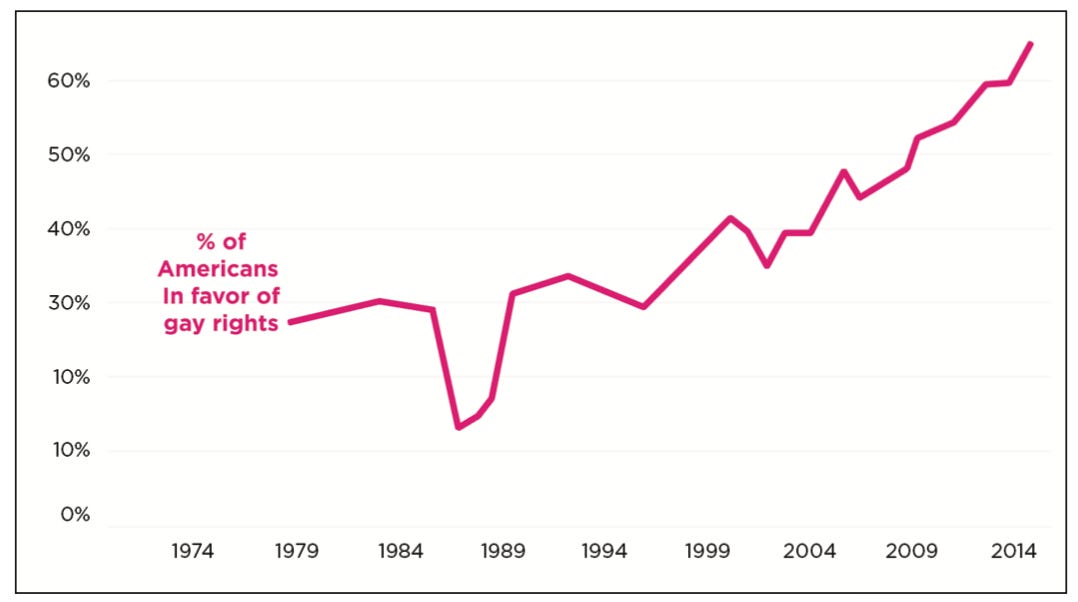
This wasn’t just coastal liberals. This was everyone. People became more accepting in religions that deem homosexuality offensive to God. Pew Research showed a growing percentage in favor of equal LGBT rights among every major American religious group.
Within a generation, the majority of Americans were saying it was okay for someone who felt differently from them to love who they wanted to love. At the very least, the sentiment became, those differences shouldn’t be cause for loss of rights.
What could explain this phenomenon? We learned in the previous chapter about how traveling to—and living among—foreign cultures helps to open our minds. But the millions of Americans that changed their minds about Asian immigrants between 1945 and 2000 didn’t all spend a gap year in Asia. And there wasn’t some magical Gaytopia across the sea to convince straight Americans that gay people weren’t so scary after all.
These two changes in attitude happened at somewhat different times. Other groups like African Americans, Arabs, and Latinos would have much less luck.
And yet, one of the main factors driving these two shifts in the American psyche would ultimately be the same.
5.
For several years, George’s dream of being a famous actor was remote as ever. After getting his architecture degree, he went to theater school and began auditioning. Most parts available to a Japanese man in Hollywood in the late 1950s and early 1960s were fairly cheesy. Hysterical nitwit side characters. Skeevy Fu Manchu types. When his rich bass voice got him a gig doing English voice-over for the American release of Godzilla Raids Again, George was ecstatic. But he was still swimming against the tide.
George didn’t tell people he was gay. His square jaw and deep voice lent themselves to the heterosexual ideal of Hollywood in its Golden Age, so he played into it.
At the time, television portrayed homosexuals as either violent criminals or mentally ill. In one early TV episode—Marcus Welby, M.D.—a man comes to the doctor suffering depression and diabetes. Dr. Welby diagnoses him with “homosexuality,” but assures him that one day he could become “normal.” Other episodes painted gay people as pedophiles and rapists. The first group of lesbians on TV that I could find were homicidal killers in the show Police Woman. These tropes ignored, of course, the fact that murder and rape exist at no higher rates among gays than among straights.
Over time, however, television’s gay stories started to get more realistic. In the 1972 made-for-TV movie That Certain Summer, Martin Sheen and Hal Holbrook played gentlemen who lived together in secret. Another early gay character was Billy Crystal in Soap. Crystal was lovable and captivating, though his character was made to flirt with the idea of getting a sex change, as if this were something that gay people would all want.
Progress was slow, and offensive stereotypes persisted. But, over time, gay characters got more sympathetic, and they got more airtime. When fan-favorite Ellen DeGeneres came out on TV in 1997—both as herself and as her fictional character Ellen Morgan—42 million people tuned in. The tide had turned. Gay was mainstream. Major networks started airing more shows with recurring gay characters.
Here’s a graph of the number of recurring gay television characters from 1970 to 2015:
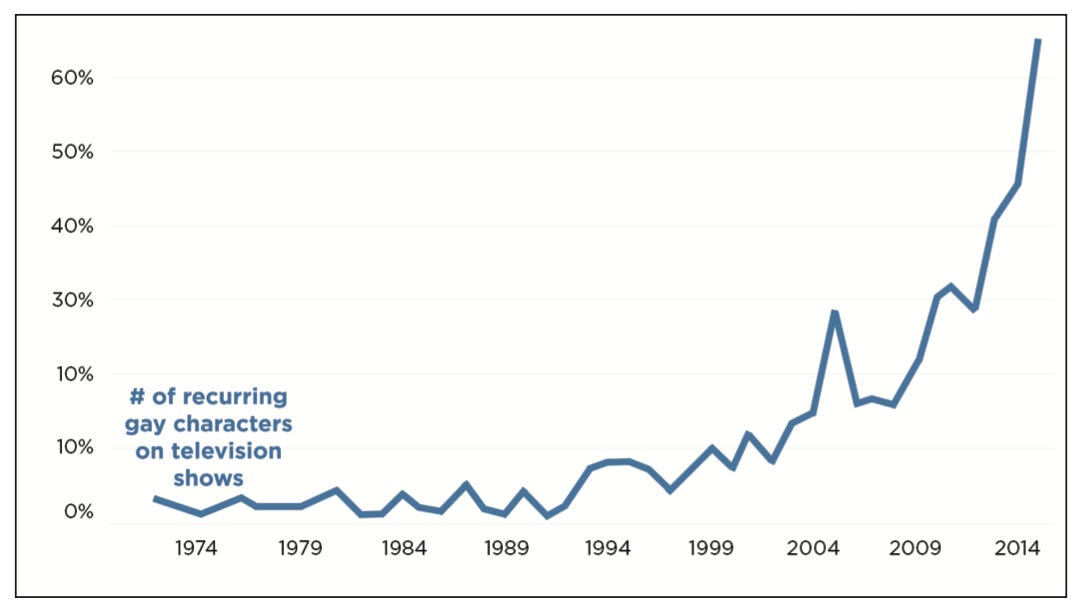
It shouldn’t be too surprising that as the number of people with positive attitudes toward gay people increased, so too did the way we portrayed gay people on television. In fact, here’s a representation of the increase of the word “gay” in movie and television scripts between 1965 and now, compared to the decline of a common gay slur in movie and TV scripts during the same time period, according to data from Ben Schmidt and Erez Aidan’s Bookworm Project:
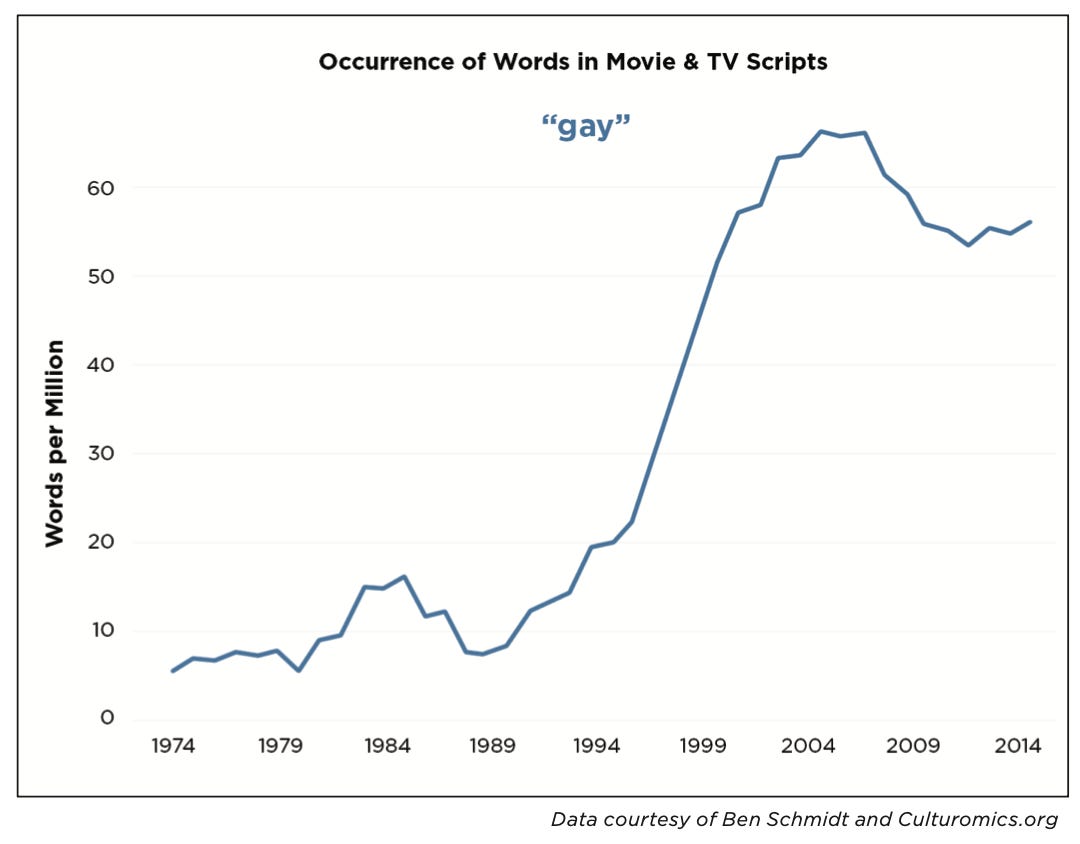
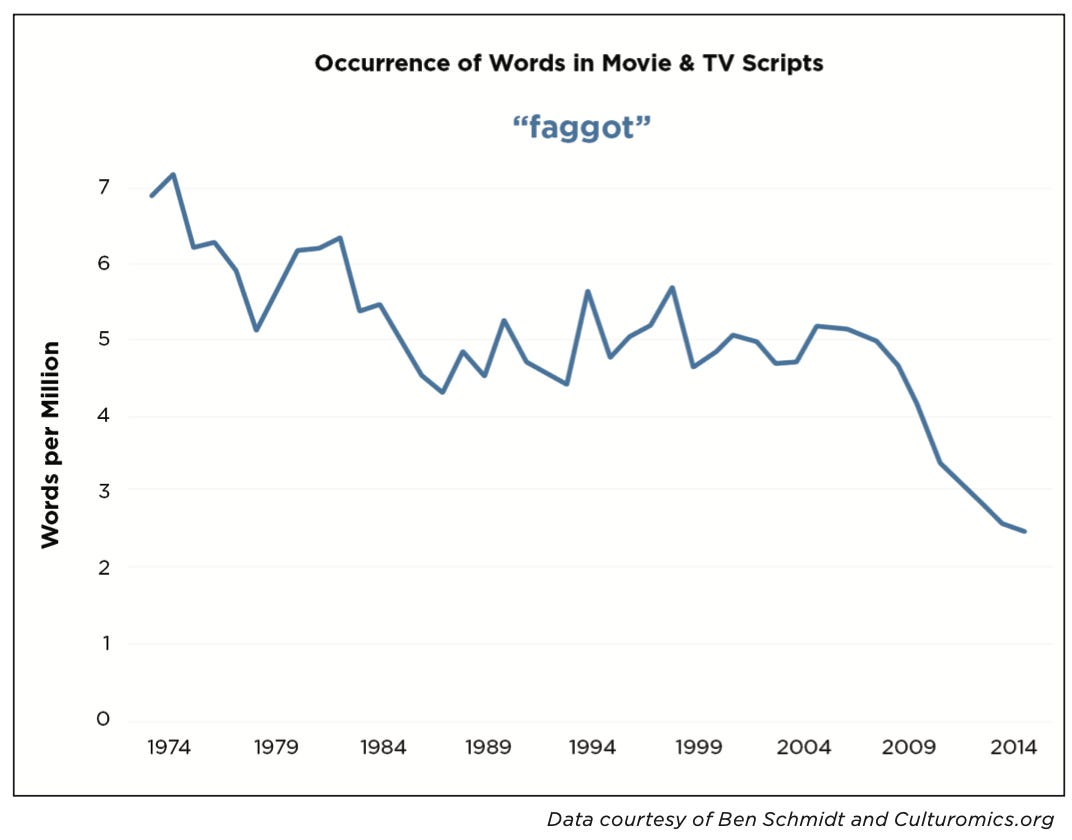
And there’s something intriguing hidden in these charts. When we overlay them with our first chart of gay acceptance milestones and account for the lag time between when scripts are written and when they hit screens (which can take years), we can see that we have things backward. Hollywood didn’t follow gay acceptance. Hollywood actually predicted it.
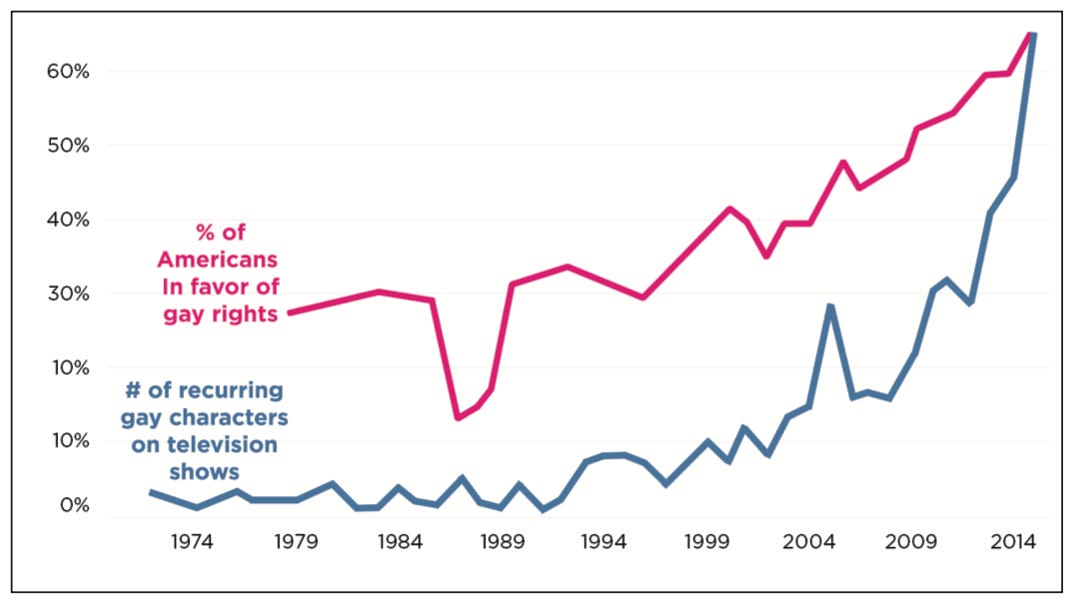
We might conclude from this that Hollywood is just slightly ahead of the curve when it comes to social issues.
But as is often the case, there was something even more interesting going on.
6.
A decade after Ellen came out, a group of people went to the theater for an unusual movie experience. The film was the latest James Bond movie—the British spy franchise created by Ian Fleming. But there was a catch! This wasn’t going to be the usual Pepsi-and-popcorn diversion. This particular audience was going to watch the film while hooked up to an array of equipment that, from the look of it, might have come out of Q’s own lab.
The man behind this science experiment was neuro-economist Paul Zak of Claremont University. While the audience watched Bond tangle with villains and flirt with disaster, Zak saw what he called “an amazing neural ballet.” The James Bond story line, his instruments demonstrated, changed the activity in the audience’s brains.
And that brain activity made their bodies do curious things. When Bond sidled along the edge of a building, bad guys closing in, the audience’s heart rates increased. Palms began to sweat. When Bond was in a tight spot, their brains registered fear. When Bond faced a gut-wrenching dilemma, the audience tensed up as if they did, too. Safe in their comfy chairs, Bond’s spectators were living out his drama inside their minds.
Of course this experience is common to virtually all of us. If you’ve ever watched a movie or been to a baseball game or comforted a friend, you’ve felt it. So why do we empathize? Why do we—to a greater or lesser extent—feel what we imagine others are feeling?
Dr. Zak’s Bond experiment showed something that surprised a lot of people. A certain neurochemical happens to be responsible for this emotional mirroring. It’s a little molecule called oxytocin. Previously, oxytocin was known to play a role in pregnancy and breastfeeding, but not in much else. And certainly not in action movies.
What Zak discovered is that this molecule is key to how we become open to other people and their ideas.
“Oxytocin is produced when we are trusted or shown a kindness, and it motivates cooperation with others,” Zak explains. “It does this by enhancing the sense of empathy, our ability to experience others’ emotions.” Empathy, of course, was important for our survival as humans. As Zak put it, “It allows us to understand how others are likely to react to a situation, including those with whom we work.”
To prove this, Zak had people snort synthetic oxytocin and watch TV ads for charities. He allowed the test subjects to donate to any of the charities if they wanted. And guess what? The people who snorted oxytocin were 57 percent more likely to give to a charity they saw in one of the ads, and they donated 56 percent more than others. Overall, the oxytocin-huffers reported feeling more concern for the people in the advertisements.
Here’s where it gets really interesting. Zak then conducted the same charity ad experiments without making anyone snort anything. He wanted to see what kinds of natural interactions between people would lead to oxytocin production. What makes our brains make more of it in real life?
What he discovered is the neuroscientific basis for one of the most marvelous and useful techniques for building openness to other humans.
In hindsight, the epiphany was simple. In one experiment, Dr. Zak had people watch charity advertisements with a narrative story line versus ads without any story. Imagine, for example a father talking about how his child was struggling with cancer, or an animal shelter employee describing how a pet was abused—versus ads with heartbreaking statistics about child cancer rates or pet abuse. Zak found that stories motivated people to donate significantly more money than ads that just delivered straight facts. When he analyzed test subjects’ blood, Zak found that the people who’d seen the ads with stories had higher oxytocin levels. Stories stimulated oxytocin production in the brain.
In the James Bond experiment, in addition to the racing hearts and sweating palms, it turned out that Zak’s equipment also showed that the audience’s brains made more oxytocin. Through this and similar studies, Zak’s lab discovered that anytime people experience character-driven stories, their brains pump out more oxytocin.
While not specifically searching for a love potion, Dr. Zak had stumbled upon the chemical explanation for what centuries of poets already knew.
Stories help us fall in love. They build relationships and make us care.
This idea goes back to before we even had pens to write stories down. In preliterate societies, myths and stories were the embodiment of our shared identity. They made it easier for us to work and to survive together. In a world without Google Calendar, stories helped us package and retain information. Our tribe’s daily minutiae—and our tribe’s ethos and lore—were alike passed by word of mouth, campfire to campfire, generation to generation. Relating and remembering stories was hardwired into our growing brains.
While stories were a great way to package information, they also held clues for who and what we should care about. The caring part was oxytocin’s job. If a story was about a character—someone whose cooperation might be important for our survival—our brain would generate the kind of activity that helped us remember that person and care about them. Oxytocin’s role, in part, was to get our bodies to mimic what our tribesmates were doing—from breathing to sweating to body language to emotion. If someone was part of our tribe, our brains wanted us to be, run, jump, and remember along with them.

A big moment in gay television history was the 2009 debut of the fictional Kurt Hummel, played by Chris Colfer in the TV musical Glee.
Kurt wasn’t a token. He was an ordinary, awkward teenager coming to terms with being different and growing up—something that every teen and former teen can relate to, gay or not. He’s outspoken, sensitive, courageous, and charismatic. As the story unfolds, Kurt has to face bullies at school, come out to his father, and come to terms with a host of confusing feelings. Glee gave millions of straight viewers a window into what it’s actually like to grow up gay. And, as gay journalist Alexander Stevenson put it, “[Kurt] is not simply a statement or storyline or supporting character used to build up the diversity of the gang. He is a person.”
And here’s the thing about Kurt: Television portrayals like his didn’t predict a positive shift in attitudes toward gay people in America. They actually contributed to that shift. A study by the Hollywood Reporter found that 27 percent of the Americans who watched Glee or Modern Family (starring two gay dads) directly credited the shows with helping them become more pro–gay rights.
The more the nongay public were exposed to human stories about gay people—people with thoughts and feelings and families and desires and struggles like our own, the more empathy said public had for them. Oxytocin was part of the learning process that put us in Kurt’s shoes. It helped make us care. Stories like these helped millions to decategorize gay people as a scary stereotype—an out-group—and see them as just people: part of our superordinate in-group.
Even though political issues like gay marriage remained charged, people who saw sympathetic stories of gay people became more willing to collaborate with them. By the time Titus Andromedon was stealing scenes in 2015’s The Unbreakable Kimmy Schmidt, fewer than 19 percent of Americans said they were uncomfortable being around someone who is gay or lesbian. The fraction of Americans who thought being gay should be illegal went from half to a quarter. Ninety percent of the country said they would, for instance, feel equally comfortable with a gay salesperson. More than 70 percent said they’d be comfortable with a gay doctor, a gay presidential appointee, or a gay member of the armed forces. Fear and discrimination hadn’t gone away, but openness had doubled in one generation.
Not that straight Americans have cause to pat themselves on the back. Of course the lion’s share of credit for gay acceptance goes to brave everyday people (including a huge number in the entertainment industry, both behind and in front of the camera) who told the world they were gay even though they knew they would be persecuted. Surveys show that getting to know someone who is gay has a lot to do with changing people’s attitudes.
And what do we really do when we get to know someone? We share stories. We relive the comedies and dramas of our past. We gab about what we’re going through. In the restaurant. In the bar. In the break room. At the dinner table.
Unfortunately, there’s a dark side to the power of stories. It has to do with the balance theory we learned about in the last chapter.
For much of the nineteenth and early twentieth centuries, the stories that went around about Asians in America had a huge effect on popular sentiment toward them. And not in a good way.
Books, radio, and early television portrayed Asians as either evil or witless. This gave schools and employers an excuse to deny them opportunities. The Japanese bombing Pearl Harbor was a true story made into a false pretense to incarcerate 120,000 Japanese Americans.
Note the absence of data in these decisions. Stories overrode logic. How often have you heard someone try to kill a statistic with an anecdote? “Well I read on the Internet there was this one guy who . . .”
This is classic balance theory at work:
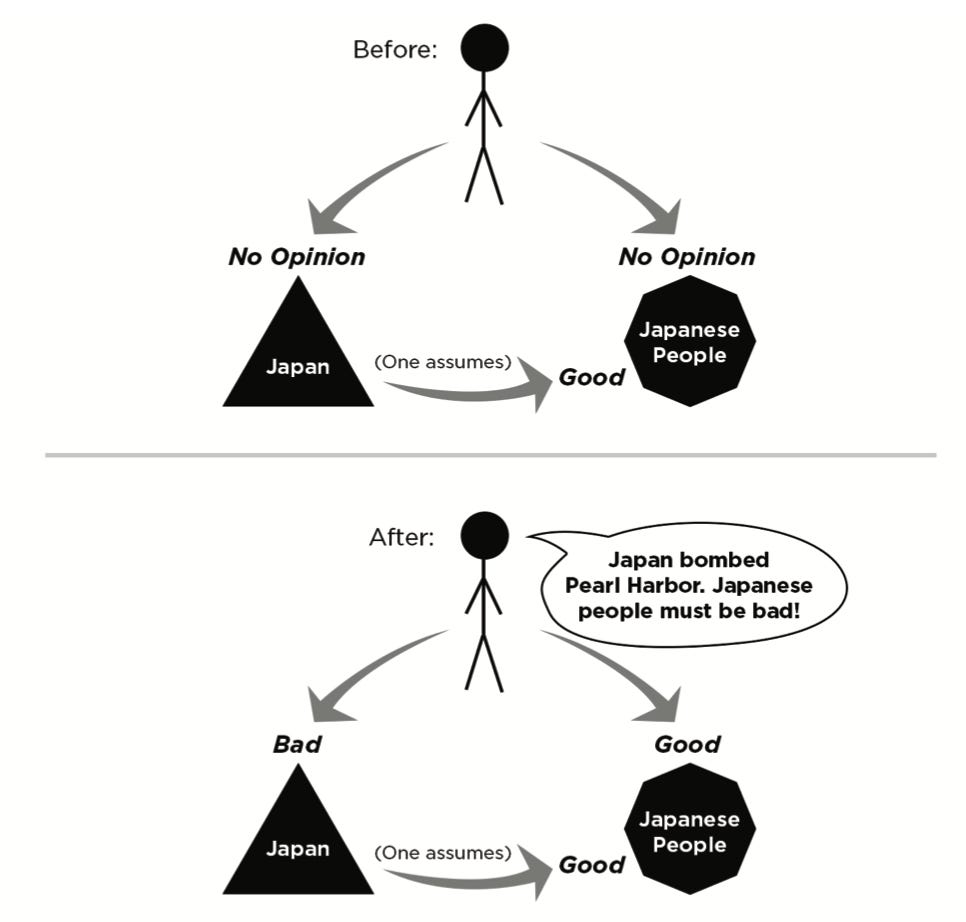
This is bad logic. Skewed balance turns a fearful story into mass guilt by association. Unfortunately, it’s also effective. Because here’s the crux:
Instead of turning on oxytocin, fearful stories give our brains an excuse to fire up our amygdalae.
One of the most devastating examples of this took place during the Vietnam War. US soldiers killed thousands of Vietnamese civilians after their leaders plied them with stories of how the Vietcong were evil. In 1971, Corporal John Geymann told the press that troops were taught, “It doesn’t make any difference what you do to them; they’re not human.”
As historian Nick Turse, citing the mountain of documented evidence on Vietnam War crimes buried in the National Archives, put it, “The idea was that the Vietnamese, they weren’t really people.” From the moment soldiers entered basic training, he continued, “They were told, ‘Never call them Vietnamese. Call them gooks or dinks, slopes, slants, rice-eaters.’ Anything to take away their humanity, to dehumanize them and make it easy to see any Vietnamese—all Vietnamese—as the enemy.”
This resulted in rapes, executions of children and elderly, and using civilians for target practice. This in turn led to brutal retaliations, and, in the end, thousands of soldiers coming home with post-traumatic stress disorder, unable to shake what they’d seen.
This is not new in the history of warfare. One of the most effective ways to rally people to do unspeakable things to other humans is to use stories that take away their humanity.
Isn’t this what the Nation of Islam was doing in the early days, back when they taught that whites were devils? How could it be wrong to hate whites if whites aren’t human? That Yacub story really did a number. X and others who left or reformed the sect later regretted using it to do something reminiscent of what racist whites had done in dehumanizing blacks with their own stories.
Dehumanizing stories are an essential element of homophobia, too. Pundits have deployed anecdotes to support the argument that “gays aren’t people,” therefore gays aren’t protected by the Constitution. Other dehumanizing stories include early horror films portraying monsters as thinly veiled metaphors for gayness, and absurd stories about predatory gay men turning straight men gay. These baseless anecdotes linger in folklore alongside vampires, kidney thieves, and the Loch Ness monster.

Stories have power. Stories can activate oxytocin and empathy, or they can turn on primal fear. Like fire, like steel, like nuclear energy, stories can be used for evil or for good.
On the “good” front, we find Lijiang Shen, PhD, at Penn State. In the late 2000s and early 2010s, Shen devised a cool set of science experiments wherein test subjects would sit down to watch public-service announcements about the dangers of cigarettes. While some watched ads centered on the familiar scare tactics—tracheotomies, amputations and the like—others watched ads designed to make them feel empathy for people affected by smoking. (Think things like brave children coping with lung damage from secondhand smoke.) Shen found that both types of ads led some people to change their attitudes about smoking, but the fear-invoking ads had less of an effect. In fact, scary ads made many test subjects more resistant to changing their minds. Subjects reported that scare tactics put them on the defensive, making them feel as if their freedom to choose were under attack.
But empathy-inducing ads met no such resistance. These ads made people want to change on their own, no threat required.
Dr. Shen’s findings have been corroborated by other research. Researchers in other fields have encountered the same phenomenon—among them CEO Robert Pérez, founder of the consulting group Wonder. In his work, Pérez has shown that people are more willing to do something scary—such as reverse a long-held belief about something they consider important—if they feel empathy toward the person trying to persuade them. In one example, business owners who were afraid of hiring ex-convicts heard a presentation from another business owner in the same market. When their peer told them how hiring ex-cons could actually be an advantage, Pérez found that business owners were far more likely to change their minds than if they heard the same pitch from anyone else.
Because stories are so good at inducing empathy, they help us become open even to people we can’t relate to.
Imagine you’re a manager, and you’re having a hard time dealing with two bickering team members. They have different perspectives, and they aren’t open to one another’s ideas. Imagine you sit the two of them down together and announce that you’re going to fire them both if they don’t get along.
What outcome would you predict?
I think we’d both agree chances are good they’ll take your threat seriously and stop openly fighting. But they won’t like each other. You scared them into changing their behavior, but not their hearts. You’ve scared them into organizational silence.
Now imagine instead that you took these same two team members and told them they have to do dinner together. No talking shop—it’s forbidden. They have to tell each other stories about their lives: where they grew up, how they met the most important people in their lives, their 10 Best, their blooper reel—that sort of thing.
Can you imagine them walking into work the next day having a little more empathy for each other? Treating each other a little better? Even, dare I say, having each other’s backs? Considering each other’s ideas?
This is the power of stories.
Jonathan McBride, the former assistant to the president, in charge of staffing for the White House, has put this exact technique into practice at Blackrock, the world’s largest asset manager, where he was a managing director at the time of this writing. Over several years, McBride and his associates developed a methodology for bringing different people together.
Blackrock had made a big push for cognitive diversity—and all the sorts of demographic diversity that should come with it—but over the years had run into the same things that we saw earlier with our failed mergers and team breakups. Different people can have a tough time getting along. If you’re in the minority in a group, you’re likely to get quiet. If your group has too much tension, the whole group can lapse into organizational silence. The upshot of a push like Blackrock’s for more different team members was a lack of a feeling of “belonging.”
McBride and his team did all sorts of little things to help reverse this, to help Blackrock employees feel like they could belong to a superordinate group, though they might be different. This included training leaders to be conscious of opportunities for positive micro-actions, as Keith Yamashita taught us earlier. But the most powerful thing Blackrock did was teach people—employees and managers alike—to bond through sharing their personal stories with each other. These storytelling interventions, among other work, have led the company to become one of Fortune’s Most Admired Companies, one Human Rights Watch’s Best Places To Work For LGBT Rights, and LinkedIn’s Top Companies “Where The World Wants To Work.”
“You need people to care about each other,” McBride says. “And how you get people to care is through emotional narrative.”
7.
In late 2017, I flew to Los Angeles to visit Dr. Zak’s neuro laboratory. There, on a Sunday morning, he strapped a device to me called an INBand, which measures the downstream effects of oxytocin production in your brain. It does this by tracking changes in the vagus nerve, which is a big nerve that goes from your brain to your heart.
After strapping me up, Zak had me watch a video. It was a commercial for HP in which a father is trying to be a good dad to his teenage daughter. Throughout the video, he does nice things for her, and she ignores him or rolls her eyes like a typical moody teenager. At one point he takes a photo with her, which she’s grouchy about. She later opens her lunch box at school to find this photo and a note from her dad. She quickly hides it.
Finally, the dad comes home after a long day of work, says hi to his daughter, who ignores him once more. He then walks sadly into her room. There, he looks around at all the signs that his little girl is growing up. He sighs and lies down on the bottom bunk of the bed she shares with her sibling and looks at the ceiling.
And on that ceiling he sees that his daughter has secretly saved all of photos that he’d taken with her over the years.
Are you tearing up? I was. Dr. Zak showed me the screen on which he was monitoring my oxytocin, and it showed very clearly where I started to experience empathy for this father. Throughout the video, I got little spikes of oxytocin as he tried to be a good dad, and at the end, I experienced an enormous surge of it.
I wasn’t a father. I didn’t know this guy in the video. I knew it was a fictional story. I had no reason to relate to his character. But after watching this little story, I felt for him. I liked the guy. I wanted to hug him.
This effect, Dr. Zak explained to me, “is melting that self-other divide.” Positive social encounters release oxytocin—things like hugs, acts of kindness, and emotional stories. This oxytocin helps build relationships between people who are different, even people who are not inclined to accept each other. “If you release oxytocin naturally,” Zak explains, “the in-group out-group bias disappears.”
I want to make sure we caught that. When our brains release oxytocin for a person who is not in our in-group, the bias we have for them disappears. And one of the key ways we can do that is through sharing good stories.

In the 1960s, the stories about Asian Americans went from scurrilous to approving. A lot of Americans developed greater empathy for their Asian neighbors—relating to them; respecting them, differences and all; allowing them opportunities long denied.
And this was partly thanks to Fumiko and Takekuma’s son George.
8.
In 1966, television producer Gene Roddenberry made a phone call to a young Japanese American actor he had heard good things about. Roddenberry was working on a science fiction show that would feature a diverse case of problem-solving space adventurers. He wanted an Asian man to play the role of the spaceship pilot.
The show was called Star Trek. Its lead would be heartthrob William Shatner as the dashing Captain Kirk. Kirk’s comrades: Leonard Nimoy as the wise Spock, DeForest Kelley as the sarcastic Doctor Bones, and former jazz singer Nichelle Nichols as Communications Officer Uhura.
And in one of the first positive, de-stereotyped roles for an Asian American actor in Hollywood history, Star Trek would also star twenty-nine-year-old George Takei as the brave and clever Lieutenant Sulu.
Lieutenant Sulu didn’t speak in a bogus accent. He didn’t have insulting teeth, and he didn’t blunder around crashing into things—the threadbare TV tropes of the day. Takei’s character spoke precise English, with that rich bass of his, and masterfully piloted the USS Enterprise.
“As an Asian American, you always felt a real strong sense of excitement when you saw Asian people on TV,” recalls Tony Award–winning actor B. D. Wong in a documentary about Takei’s life. “And what’s amazing to me now is how often those Asian people that you saw on TV were embarrassing.”
But Sulu wasn’t embarrassing. No yukata, no goatee, no sinister plotting. Sulu wore a Starship Command uniform and coolly collaborated with crewmembers. They trusted him with their lives. This was novel. And to B. D. Wong, this was an omen of change. “George,” Wong recalled, “was this kind of beacon of dignity.”
As Star Trek became a cultural phenomenon, George Takei’s positive portrayal of Sulu reached millions. Takei was one of the first actors to tell a new story about Asian Americans. Thus, when a young athlete was discovered at a martial-arts exhibition in Long Beach in 1964, Bruce Lee was able to shatter the glass ceiling Takei had cracked. Pop-culture experts believe that Takei’s pioneering role paved the way for Lee’s international stardom.
New stereotypes were emerging. Hollywood was pushing the image of the Asian savant or the Asian action hero. Meanwhile, Chinatown—perhaps ironically—was pushing the image of the “upstanding Asian,” working to supplant the old stereotype of the degenerate Asian in the press.
“The model minority myth as we see it today was mainly an unintended outcome of earlier attempts by Asians Americans to be accepted and recognized as human beings,” said Dr. Ellen Wu of Indiana University. Wu’s book The Color of Success documents Asian Americans’ struggle for acceptance in the mid-twentieth century. “They wanted to be seen as American people who were worthy of respect and dignity. The Chinatown leaders were really smart. They started to peddle stories about Chinese traditional family values and Confucian ethics. They claimed that Chinese children always listened to their elders, were unquestioningly obedient, and never got into trouble because after school they would just go to Chinese school.”
Smart? Yes. But people are people; kids are kids. Of course some Asian American children were obedient and some not; some Asian American families were close-knit and some not. The thing that actually changed between the time George Takei was imprisoned and the time George Takei was offered a part in Star Trek was the story. Asian Americans themselves remained fundamentally the same—good human beings deserving of inclusion and curiosity and respect. But the story being told about Asian Americans—at the school board meeting, in the newspaper, on the silver screen—was dramatically different in 1972 from what it had been in 1942.
You’ll recall how Dr. Hilger’s research concluded that Asian Americans in the 1940s and ’50s were simply held back by lack of opportunities. As the stories about them changed, the opportunities came. They seized them. This bred more good stories and more positive exposure to mainstream Americans, which in turn bred more opportunities.
Discrimination is still alive and well in America, but Takei’s and others’ stories helped to open people’s hearts. More mainstream Americans started letting Asians on the team.
9.
So who likes stats? (In my mind’s eye I see every hand go up. Hello, fellow nerds!) And who likes books? You, presumably—since you’ve come this far.
Well, if you like books, you’re going to love this next stat. As a writer of books, I know I did.
In 2017, I took Krumrei-Mancuso and Rouse’s assessment for intellectual humility and added a few questions of my own. Demographic information—where you’ve lived, where you’ve traveled, plus several other things. I asked thousands of people to take this test, and as we discussed in the last chapter, I found a delightful connection between living or traveling abroad and intellectual humility.
One of the questions I asked involved traveling somewhere a little less expensive: into books.
Take a look at what the survey data show us when you compare intellectual humility scores with how much people read books:
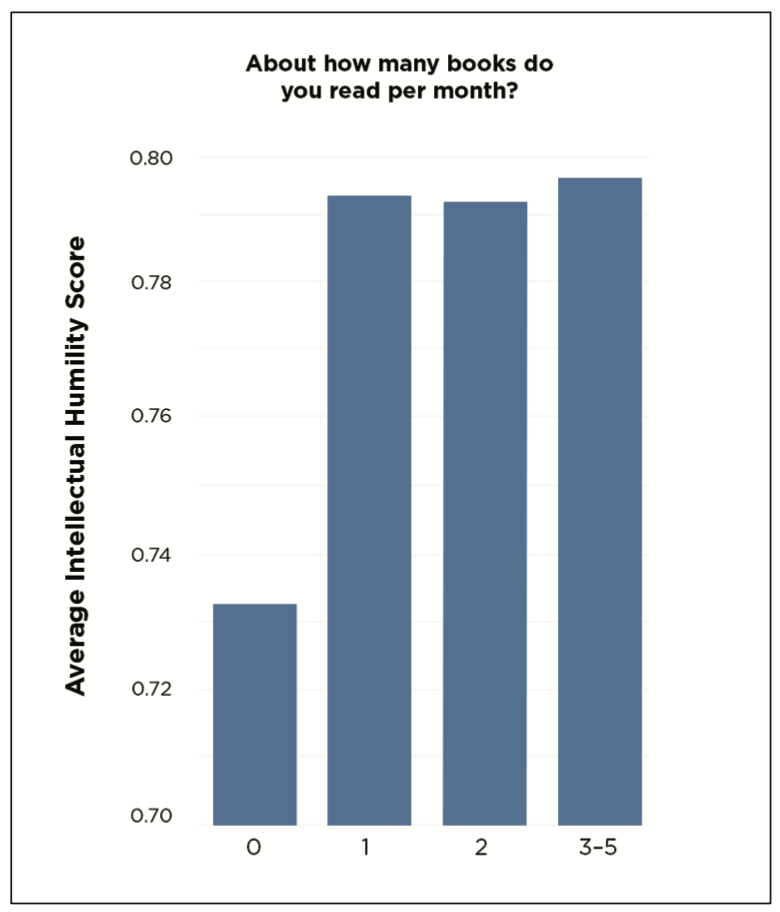
People who read a book or more per month, the data shows, are significantly more likely to be have IH than those who rarely read!
Reading lots of books means we’re taking in lots of stories about lots of people and things. Is it really a quantum leap to suggest that doing so will give us a little more openness toward the people we meet in everyday life?
In 2010, a professor named Dr. Delia Baskerville of Victoria University put this theory to the test when she brought a bunch of young students from different cultural backgrounds together for story time. She found that when kids participated in story time together—sharing stories about themselves, their cultures, and other things they cared about—it “fostered empathy, compassion, tolerance and respect for difference.” These kids grew to be a little less xenophobic than their peers.
In 2014, Dr. Zak proved this same effect from a neuroscience angle in a project for DARPA. Zak’s lab, the Center for Neuroeconomic Studies at Claremont University, once again hooked people up to brain-chemical-tracking devices. It found that inspiring stories across out-groups made people less xenophobic toward those groups and more likely to donate to causes that supported them.
The most powerful of these experiments involved an animated video of a little black boy who wanted to be an astronaut. The adult real-life brother of this boy narrated how his brother, Ronald McNair, once had a librarian call the police on him when he asked to check out books from the library. The police told the librarian to let him have the books. Ronald loved to watch Star Trek, and while his brother thought the idea of people of multiple races—including a black person—working together on a spaceship was pure science fiction, Ronald called it “science possibility.” Eventually, Ronald became a physicist, and the second African American astronaut in history. Tragically, he died aboard the Challenger shuttle in 1986. And the library that once tried to deny him books renamed itself after him.
People in Zak’s lab who watched this animation showed all the signs of empathy, generated oxytocin, shared heartfelt comments about the story, and donated a lot of money to an African American–related charity when asked afterward—regardless of their own race.
“Narrative transportation was the strongest predictor of charitable behavior,” the Center wrote, referring to viewers’ reports of being “pulled in” by such a good story, “followed by the experience of empathic concern.” Race didn’t matter when people saw the story. Ronald McNair was a human being, and part of their team.
It is melting that self-other divide. If you release oxytocin naturally, the in-group out-group bias disappears.
My research shows how books can be a great way to experience stories and open our hearts this way. Gallup and Pew research about gay rights attitudes show us how stories on the screen help us do this, too. The New Zealand study and the positive results at Blackrock show how stories from one person to another help us feel like part of the same team. Dr. Zak’s DARPA study showed us how watching a cartoon about a black kid’s dream of going to space, and his subsequent death aboard the Challenger space shuttle after becoming a groundbreaking physicist made people of all races feel more connected to, and empathy for, black people.
Knowing this, we shouldn’t be at all surprised by what happened when George Takei and other Japanese Americans shared their story with Washington.

In 1983 the congressional Commission on Wartime Relocation and Internment of Civilians (CWRIC) formally admitted the grave injustice the United States had done by interning Japanese Americans. Since 1980 the CWRIC had been holding public hearings around the country, learning the experiences of Japanese Americans whose lives were upended during the war. More than 750 people testified, among them George Takei, who spoke at hearings held in Los Angeles in August of 1981.
George told the commission about being forced into that camp. He told them about playing inside the barbed wire fences, in the shadow of the machine guns. He shared how his parents’ hopes and plans and hard-earned home-ownership goals had been crushed for no better reason than the way they looked.
Takei’s story stirred empathy with the public, and it resonated with members of Congress. The CWRIC report was instrumental in President Reagan’s decision to sign the Civil Liberties Act of 1988, which included a small, mostly symbolic monetary apology to survivors of the camps. Nineteen forty-two was a long time ago, but these stories still made people care. And they made a difference.
But internment wasn’t the only way George Takei had been confined by prejudice. For the first sixty-eight years of his life, Takei never spoke on the record about being gay, though it had been an increasingly open secret among fans since the ’70s. George had made a name for himself in Hollywood at a time when a California law allowing involuntary sterilization of homosexual people was still on the books. For decades George had lived with the tension between who he was and who the public wanted him to be.
But when then-governor Arnold Schwarzenegger vetoed a California same-sex marriage bill in 2005, George Takei felt he had to take a stand. After formally coming out in an issue of Frontiers magazine, Takei launched Equality Trek: a speaking tour that brought his story to college campuses around the United States. Takei had long been active in California politics and LGBTQ organizations, but with Equality Trek, George was taking his story nationwide.
And can you guess what happened?
To thousands of fans, George the actor became George the person. George Takei helped college kids and Trekkies alike see the gay rights movement for what it is: a quest for the equal protection of ordinary people under the law. As social media grew, Takei used his fame, his story, and his sense of humor to build a gigantic Facebook following.
More than a decade after formally coming out, George Takei was still sharing stories to build support for social justice. In 2013, he was declared the Most Influential Person on Facebook, having touched tens of millions of people through sharing stories—both funny and heartfelt—about human beings deserving of the world’s empathy and respect. At the time of this writing, Takei was screening a Broadway musical he created, called Allegiance, about the Japanese internment camps he grew up in. It was just another way to use stories to teach about how locking Japanese Americans up in 1941 and discriminating against gay couples in 2017 are just different symptoms of the same disease: excluding people because of who they are.
Winning respect for Asian Americans was not a solo project. Nor was winning gay rights. By sharing his story, and playing a part in the stories of Star Trek and others, Takei helped recruit collaborators in both efforts. He helped build the gigantic Dream Team of people that every social movement needs to make progress.
If storytelling could do all that, imagine what sharing our stories can do at smaller scales. Imagine how stories might help humanize those with whom we have tension—in our partnerships, our companies, our coalitions. Our causes. Our families. Imagine what stories might do for our teams, when we haven’t developed the respect and intellectual humility to properly harness our differences together.
Imagine how those stories might help us learn to love the people we fear instead of shutting them down.
10.
In 1967, as Star Trek began its second season of filming, George Takei arrived one morning to his dressing room to a surprise.
Inside the room were two costumes. While Takei had been filming a side project, the screenwriters had written in another character to work as ship’s co-commander. Walter Koenig, playing the character Pavel Chekov, would now be sharing the helm with Takei.
Takei was furious. “I’ll admit it—I hated him,” he recalled. He was jealous that someone else would be splitting the role he had worked hard to develop. “The veins in my scalp started to swell up.”
When Koenig showed up to the dressing room, the first words out of his own mouth were, “I hate this!”
“Well, I don’t like it any better!” Takei retorted.
Koenig hesitated. “You do, too?”
“Of course,” Takei said. “I don’t like it any better than you do.”
“Well, at least you don’t have to wear it,” Koenig said.
Takei then realized that Koenig had not been talking about having to work together. He was talking about the floppy wig in his hands that the producers were making him wear.
Embarrassed, Takei set aside his temper for a moment and let Koenig talk. As he listened to the man’s story, Takei’s heart began to soften.
He learned that Koenig had also attended UCLA, that he had a brother who worked in medicine, that he had been working long and hard for an acting break so his family would respect his career choice. “I saw that he was an ambitious actor excited by the opportunity of being part of a quality television series, just like me,” Takei said. “The hate that had tempered down to pity, then tolerance, was now softening to a recognition of our matching lives and shared ambitions.”
After learning Koenig’s story, Takei couldn’t help but swallow his pride and work with the man. “We were in this together,” he said.
So they teamed up. They leaned on each other. They commanded the starship Enterprise together. And the image of Sulu and Chekov sharing its console became one of the iconic images of not only Star Trek, but of the kaleidoscopic Dream Team that humankind could one day become in Earth’s actual future.
And forty years later when George Takei married his sweetheart, Brad, in Los Angeles, Walter Koenig was his best man.
Thanks for reading along. If you enjoyed this serialized Substack re-sharing of Dream Teams, please share it along. Or even better: check out Shane Snow’s keynote speaking & more here »
P.S. RIP to Walter Koenig a few weeks ago. <3