


In this chapter, we drill into “organizational silence,” the “zone of productive conflict,” and how to push each other inside our teams to get better. If you missed the previous chapters, read them here:
P.S. Though my latest research revolves around adaptation and change, I’m still speaking about Dream Teams at conferences and leadership offsites. If you know a group that could use this message, check out my speaking page here.
Trouble In Shao-Lin
We wanted to make money. We wanted to get outta the streets.
1.
In May 1998, two massive worlds collided.
Chrysler, the Detroit-based maker of Dodges and Jeeps, had the highest profit margins of any auto company in the world. Its product development cost was half of Ford’s, and one-third of General Motors’—even though it was the smallest of the three companies.
Despite this, CEO Bob Eaton worried that Chrysler wasn’t prepared for the future. As the Internet empowered people with more information, car buyers demanded higher quality. Advances in electronics threatened to make Chrysler’s engine designs obsolete. And a surge of cheaper and superior Toyotas and Lexuses imperiled the jobs of Chrysler’s 123,000 blue-collar workers.
Daimler, meanwhile, was one of Europe’s top manufacturing companies. The 300,000 employees of this Germany-based maker of Mercedes-Benz and Maybach built some of the nicest cars, trucks, and buses in the world. Though Daimler was on the cutting edge of automotive design, CEO Jürgen Schrempp was worried, too. Daimler pumped millions into research and development but was having trouble making a big return on its investments. The company had a tiny market share in the United States, and it, too, feared mounting competition from Japanese automakers.
The two CEOs realized that their companies’ heuristics might cancel out each other’s weaknesses. Chrysler’s unbeatable efficiency plus Daimler’s legendary innovation? Killer combo. Daimler’s quality and Chrysler’s “cowboy can-do” would make them unstoppable. Combined, they’d have the tools and talent to take on Ford, GM, and Toyota, and to become one of—if not the—biggest automobile companies on the planet.
So they made a deal. Eaton and Schrempp shook hands, and Daimler and Chrysler became DaimlerChrysler. Schrempp called it “a merger of equals, a merger of growth, and a merger of unprecedented strength.”
The new company was worth around 100 billion dollars. It was the largest transcontinental merger in corporate history.
And it would go down as one of corporate history’s biggest disasters.

According to the Harvard Business Review, between 70 and 90 percent of company mergers fail to achieve synergy. That is, they don’t manage to eventually turn two companies into one business that’s worth more than the sum of the individual companies’ value before the merger. More alarming, half of mergers actually result in a worse business.
Few cases of this are as dramatic as DaimlerChrysler. Three years after the “merger of unprecedented strength,” the 100-billion-dollar company was worth somewhere between 44 and 48 billion—about what Daimler had been worth by itself.
It was supposed to be the greatest merger ever. A Dream Team of automakers. What happened?
The colossal failure has been the subject of many business school case studies. Some point to how the two companies overestimated their potential. Others illustrate how management stumbles hampered growth.
But those things alone didn’t wipe out 50 billion dollars in value. DaimlerChrysler didn’t crash because their cars got worse. Or because its managers forgot how to do their jobs. The cause of DaimlerChrysler’s epic tumble is the same thing that’s doomed the majority of mergers in modern business history.
The merger failed because of “cultural conflict.”
On the surface, Daimler’s and Chrysler’s people were very similar. They were four hundred thousand mostly male, mostly white engineers and designers and assembly-line workers and managers who loved cars.
“They look like us, they talk like us, they’re focused on the same things, and their command of English is impeccable,” said one Chrysler executive of his German counterparts, as reported in a Dartmouth case study. “There was definitely no culture clash.”
This assessment was laughably superficial.
The Germans and Americans who were now supposed to work together had different communication habits, different concepts of personal space, and different negotiation tactics. They had different core beliefs about women in the workplace and the role of leadership. They had different levels of intensity, different motivations, and different perspectives on what mattered when it came to making cars. In other words, they had, as we learned in the last chapter, significant diversity of perspectives and heuristics.
The new company spent a few million dollars on cultural workshops like “Sexual Harassment in the American Workplace” and “German Dining Etiquette.” But those were superficial, too.
From Daimler employees’ perspective, the goal of automaking was uncompromising beauty and precision. “Quality at all cost,” they would say. But to Chrysler workers, the goal was utility and affordability for their customers.
The Americans thought their new German coworkers were elitist. The Germans thought the Americans were risk takers with bad taste. Some Daimler executives even told the press that they “would never drive a Chrysler.”
Though their complexions were similar, DaimlerChrysler employees were different as can be.
Less than ten years later, the two companies broke up. Schrempp left amid shareholder anger. Eaton had been long gone by then. A private equity firm paid a reported $6 billion—10 percent of Chrysler’s 1998 value—to spin the Americans out. Soon after, that company went bankrupt.

Aside from the massive price tag attached, this is not a rare story in the business world. More than half of mergers lose value rather than maintain it. Half of those say the most significant factor in the failure was “organizational cultural differences.” Thirty-three percent say “cultural integration issues.”
In other words, most mergers that lose money don’t do so because of bad business. They lose money because their people can’t deal with their differences.
It doesn’t take a whole merger for this to happen, either. The same thing occurs when companies simply hire people from different demographic backgrounds and merge them into their workforces. At the time of this writing, 90 percent of Fortune 500 companies had hired a head “diversity officer” of some sort to help recruit and keep demographically diverse employees, because teams made of people of different races and genders and ages, they argue, would be smarter—much like what we argued last chapter. But like mergers, hiring statistics show something disheartening. Adding people who are different to the team usually causes problems.
The research is straightforward. Racial, cultural, and gender “diversity tends to lead to increased conflict,” conclude professors from four universities in a sweeping study for the Strategic Management Journal. Adds Dr. Nigel Bassett-Jones of Oxford Brookes University, “Heterogeneous groups experience more conflict, higher turnover, less social integration and more problems with communication.”
This puts organizations in a pickle. “If they embrace [demographic] diversity, they risk workplace conflict,” Bassett-Jones writes. “And if they avoid diversity, they risk loss of competitiveness.”
Welcome to the paradox of differences.
As we learned in our exploration of law enforcement and the parable of Problem Mountain, cognitive diversity makes us smarter. But unfortunately, all the studies show, it also makes us more conflict prone. And that conflict often blows our teams up before we can make use of our differences.
A review of seven hundred US companies by Harvard professors concluded that not only did most demographic diversity programs have no positive effect, but many made things worse for minorities. Research on government diversity hiring programs found no evidence that they “created a more equitable work environment for women or people of color.” Zero. And more disheartening, research from Portland State University found that assigning only minorities to run “diversity management” programs “further marginalizes these already marginalized groups.” It actually deepens the divisions.
On a civic level, a study by the Harvard political scientist Robert Putnam shows us that the greater a town’s or country’s ethnic diversity, the fewer people voted or volunteered. As we mentioned in the last chapter, diverse cities tend to produce more inventions and patents. But Putnam’s research showed that they also had lower social trust—meaning people were more nervous around their neighbors. And follow-on research shows that this social trust is a more powerful predictor of economic growth than “levels of human capital or skills.”
Ahhhhhhhhh!
But wait. Didn’t we spend the last chapter talking about how differences are what give us progress? Didn’t we learn that companies with diverse leadership make more profits? Didn’t we discover that police departments and intelligence agencies get better when they include women and other different kinds of people?
Get ready to be depressed. Despite everything we learned last chapter, a study of 464 police departments across America found that the departments with the most racial diversity had the most officers be fired or quit. Studies show the same is true of most businesses in general. Sure, differences lead to problem solving, but they also tend to lead to conflict among collaborators.
Imagine, for a moment, that you are Chris Jung in the early 1970s. You’re starting your first job after graduating from the FBI Academy. You show up to your office and find that you are the only woman. You’re also the only agent of Asian descent. The male agents all get along extremely well. They go to beers together every other Friday. They talk in sports metaphors and have their own “bro” code. When you speak and act a little differently than the gang, some of them are annoyed. When you suggest a wine bar for Friday’s drinks one week instead of the sports bar, they laugh at the idea. When you get ignored or interrupted in meetings, no one seems to notice but you. Perhaps you stand up for yourself, and they get irritated.
Worst of all, half of your colleagues don’t even realize any of this is bothering you.
There’s a reason we use the term “culture fit” so much at work. It’s because when we have it, we have peace. If you’re the cultural outsider in a tight-knit team of coworkers, your unique ideas and perspectives are useful. But your presence causes some friction. If only you could be more like the rest of the gang.
And that’s the upshot with DaimlerChrysler. If the newly merged company’s employees hadn’t had so much cognitive diversity, there would have been less conflict. And with less conflict, that merger wouldn’t have lost so much money.
Or so they thought.
2.
A few years before Daimler and Chrysler joined forces, another merger was taking shape in the government housing projects of New York City—a merger that would change the life of Robert Fitzgerald Diggs.
Diggs had ten siblings and grew up in ten different projects. His last memory of his father was from when he was a toddler. It was of Dad smashing up furniture with a hammer, right before he left Mom.
Diggs’s mother’s meager wages kept the family in government-subsidized apartments. Queens, then Brooklyn, then Staten Island. In one basement-level room, Diggs and five brothers slept on two twin beds. Sometimes heavy rains would cause the sewer to back up and fill their window view.
He was a thoughtful kid. He would later write about the silver lining of that miserable life. “Living where shit floats was a source of precious wisdom,” he observed.
Religion became his lifeline. First Baptist Bible study. Then Islam, with its lessons about mathematics and peace. Then Taoism. Ten-year-old Diggs decided he liked them all.
But he got swept up in street business anyway. Selling drugs, running around with gangs. At one point, a teenager shot and killed one of Diggs’s friends. In the ’80s neither Jesus nor Muhammad could keep kids in the projects out of “the life.”
In his early twenties, Diggs moved to Cleveland. He immediately got caught in cross fire between rival gangs. One day when he was driving his cousin’s girlfriend home, he was ambushed by jealous gang members. They shot at the car, the girl, and Diggs. Diggs returned fire. The car took a beating. A person took a bullet. And Diggs went to trial. The city wanted eight years for “attempted murder” because Diggs fired a pistol into the dark.
A black kid from the New York projects didn’t stand a chance against a motivated Cleveland prosecutor looking to make an example of what happens to gangbangers who move to his town. But Diggs went to the law library. He studied day and night to prepare a statement for when he took the stand. When his turn came, he delivered an impassioned speech. He told his story.
The effect was so powerful that three of the eleven white jurors hugged Diggs after declaring him “not guilty.” The headline in the local newspaper read something like, “Jury Cries as Diggs Sentence Comes.”
It was a second chance. “I got eight years of my life back in my own hands,” he said. He stopped smoking and drinking until he could take control again. He quit hanging out with gangs. He moved back to New York.
Growing up, Diggs had an eclectic assortment of hobbies. He could quote the plot of any kung fu film the local library had on order. And his second religion (after his homespun Christianislamotaoism) was chess. He and the other kids in the projects played for thousands of hours. And like his peers, Diggs was entranced by a new type of music emerging from he Bronx in the late ’70s and early ’80s: hip-hop. He started recording hip-hop beats on makeshift equipment at age eleven.
After the trial, Diggs began taking long, meditative walks.
On those walks he developed a vision. He would blend his favorite things—chess, kung fu, religion, and music—into one. “Meditation allowed me to connect them all, to see their possibilities,” he later wrote. “I realized that nobody else could do that at the time, because nobody had that particular group of experiences.” He would use them to start the greatest rap group ever. But it wouldn’t be any rap group, he decided. It would be an empire. A rap army. And he would name it the Wu-Tang Clan, after his favorite kung fu movie, Shaolin and Wu Tang.
It was a ridiculous idea.
This begins our second merger. Diggs recruited the best amateur rappers he knew from the Brooklyn and Staten Island projects. They ended up with nine guys, including Diggs. A few of them he knew already: his cousins Gary and Russell, and his roommate Dennis. Most of the others were drug dealers, guys Diggs had met in the street business. Some were even from rival gangs. Diggs used their love of hip-hop plus the carrot of getting out of the projects to lure them together to hear his plan.
It was simple enough. “Give me five years, and I will make you number one.” Diggs would create the beats, and each rapper would write his own lyrics. Each would create his own kung fu persona, and Diggs would decide who got to record what. Each man would pitch in a few bucks, and Diggs would produce their first single.
The nine men agreed and pooled whatever cash they had.
And so, in October 1992, Gary Grice (aka GZA), Russell Jones (Ol’ Dirty Bastard), Clifford Smith (Method Man), Corey Woods (Raekwon the Chef), Dennis Coles (Ghostface Killah), Jason Hunter (Inspectah Deck), Lamont Hawkins (U-God), Jamel Irief (Masta Killa), and Robert Fitzgerald Diggs—who from then on became known as the RZA—booked a recording studio.
And then they nearly killed each other.
3.
On the surface, the members of Diggs’s hip-hop crew were as similar as the respective engineers and managers at Daimler and Chrysler. They were all young black alpha males who’d grown up in the projects of New York City. They all loved their hip-hop craft, and each was more or less down with kung fu.
But that was about where the resemblances ended.
Some of the guys were from the Stapleton projects, others from Park Hill. A couple weren’t even from Staten Island—they were from rival projects in Brooklyn. They made a big deal about this.
And egos aside, their personalities were far from similar. Some were calm, others violent. The oldest was twenty-six, while the youngest was pushing seventeen.
They loved hip-hop, but each of them had a different style of hip-hop. ODB was charismatic and rhythmically unpredictable. GZA and Masta Killa were cerebral and laid-back. Method Man had grit-voiced braggadocio. Raekwon rapped fast and aggressively, while Inspectah Deck waxed intricate. Ghostface’s style was more emotional, while U-God’s was blaxploitative.
Diggs thought these contrasts were cool. But nine cooks with different taste was a recipe for food poisoning.
Like Daimler and Chrysler employees suddenly working together, social trust in the Wu-Tang Clan was low. RZA and Method Man, perhaps the two most talented artists in the group, argued like crazy. But no two trusted one another less than Raekwon and Ghostface. Rae thought Ghost was a “crook.” They’d been enemies in the neighborhood for too long.
“We didn’t know each other enough to really trust each other,” Raekwon told me later, referring to the group as a whole. “Differences is differences, ya know?”
As the nine young men gathered to work on hip-hop, they immediately got in each other’s faces. Some of them carried guns with them when they went out, which meant their constant bickering could easily turn to violence.
But Diggs managed to keep their guns in their pockets long enough to present part two of his plan.
“It was almost like he did a Gotti move,” Raekwon recalled years later. “He brought all the families to the table.” And then he did something clever.
Being in the crew didn’t mean your voice was going to be on the record, RZA announced. He was going to produce Wu-Tang’s tracks the way hip-hop itself was born in the underground party scene.
Every session was going to be a battle of lyrics, RZA told them. He’d make a beat, and they should come prepared to compete on the microphone.
After all, he said, “Hip-hop was a war.”
4.
Andre: Hip-hop all started in Jamaica with DJ culture and sound system culture.
This is Andre Torres, the executive editor of RapGenius. I was sitting with him in a converted warehouse in Gowanus, Brooklyn, trying to bone up on my hip-hop history. Having grown up on pop-punk and country music in the middle of farm territory, I didn’t even know how to pronounce “RZA” (it’s “Rizza”) when I first started lining up interviews with Wu-Tang and other rappers.
Andre: It eventually made its way, with Kool Herc, to the Bronx because he was Jamaican. They would have sound clashes. You know, one sound system DJ battling another.
Shane: They were playing at the same time?
Andre: Yeah.
Shane: So, these battles . . . were two disc jockeys trying to get people to come over and dance on their side of the party?
Andre: Yeah, to a point where you were going to drown the other guy out.
Rob: Sorry I’m late. Came all the way from Staten Island.
This is Rob Markman, Rap Genius artist relations.
Shane: No problem. We were talking about how hip-hop developed.
Andre: I was getting into . . . this tension that started literally with the DJs and sound systems. It wasn’t about the MC—
(Master of Ceremonies)
—It was all about the DJ. The MC really was in support. He was there to just “big up” the DJ.
Shane: Sort of the like the hype man.
Rob: That’s what it was. The first MCs, they weren’t even talking about how good they were. It was like, “How good my DJ is.”
Then when another DJ came on the set, his MC would talk about how good his DJ is. Eventually it started competitions. The MCs would take different shots at each other.
Andre: One of the turning points was the Busy Bee vs, Kool Moe D battle at . . . Harlem World?
Rob: Yeah, it was Harlem World.
Andre: In 1982. You can hear part of it online. That was a break from what started out as, you know, “Throw your hands in the air!” You know, the little short party couplets.
I listened to the clip. Busy Bee’s hyping the crowd up by shouting things like, “Ba wit the ba yo bang da bang diggy diggy! Say ho! Come on y’all!”
Andre (cont’d): Busy Bee was the top dude. Kool Moe D was on the come-up with a group called Treacherous Three at the time. He was looking at Busy Bee like, “This dude ain’t all that.”
Then he comes up and just destroyed him with like five minutes of way beyond any just straight party. He was getting personal.
Kool Moe Dee: “Hold on, Busy Bee, I don’t mean to be bold. But put that “ba-ditty-ba” bullshit on hold. We gonna get right down to the nitty-grit. Gonna tell you little somethin’ why you ain’t shit.”
Andre (cont’d): That was a new way of doing this MC thing. It became more like, “Oh, I’m going to come up and I’m going to crush you and make you look like a fool.”
Rob: It was a crowd-pleaser because it was like nothing you ever heard.
Andre: They were loving it.
Rob: Busy Bee at the time—Busy Bee is the man. He’s part of the reason that you come to the party in the first place. You know how they always say most people watch a Floyd Mayweather fight to see him lose? It wasn’t that you came to see Busy Bee lose, but when he got taken out, it was just a new twist. That’s when it started shifting.
Andre: Yeah!
Rob: These battles became legendary. You would tape the live performance and people would pass those around and treat those like records.
Andre: Eventually when these recordings make it to record, it sort of sets the standard.
Shane: So that idea of the battle basically created hip-hop?
Andre: Without a doubt.
Rob: They had a song literally called “Meth vs. Chef.” RZA made them battle for it.
Andre: Which, I think, forced the creativity.
5.
In their efforts to win over partygoers, 1970s Bronx DJs and their hype men didn’t only give birth to a new genre, they created a laboratory for musical innovation. Week after week, competing musicians would write new lyrics in preparation for the next battle. “If you got beaten, then you couldn’t wait till the next Friday to try again,” hip-hop historian and author Jeff Chang told me. You came back to the party with something fresh.
The musicians often found their advantage by hacking their sound equipment itself. There was no such thing as a “fader” switch to allow you to turn the volume down on a speaker while still listening to it in headphones. A DJ named Grandmaster Flash soldered such a switch onto his gear, allowing him to mix and match pieces of two different records back and forth like it was magic. This is a staple of any kind of DJ performance today but at the time was groundbreaking. When electronic sound machines came out, DJs broke them open to add computer memory. This let them play “samples,” or snippets from other songs, or even violin or drums by pressing keys.
Battling pushed musicians to be more inventive, and to combine diverse ideas into new sounds. Even though on the surface the hip-hop battles were often competitions between individuals, the competitors became a sort of team that pushed the genre forward. Out of their battles sprang not just hip-hop, but R&B, techno, electronica, and whatever the hell dubstep is.

Diggs paid for the studio time to record the Wu-Tang Clan’s first single in quarters.
There, he channeled his rappers’ diverse aggressions into the microphone. Each member dug deep and showed up to record as if for a real battle. “Wu-Tang Clan truly did take a martial arts approach,” Diggs later wrote, “to the sound of the music, the style of the lyrics, the competitive wordplay of the rhyming, the mental preparations involved.” They made a single called “Protect Ya Neck”—with eight rappers and seven verses—and started selling it out of the trunk of a car.
The sound wasn’t just unique. It was epic.
A few months went by, and then a DJ on a local New York radio station played the track. The Wu-Tang couldn’t believe it. High off that momentum, they holed up in a basement on Morningstar Road to record a full-length album: Enter the Wu-Tang: 36 Chambers.
Diggs siphoned electricity from the neighbors to run his borrowed equipment: an eight-track, a sampler, and a keyboard. He cribbed drumbeats from old soul albums and sound effects from the film Shaolin and Wu Tang.
Diggs didn’t come out of the basement for months. His eyes grew sunken. His Afro grew nappy (his words). Ghostface shoplifted canned food from the local grocery to feed him.
Finally, the RZA took off his headphones and played the record.
36 Chambers was a masterpiece. Their combined musicianship had created a sound no one on planet Earth had ever heard.
It would take three years of playing underwhelming clubs and selling records out of trunks for the world to finally notice. But when it did, 36 Chambers went platinum. Wu-Tang Clan’s second album would debut at number one on Billboard. Its members would go on to collectively sell 74 million records over the next twenty years. They would inspire a host of future Grammy winners—from Kanye West to Kendrick Lamar to white boys like Macklemore and Ryan Lewis.
Critics from Rolling Stone to the Village Voice would eventually call them the greatest rap group of all time.
6.
Our two stories present us with another paradox. Both in the case of DaimlerChrysler and in the case of the Wu-Tang Clan, teams which at first appeared similar were in fact hiding fundamental areas of difference. Cognitive diversity led these apparently homogenous groups into big conflict. In one case, that conflict destroyed a company. In the other case, it changed music history.
As we can see, it would be too hasty of us to repeat the myth that “the conflict arises from our differences is bad.”
But it would be equally hasty to generalize the opposite.
Conflict in the hip-hop industry was often far from productive. Things got ugly in the rap scene. The first hip-hop pioneers were competing only for a crowd in a dance hall. But in the late 1990s, the war came to be centered on issues of money and “turf.” East Coast rappers developed beef with West Coast rappers, and vice versa. Instead of challenging each other musically, some artists started challenging each other with guns.
Things came to a head when two rival rappers were assassinated in close succession.
“The big moment of truth was after Tupac was murdered and after Biggie was murdered,” Chang, the hip-hop historian, explains. “This massive evolution of style occurred because of the battle. But then the battle spilled into the streets. Conflict helped the industry innovate, but at what point does conflict become counterproductive?”
To get at the answer, we’re going to go back in time.

The year is 1901. It’s a sunny summer day, and you’re walking down Third Street in Dayton, Ohio. Two-story brick buildings line the road. Small storefronts, manufacturing shops, ice cream parlors. Birds are chirping, pedestrians are chatting. It’s an idyllic Midwestern scene.
As you stroll past the striped awning of a bicycle shop, you hear a jarring sound coming from inside. Shouting.
If you were to walk by this same bicycle shop again, you’d learn that the shouting went on every day. It commenced in the morning, paused around noon, and resumed after lunch.
This nonstop ruckus was commonplace at the company’s previous location on South Williams Street, and it carried on unabated, at the company’s next shop in North Carolina.
But the fighting was not, as it might appear, a symptom of an abusive relationship. It was simply the way these two shopkeepers worked.
When they needed to solve a problem, they would raise their voices and start arguing. But then the shopkeepers would do something interesting. After a fair amount of debate, they would stop, switch sides of the argument, and start yelling again. The one who’d just debated against something would now argue for it, and vice versa. They’d do this until they worked out a solution to whatever they were stuck on.
For most of us, schizophrenic yelling matches may sound like a hostile work environment.
But most of us aren’t Wilbur and Orville Wright, the inventors of human flight.

As a kid, I discovered a great way to irritate my own brother: shooting him with a makeshift rubber-band gun comprising my forefinger and thumb. In physics, there’s a concept called “potential energy” that’s illustrated well by this brotherly attack. A regular old rubber band lying on a table has very little potential energy. If you leave it alone, it’s not going to do anything. But when you pull the rubber band from two directions and stretch it, suddenly it has a lot of potential energy. If you let go of it, it will go flying.
And the more you stretch the rubber band—or put another way, the more tension you put on it—the more potential energy the rubber band has. The farther you can shoot it.
Of course, at a certain point if you stretch the rubber band too much, it will snap. All that potential energy breaks the rubber band, and now it’s inert again. We might chart the rubber band’s potential like this:
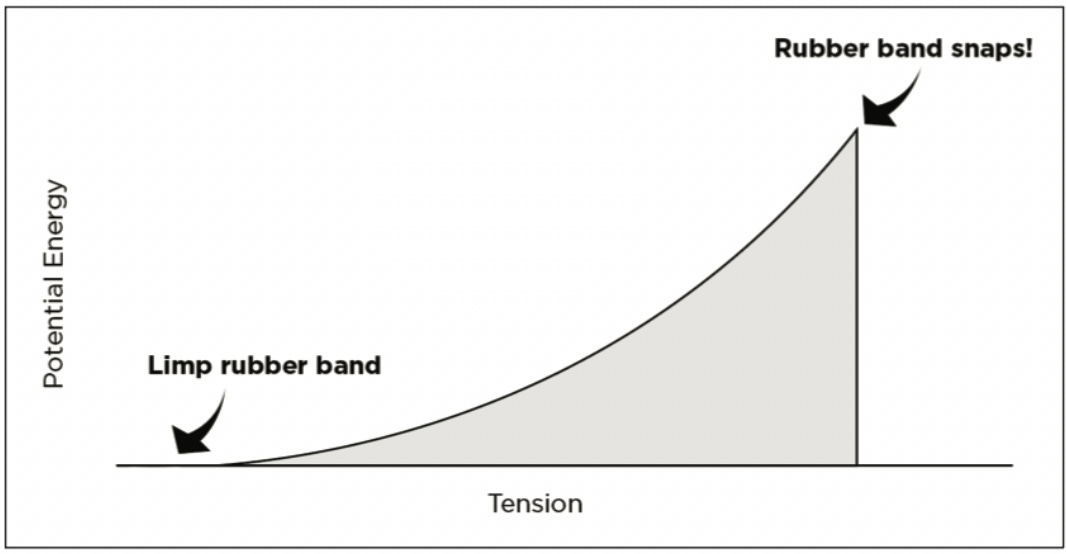
We can use rubber-band physics as an analogy for potential energy in a relationship between a group of people. Whenever different ways of thinking collide, they create tension. A cognitively diverse team is like a group of people pulling on different sides of a rubber band. The more tension, the farther the rubber band can launch if it’s pointed in the right direction. Psychologists call this cognitive friction—where cognitive diversity collides and creates potential energy.
Just like a rubber band, if the tension in a group of different people gets too great, things break down. The group snaps. It makes no progress.
At the other end of the spectrum—in the absence of tension—there’s also no progress. A group of people standing around a limp rubber band goes nowhere.
Between these two extremes—between inertia and destruction—lies a zone of possibility. This is where the magic of group progress happens. We might call this area where cognitive friction creates potential energy the Tension Zone. But to simplify, and because Tension Zone sounds like a Kenny Loggins song from the 1980s, let’s just refer to it as The Zone.
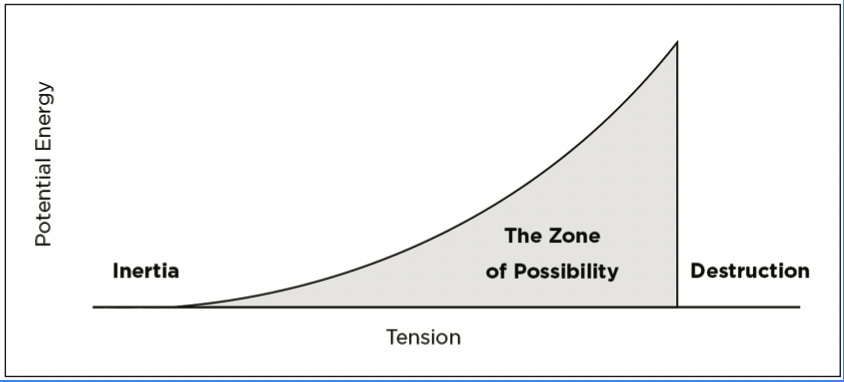
In American slang, “being in the zone” implies that a person is focused and able to perform their best at something. So it’s not inappropriate for us to say that The Zone, in capital letters, is where that kind of magic happens for a team. And the important ingredient, the thing that gets teams into The Zone, is not peace and harmony and sameness—it’s engaging the tension between their perspectives, heuristics, ideas, and differences.
When we look at the history of great collaborations, we see this pattern everywhere. In fact, every successful cognitively diverse relationship takes place inside The Zone. And it’s the key to explaining our merger paradox.
At one point when they were working on their airplane, Orville and Wilbur Wright had a problem with the propeller. They needed something to propel the vehicle forward, which a spinning blade could in theory accomplish, but it was unclear how to make it work, to get the plane off the ground without sending it out of control. So, as usual, the arguments began.
They shouted back and forth at each other for weeks. They flip-flopped sides of the arguments, and eventually realized that they were both wrong. The solution wasn’t a propeller; it was two propellers, each spinning a different direction. Which is just about the perfect meta-analogy for how The Zone works.
Orville and Wilbur knew that neither was going to think up the design of an airplane by himself. Their arguments created tension that pushed them into The Zone where progress was possible.
But while arguing helped the brothers explore new intellectual territory together, it also created the danger of going too far—of devolving into real fights, or hurt feelings, like a rubber band ready to snap.
So, to keep the tension safely within The Zone, Wilbur and Orville did their little debate switcheroo. This technique helped them to decouple the arguments from their personal egos, which in turn helped them look at things from different perspectives without getting too mad. It depersonalized the conflict, ensuring that the goal was always to make progress up the mountain rather than to kill each other.
“I don’t think they really got mad,” said a mechanic who worked with them. “But they sure got awfully hot.”

In his basement studio, Robert Diggs harnessed the cognitive friction between his rappers’ diverse styles and personalities—and also the tension between his own diverse tastes—to create a new sound. By channeling the potential energy from the Clan’s rap battles into a collective goal, Diggs was able to make the hip-hop world’s most powerful rubber-band gun, so to speak. He managed to keep things inside The Zone long enough to make Wu-Tang superstars.
Diggs’s strategy of scrambling different rap styles together spilled into each individual rapper’s technique. Raekwon shared his experience of street life through culinary metaphors. Method Man mingled drug references with Green Eggs & Ham and classic Dick Van Dyke songs. Inspectah Deck reflected on gang violence, Greek philosophy, and science.
I bomb atomically
Socrates’ philosophies and hypotheses
Can’t define how I be droppin’ these mockeries
Lyrically perform armed robbery
Flee with the lottery
Possibly they spotted me
Battle-scarred shogun, explosion when my pen hits
Tremendous, ultra-violet shine blind forensics
–Inspectah Deck, “Triumph”
At times, though, the conflict at Wu-Tang went too far. Over the years, the group fought and sparred and walked out on one another dozens and dozens of times. In 1997, as Chrysler and Daimler were crafting their merger plan, persistent infighting forced Wu-Tang to drop out of its massive tour with rock band Rage Against the Machine.
Which reminds me. What about our poor friends at DaimlerChrysler? Their relationship wasn’t nearly as volatile as Wu-Tang’s. The Germans and the Americans were different, sure, but they never got in any shouting matches.
It turns out their problem wasn’t too much conflict at all. It was the exact opposite.
7.
Any science writer who ends up writing about relationships eventually ends up at the Gottman Institute. I was no exception to the cliché when I started digging into the science of Dream Teams.
At their research center in Seattle, Drs. John Gottman and Julie Schwartz Gottman study romantic partnerships and what makes them tick. I found them because of my interest in what makes lovers stop ticking. What causes partners who once thought that they’d be better together to call it quits?
The answer is surprising, but quite simple.
“Interaction patterns, such as disagreement and anger exchanges,” they report, “may not be harmful in the long run.” In fact, conflicts can be “predictive of improvement” in partnership satisfaction over time.
The reason is not because arguing makes us happy. It’s actually because if you’re still arguing, you’re probably still together. There’s potential energy in the rubber band you’re stretching together. If you keep talking long enough—and those arguments don’t spill over into violence—you’re going to eventually work things out.
Indeed, the biggest leading indicator that a marriage is about to end is not, in fact, when couples argue. It’s when they stop talking.
Two experiments help us connect this to our exploration of differences and teamwork. First, a group of researchers from Harvard, Berkeley, and University of Minnesota decided that they wanted to know just how much training people to be mindful of demographic diversity helped big companies with lots of employees. So they found 829 businesses that emphasized diversity training and tracked how they fared over a period of thirty-one years. In 2007 they published their surprising results. That is, that so-called diversity training programs had “no positive effects in the average workplace.” In fact, they found “in firms where training is mandatory or emphasizes the threat of lawsuits, training actually has negative effects.” Emphasizing how not to offend people who were different scared employees into disengaging.
Then in a 2015 experiment, another group of professors took a group of white men who were applying for an IT job, and separated them into two groups. Before the job interview, they told half of the men about the great efforts the company they were applying to used to focus on racial diversity. The other half weren’t told anything about that. The job applicants who’d gotten the diversity message did worse in their job interviews. Their heart rates rose. They were more nervous. They talked less. Talking about race differences made them freeze up.
And this was, according to the professors, “regardless of these men’s political ideology, attitudes toward minority groups, beliefs about the prevalence of discrimination against whites, or beliefs about the fairness of the world.”
These two experiments reveal something about human nature. Our most primal reaction when we are put together with people who aren’t like us is precisely the reaction of these test subjects. We tend to freeze. We get nervous about the tension we see coming, so we clam up. Even if we have good intentions toward other people.
A managing director who oversaw demographic diversity at one of the world’s largest banks put it well to me one night over dinner. “One of the biggest problems we have is we hire all these different kinds of people and then tell them to fit our way of thinking,” she told me. She would soon leave her job to oversee diversity at the world’s other largest bank, where the same thing would happen. “They have all this potential to add to the culture,” she said. “And you watch them slowly learn to keep quiet.” If you’re different from other people in your group, it’s incredibly easy, and incredibly common, to stop speaking up.
I tried to confirm this phenomenon myself. In 2016, I conducted a nationwide survey of employees of a hundred major US corporations. I asked these employees about the differences between themselves and their coworkers and managers—whether they were in the minority or majority in various categories like race, gender, age, experience, education, and geographic background—and then asked various questions aimed at discerning how much they were able to use their different ways of thinking at work. I then cross-referenced this with data on how innovative their companies were. The upshot of the study shouldn’t surprise us, given what we’ve been talking about. Businesses that rank high in “innovation”—the ones that grow quickly and produce game-changing products and services—tend to encourage the airing and clashing of diverse viewpoints. Not just having differences, but speaking up.
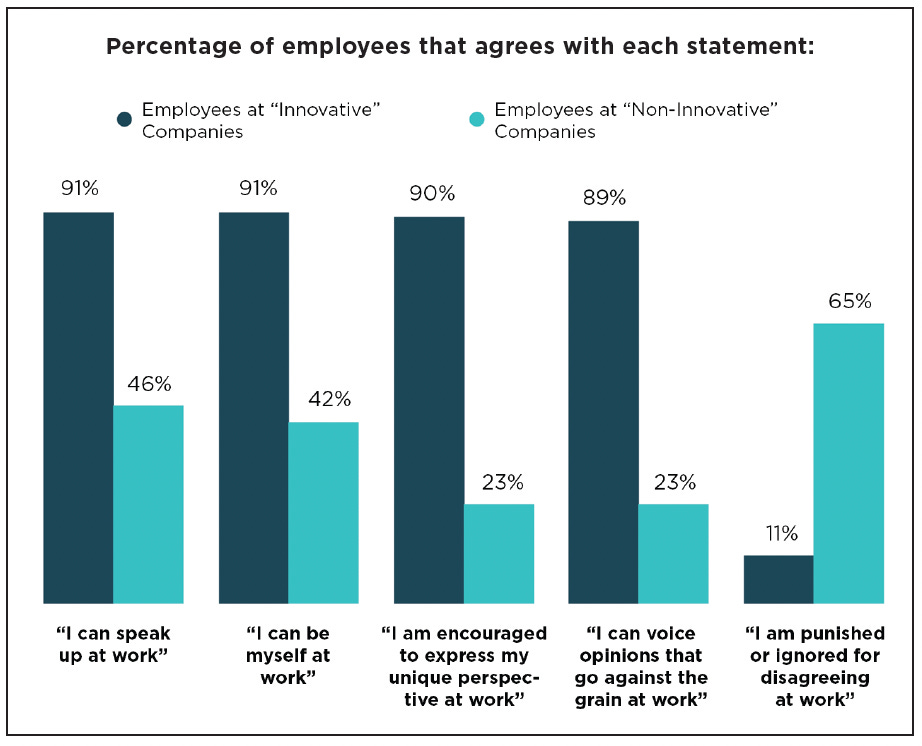
The data were persuasive. No matter how demographically diverse, organizations that let their people use their different mental tool kits are going to be more effective at finding new peaks on Problem Mountain. Companies that don’t innovate tend to make people follow a single, “approved” way of thinking. Their different kinds of people keep quiet about their different perspectives and heuristics. They break less ground than companies that encourage everyone to speak out.
And this, it turns out, was the festering sickness hidden in all those failed mergers we talked about.

In 2011, a group of professors from University of Athens decided that they wanted to see exactly how people behave after their companies go through a merger. So they found some companies that were merging, met their employees, and put tracking devices on them.
They then sat back and observed where the people went, who they interacted with, and what they said to one another. Numerous studies already supported the theory that integrating cultures was the most difficult part of a merger. But this was the first time anyone had looked at how much people from different companies actually spoke to one another.
The answer, it turned out, was not much. The professors observed that most mergers did not lead to an increase in fighting, but instead they led to an increase in something they called “organizational silence.” Basically, this is when team members don’t talk about important issues, or at all. Companies that had organizational silence developed a lack of social trust among their employees. And this led to mergers failing to live up to their potential.
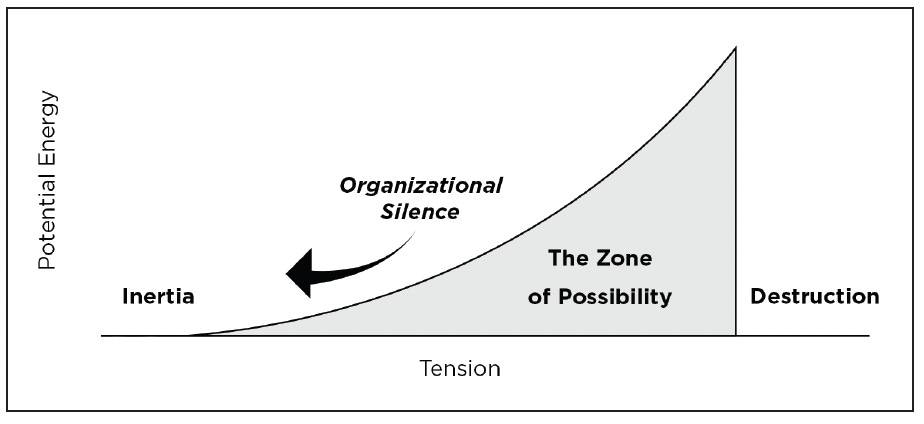
Rather than deal with the discomfort of cognitive friction that comes with everyone’s different perspectives and heuristics, the people inside of most newly merged companies get quiet. And that, it turns out, is worse for business than arguing.
Organizational silence has contributed to some of the most spectacular mistakes in history. After the infamous Bay of Pigs fiasco—one of the biggest US foreign policy blunders of the twentieth century—several former cabinet members would later admit they regretted not speaking up. President John F. Kennedy’s team stood tacitly by while a gung-ho CIA persuaded the president to secretly land troops in Cuba. “In the months after the Bay of Pigs,” Kennedy aide Arthur Schlesinger wrote, “I bitterly reproached myself for having kept so silent during those crucial discussions, though my feelings of guilt were tempered by the knowledge that a course of objection would have accomplished little save to gain me a name as a nuisance.”
Imagine that once again you’re the Chris Jung of your team (hearkening back to our previous chapter about delivering the subpoena to the mob boss), the person who thinks differently among a group of similar thinkers. How much time does it take before you start holding your tongue rather than keep bringing up ideas that create conflict for the group?
Where there’s difference, there’s tension. And where there’s tension, there’s often fear. And fearful people often avoid speaking up.
This is what the employees of Chrysler and Daimler did.
In the beginning, the Germans were afraid of coming across “heavy-handed.” So they “stayed away from Detroit.” Fearing conflict, DaimlerChrysler executives were reluctant to mesh the two organizations too closely—not even the brands. Married on paper, Mercedes, Dodge, Jeep, and the rest were strangers to one another. “Schrempp . . . told himself there is no point in trying to smash these two companies together,” said Chrysler’s former vice chairman.
Chrysler’s chief, Bob Eaton, seemed withdrawn. He went weeks at a time without speaking to the head of Daimler. Whereas Eaton had once been fond of preaching what he called “participatory management,” now he seemed like he’d stopped participating altogether.
Peter Stallkamp, one of the Chrysler executives responsible for the company’s success in the ’90s before the merger, told CNBC, “The managers feared for their careers, and in the absence of assurance, they assumed the worst. There were a good eighteen months when we were being hollowed out from the core by the Germans’ inaction and our own paralysis.”
Could we really have expected this to go well?
Within a couple of years, two crucial Chrysler VPs had packed up and left for jobs at Ford. A heavy cloud hung over the organization. Managers weren’t engaged, employees weren’t engaged. All the predicted “synergy” went out the window. Things began to fall apart at DaimlerChrysler. “What happened to the dynamic, can-do cowboy culture I bought?” Jürgen Schrempp lamented.
Most of the cowboys were still there. They’d just checked out of the rodeo.
8.
If any member of the Red Army hockey dynasty can be called a “secret ingredient,” I’d argue that it’s longtime team captain Valery Vasiliev. And not for the reasons one might initially assume.
You may recall from the first chapter of this book that Vasiliev was the guy who had a heart attack during a game and kept playing. Vasiliev was a hard worker, the embodiment of the cliché “leaving it all on the rink.”
Compared to his teammates, Vasiliev could barely skate. He never scored. But his team didn’t care. Because when Vasiliev was around, they did better.
This was due, in large part, to the role Vasiliev played in sparring with their coach. Coach Tikhonov, for all his rigor and discipline, was a tyrant. He would deny the players access to their families during practice season and wouldn’t allow them to go to the funerals of loved ones. He would berate and pummel and abuse the players when they screwed up—and Vasiliev would fight back on their behalf, berating the coach when he made mistakes, too.
Fascinatingly, neither man seemed to take this stuff personally. Vasiliev would show up to practice the day after a physical fight with Tikhonov and act like nothing happened. When Tikhonov pulled the good players and made the team lose the Miracle on Ice game in the Olympics, Vasiliev allegedly choked Tikhonov on the bus.
“Tikhonov knew Vasiliev would push back, do what these great captains do,” says Wall Street Journal sports journalist and author Sam Walker. It was part of the process. “It wasn’t a personal thing; it was about the team.”
The Red Army didn’t just benefit from the cognitive friction of its coaches’ diverse stylistic inputs—the dance and ninja training, the marathon skating drills. They also benefited from the constant tension between coach and captain in the name of bettering the team.
Keith Yamashita, the founder of SYPartners and coach to Oprah and Steve Jobs whom we met earlier, likes to talk about how “micro-actions add up.” A hundred small instances of being included as part of the group can lead to organizational trust, and even explain how people like Tikhonov and Vasiliev could fight like they did and still work together. They never stopped engaging each other in the name of the cause. On the other hand, a hundred small occasions of being ignored or excluded—even if each occasion on its own is innocent or not a big deal—leads us to feel like outsiders, perhaps even hated. The team member who sits on the bench, doesn’t get the high five, doesn’t get asked for input may as well be a ghost.
This is why research by Gallup shows that when a manager ignores his or her people, the chances of those people being “actively disengaged” are a whopping 40 percent. And, as writes Gallup’s Tom Rath in his book StrengthsFinder 2.0, “Having a manager who ignores you is even more detrimental than having a manager who primarily focuses on your weaknesses.”
The Red Army didn’t have that problem. And neither did Wu-Tang.
In terms of self-destructive potential, Wu-Tang’s merger of nine volatile personalities far outstripped DaimlerChrysler’s “merger of equals.” And yet despite the arguments, despite walking out on shows, despite some very public brawls over money, Wu-Tang managed to produce seven albums together over twenty-five years. There was no organizational silence. They were the family that never truly fell apart, because they kept coming back to hash things out.
And as uncomfortable as the infighting was, Diggs recognized that it was this very friction that made them powerful.
“When steel rubs against steel,” RZA said, “it makes both blades sharper.”
9.
The 1983 movie Shaolin and Wu Tang opens with a dojo scene. Students from two rival schools are tussling. One is Shaolin, which specializes in a secret fist technique. The other is Wu Tang: masters of a secret sword strategy.
Both masters throw in the towel early. “Don’t show him too much!” the Shaolin master warns. The elders are less afraid of losing than they are of the kids giving away their secrets.
Before long, the bad guy, the evil Qing Lord, learns about the schools’ secret techniques through his spies. Realizing that they pose a threat to his power, the Qing Lord hatches a plan to eliminate them. He holds a martial arts contest, hoping that each dojo will destroy the other.
But the two rival kids from act 1 get wind of what the Qing Lord is up to. They join forces. When they combine their unique heuristics—the Shaolin fist and the Wu Tang sword—they create a deadly combination. The Qing Lord is appropriately defeated.
“You’re genius to have mixed the two!” the empress tells the young warriors in the final scene.
Robert Diggs didn’t just mix two techniques. He mixed nine of them. And in kung fu tradition, each of his nine master rappers mixed various styles, foreign ideas, and non-musical metaphors into his own musical process.
A decade after bringing the Wu-Tang Clan together, Diggs could finally afford to travel the seven thousand miles that lie between New York City and the real Shaolin. He could finally afford to see the real Wu Tang Mountain.
“When we stood on this mountain and looked up at the range of peaks called the Nine Dragons, this is what we saw,” he recalled. “Three mountains forming a giant ‘W’—the symbol I chose to represent a crew of nine men, nine years earlier. It was as plain as day, and has been for a million years. But some things aren’t visible until you’re truly ready to see them.”
Diggs’s obsessions gave him a unique set of perspectives when he looked at his own mountain—the mountain he and his brothers would have to climb if they were ever going to get out of the projects.
Kung fu taught Diggs that friction sharpens our mental weapons, and that those weapons are more powerful together than alone. Spiritual mathematics had taught him that seemingly conflicting things can combine to form something wonderful. And chess taught him, like Valery Vasiliev and the Wright brothers, to depersonalize conflict in the name of getting better.
“The most important thing is to realize that the problem is on the board,” Diggs would reminisce. “It’s not with you.”

As we can see, there’s enormous potential energy in diverse perspectives and heuristics. But we can’t unlock that energy unless we knock our heads together. Dream Teams, in other words, predictably require tension.
It’s a compelling idea—the power of The Zone. But as Diggs learned, as Daimler learned, as the Wright Brothers learned, making our cognitive diversity work for us isn’t easy. So often, the same tension that can lead to progress instead leads to destruction or inertia because we can’t handle our differences.
The problem—and, as I would soon discover, also the solution—lies in a tiny cluster of cells at the center of our brains.
Stay tuned for the next free chapter of Dream Teams next month!
Make a great day—
Shane
P.S. Though my latest research revolves around adaptation and change, I’m still speaking about Dream Teams at conferences and leadership offsites. If you know a group that could use this message, check out my speaking page here.