


Re-reading and revising this chapter of Dream Teams 8 years later during this fraught time in the United States gave me chills more than once. I would dare say the “math” of cognitive diversity is more important to understand and appreciate than ever—even as the mere idea of being different or speaking up against the “approved” way of thinking is being slandered and crushed under the boots of bullies. Please share this along!
P.S. If you missed them, read the Foreword here and Chapter 1 here.
Buddy Cops & Mountain Tops
1.
The Chicago detectives were in Baltimore, of all places, investigating a train robbery (of all things!) when they learned about the plot to kill their hometown congressman.
It was February and cold outside the office bearing the name “John H. Hutchinson, Stock Broker” on South Street near Baltimore’s Inner Harbor. The office was a front—a temporary headquarters for agents of Hutchinson’s private detective firm. The firm specialized in fraud and corporate espionage, particularly for clients who wanted to keep things quiet.
Hutchinson’s detectives had inhabited this secret office for several weeks now. They were there at the behest of the president of a local railroad company, a man named Samuel Felton. He’d hired them to look into a rumor about a plot to ruin him by disrupting millions of dollars of train cargo. Local politics were tense in Baltimore at the time, and Felton had feared “an extensive and organized conspiracy” that included members of the city police, or even higher up. Paranoid as he was, Felton decided to hire outsiders to suss out whether the rumors had merit, before involving authorities.
And when it came to that sort of thing, Hutchinson was the best. A classic entrepreneur, he was a school dropout with a knack for solving puzzles. This led him to become a police detective, then to open a private firm. After ten years in operation, Hutchinson still personally masterminded most high-profile jobs.
For the Baltimore Railroad case, he had also staffed his finest crew:
Detective Webster was the principal investigator on the case. He was a tall British immigrant, with curly hair and a beard that can be best described as “hipster.” Webster was tough and experienced and unafraid to kick down a door or jump from a moving train—as he once did while chasing a fleeing suspect. A family man with four kids, he’d earned his stripes as an NYPD officer for over a decade.
Webster’s counterpart, Detective Warne, on the other hand, was sly, charismatic, and twenty-eight years old. Where Webster was a decisive man of action, Warne was the agency’s smooth talker and master of disguise—thin and chameleonlike, with a knack for getting people to cough up information.
The two had been chasing down Felton’s railroad conspiracy at various Baltimore PD haunts for a month when they overheard a rumor that sent them racing back to base. In the course of that month, they had determined that a group of corrupt officials and politically disenfranchised socialites indeed had it out for Felton. But as far as they could tell, the group had done little but talk trash about him and other high-profile figures in Baltimore.
Webster, who knew how to relate to police officers, had been buddying up with off-duty drunks at local cop bars. Meanwhile, Warne was spending evenings in disguise at elite social hangouts, eavesdropping on the conversations of potential conspirators. In this manner, the two pieced together the troubling details of what was really afoot:
Basically, it was terrorism. The group, frustrated at the state of national politics that they felt was leaving Baltimore behind, wanted to send a message: the government had failed. “Look at our city,” one conspirator confided, “and tell me if we are not going to ruin.” They’d considered several ways to draw attention to this point, like ruining Felton’s railroad line. But the group had recently cooked up plans to do something much less subtle: assassinate a high-profile congressman who would soon be passing through town.
The congressman—a popular but polarizing Republican—was the perfect target. He represented everything these extremists hated about the current state of politics. They suspected that his death, while shocking, would spark the dialogue they desired. They’d then knock off Maryland’s governor for good measure. Each would die as an example, one conspirator said, of a “traitor to God and this country.”
The conspiracy reached high. A police captain named Ferrandini had vowed that the out-of-state congressman would “die in this city.” And police chief George Kane, who was sympathetic to the extremists’ cause, was willing to turn a blind eye.
The congressman had made public plans to travel among the citizens—by train—from Illinois to Washington, with a series of speaking events scheduled en route. After stopping at Columbus, Pittsburgh, New York, Philadelphia, and Harrisburg, he would board a train to Baltimore. There a driver would take him to the Eutaw House, where he would deliver a short speech. After the speech, the driver would take him to a train station a mile away, for a final leg to Washington, DC.
Although it’s customary in America for local police to provide an armed escort for visiting politicians—often a showy spectacle of blocked roads and sirens—the plan was for Chief Kane to claim at the last minute that he could not spare any officers to meet the congressman’s entourage at the train station. The man and his personal detail would be on their own.
The conspirators would post agents along the route, sending word of the congressman’s progress toward Baltimore. They had choreographed a “street fight” to break out as he passed through the vestibule at the train station to meet his driver. The fight would distract the transit security. Simultaneously, a mob of faux commuters would swarm the area. Several of these would be armed men—including at least one police officer—who would proceed to gun down the congressman and his entourage.
When he reviewed Webster’s and Warne’s intel, Hutchinson spiraled into anxiety. This was much bigger than railroad sabotage indeed. They needed to alert some proper authorities. But how far up did the conspiracy go? Hutchinson dispatched Warne to alert the congressman and advise he go straight to Washington and skip the speaking tour.
But the congressman deliberated: given the current climate, canceling all these speeches could be politically disastrous. And tipping off the terrorists now would make them harder to catch later. Still, evidence of the murder plot was compelling. He asked Warne: Could they discreetly get him to DC after his final event in Harrisburg—and leave authorities out of it?
Hutchinson reluctantly agreed, understanding that any leak could hamper an investigation into the wider conspiracy. But he was nervous. This was not corporate espionage. It was life and death. And anyone could be a conspirator.
Except for Mr. Felton, Hutchinson decided. He’d enlisted them to investigate these corrupt officials in the first place. He had to be clean. Now it was their turn to enlist him.
So, with Felton’s help, the detectives devised a plan.

On the night of the planned murder, after a packed speaking event in Harrisburg, the Republican from Illinois’s Seventh District excused himself to his hotel room. He donned the disguise that Warne had prepared for him—a felt hat and slouchy overcoat—and exited the hotel alone through a back entrance. Hutchinson and a bodyguard met him there and accompanied him to the midnight train to Philly. Warne was waiting, having reserved a car for their “family,” whose “invalid brother” needed special assistance.
While changing trains in Philadelphia, the disguised congressman stumbled through the station, playing the part of the disabled brother marvelously. The conspirators who camped out to alert the gang ahead didn’t notice as the group crossed the station and boarded the next train to Baltimore.
Meanwhile, behind the scenes, Hutchinson’s crew were busy altering train routes. They’d secretly arranged for the earlier train to Baltimore to travel slower, and along a side track. This allowed the congressman’s train to accelerate and arrive in Baltimore well ahead of schedule.
They arrived early, as planned. Again, no one noticed the “invalid” in the cowboy hat as he transferred with his “family”—to an early train to DC.
Captain Ferrandini and his assassination gang were still waiting outside the Baltimore station as the train left for Washington. The disguised congressman passed through right under their noses.
Detective Warne stayed awake all night as the train clattered past Fort Meade, Glendale, and Landover Hills. The congressman snoozed as his car crossed the Anacostia River and pulled into the station. Then he woke up and stepped out into the drizzly DC morning.
Where he, Abraham Lincoln, was inaugurated the sixteenth president of the United States.
2.
We’re going to start our adventure in the science of breakthrough teamwork with cops—small partnerships that have to solve big problems. Because what makes good policework work illustrates the foundational principle upon which Dream Teams operate. This will prepare us to explore all sorts of other kinds of teams, from bands to businesses to armies to social movements.
The foiling of the “Baltimore Plot” to assassinate Lincoln is an excellent case study for us to begin with: We had two groups of collaborators. One was outnumbered, outgunned, and out of time. The other was large, connected, and coordinated. Beating the odds required Hutchinson, Felton, Warne, and Webster to conduct a last-minute symphony, solving a series of problems in a variety of clever ways. They wore disguises, ferreted out the enemy’s plans, and orchestrated delicate logistics to save a life—and potentially a nation. And they had to do it all in secret.
In fact, even the name John H. Hutchinson itself was an alias. His real name is one you may have heard: Allan Pinkerton. After the Baltimore Plot, Pinkerton’s National Detective Agency become one of the most famous in history.
Which reminds me, there’s something else that I need to tell you.
There’s something about that charismatic, disguise-loving, twenty-eight-year-old whose work was instrumental to saving Lincoln’s life that’s germane to our exploration of breakthrough collaboration. It’s something that will help us understand the first and most fundamental component of Dream Teams.
It’s that if you’re like most people, you probably thought Detective Warne was a man.
But she wasn’t.
3.
Let us face reality. If the credibility of the FBI is to be maintained in the eyes of the public, the lawbreaker, fugitive, deserter, et cetera, and if we are to continue a flexible, mobile, ready-for-anything force of Special Agents, we must continue to limit the position to males.
—J. Edgar Hoover (March 11, 1971)
4.
Kate Warne was the first female detective we know about in US history. But it took a long time for there to be many more.
Women weren’t allowed to join police departments until thirty years after the Baltimore Plot. It wasn’t until even later that police departments assigned any women to be detectives. And the FBI didn’t hire a single female agent until 1972.
The ranks of women law enforcement agents did not swell, in America at least. At the time of this writing, only 15 percent of active duty police officers identified themselves as women, and women made up just 20 percent of FBI agents. This is despite what retired FBI agent and University of Northern Florida professor Ellen Glasser points out: “Half of criminal justice students in college are women.”
The common explanation for why is a simple one, as another former FBI agent put it to me: Generally speaking, women do not have the same strength as men.
For better or worse, this is a biology thing, not an equality thing. The Centers for Disease Control’s most recent data found that 89 percent of adult men are stronger than 89 percent of adult women. The Journal of Applied Physiology reports that men have an average of 40 percent more upper-body strength than women. And if two random strangers of the opposite sex decide to have a leg-kicking contest on the street, there’s only a tiny chance that the woman will win.
The following chart shows the grip strength, a common proxy for overall strength, of men versus women by age:
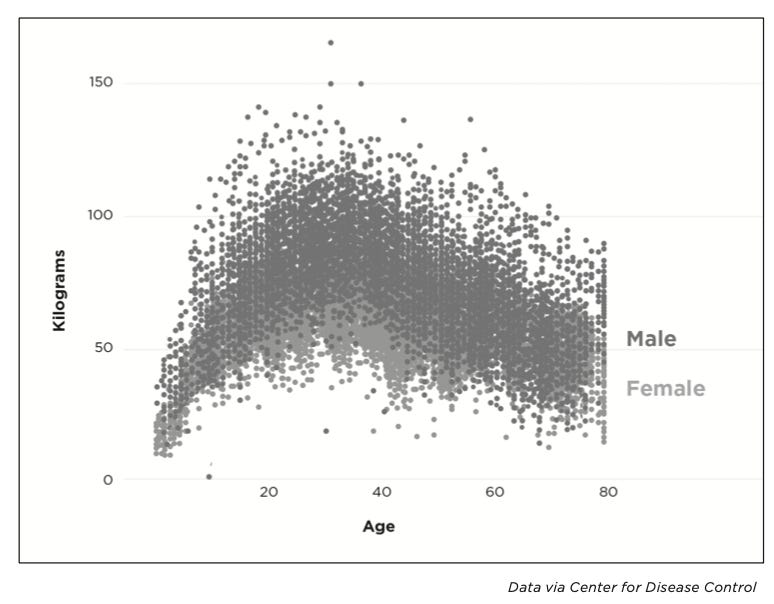
Genetics say that women are—on average—not going to be quite as good at chasing bad guys, punching bad guys, or intimidating bad guys with their size. That’s one of the reasons that FBI director J. Edgar Hoover didn’t let women become agents at all. “The Special Agent in his appearance, approach, and conduct must create the impression to his adversary that among other qualities he is intrepid, forceful, aggressive, dominant, and resolute,” Hoover wrote. The other reason for excluding females was unity. Hoover’s army of agents needed to march to the same beat to be an effective team. “We must put up the best front possible,” he explained.
And you know what? That’s okay. It turns out that some jobs, like law enforcement, are just better suited for men. Kate Warne was nothing but a rare anomaly of a female on a law enforcement Dream Team. She is by far the exception to the rule.
Except, it turns out that Hoover was wrong, and all that stuff in those last two paragraphs is garbage.
The story of FBI special agent Chris Jung and a Newark mafia boss shows us why.
5.
The morning sun reflected off the garbage floating in the bend of the Passaic River that formed the city limits of Newark, New Jersey. Horns blared and street hustlers hustled as bell-bottomed commuters poured into the cluster of office buildings on the river’s western shore. Inside one of those buildings, agents from the Federal Bureau of Investigation were planning a raid.
Well, sort of. They were planning something. They weren’t sure what.
Nineteen seventies Newark was run by syndicates of a handful of Italian American crime families. The Lucchese family was known for controlling the newspaper delivery and kosher meat unions. The Genovese family was famous for its founder, “Lucky” Luciano. And then of course there was the DeCavalcante crime family, whose de facto boss is said to be the basis for the character Tony in HBO’s The Sopranos. They controlled the city’s gambling parlors, its piers, its garbage collection, and its murder.
Mafia bosses are hard to get into a courtroom. But in the spring of ’74, the FBI had dug up some dirt involving one of the big bosses. (The FBI agents I interviewed were willing to tell me this story but not the name of which mob boss it was. So we’ll just call him Mr. Lombardi.)
The dirt was dirty enough to subpoena Lombardi, or force him to appear in court to testify.
But there was a problem. The law required that subpoenas be delivered in person, by hand. Once you received the subpoena, you’re required by law to appear in court, or you could be arrested. And if you were a mob boss who appeared in court, you were suddenly in a lot of danger. Of saying something you shouldn’t—or worse, of another mobster getting worried that you were going to.
The mob had figured out by this time that one of the best ways to stay out of prison or the Passaic was to avoid being summoned to court in the first place. If a subpoena never got delivered, it couldn’t be enforced. So they’d developed a simple, but effective strategy: surround the boss with enough layers of bodyguards that no cop could ever talk to him in person. Thus, the Newark crime heads of the 1970s were able to move about town in style and yet remain untouchable.
Lombardi knew the FBI would love to see him in court, so his operation kept special track of the agents in Newark’s organized crime squad. And anyone a mafia guard didn’t know would get stopped upon approach, until identity was verified and permission granted.
Agents at the bureau had been scratching their heads for weeks about how to get close enough to Lombardi to deliver the subpoena. They’d tried ambushing him while he was out at lunch, but bodyguards had blocked the way. They needed a better plan.
A dozen special agents and the supervisor of the Organized Crime Squad had convened in a war room to brainstorm new ideas. They had decided that there needed to be some sort of raid. The problem is that a subpoena is a request, not an arrest. You can’t really deliver a subpoena at gunpoint because you can’t shoot someone for preventing you from delivering paperwork.
Around and around the agents went. Every idea for how to coerce, intimidate, or blast their way past Lombardi’s bodyguards was a no-go.
That’s when the rookie from another department, Chris Jung, raised her hand. The Organized Crime Squad had invited her as a guest because they were out of ideas. They were willing to consider almost anything at this point.
The male agents turned their heads when she spoke up. “Mr. Lombardi’s daughter is getting married in two weeks,” she pointed out.
And that gave her an idea.
Two weeks later, a chauffeured black car pulled up to the wedding palace where the Lombardi family was celebrating their daughter’s reception. Out of the car stepped an elegant woman in heels and a purple high-necked gown.
The security guards couldn’t help but notice Ms. Jung as she walked confidently into the reception hall. Like she had predicted at the squad meeting, the guards did nothing to stop her. That a gorgeously dressed woman like her might be a federal agent occurred to no one on an occasion like this. None of the staff questioned whether she’d been invited.
Once inside, the job was simple. Jung made a beeline to the front of the reception line, where the happy couple and their families greeted guests. The bride looked beautiful. Next to her, the father of the bride—Mr. Lombardi himself—beamed.
Until Jung stepped in front of him and handed him the subpoena papers.
“Enjoy your night,” she said.
The man stared at her as she turned and walked out. As she exited the building, the mob boss began to howl.
The chauffeur, a fellow special agent, was waiting with the engine running. “I think I ruined the wedding,” Jung said.
Anticlimactic? Yes.
But that, it turns out, is the point.
6.
Here’s a statistic that might surprise you. Women make up 12 percent of American cops but only 2 percent of police shootings.
Curiously, this doesn’t seem to lower the success rates of female officers. Cop for cop, women seem to be just as good at stopping crimes as men.
It’s just that female cops are six times less likely to shoot someone.
Even more dramatic, female officers are eight times less likely to use excessive force than male officers, according to studies by the National Center for Women and Policing. Police partnerships with female officers in them make fewer mistakes and, on average, solve problems with less collateral damage.
Wearing a fancy dress to deliver a subpoena doesn’t sound nearly as exciting as a SWAT team raid. Neither does putting a floppy hat on a congressman for a midnight train ride. But both of our stories about female crime fighters erode a common misconception about law enforcement: that the job is about bullets and muscle.
It turns out that fighting crime usually isn’t about fighting at all. We could cherry-pick all sorts of anecdotes about times when the day was saved by cops literally punching people (as television often depicts), but what happened in the case of the FBI and Mr. Lombardi is how it works most of the time. “The nature of the work,” says former FBI assistant director Janice Fedarcyk, is primarily about “good judgment and problem-solving skills.” And according to FBI reports, women in police departments and intelligence bureaus are on average more successful than men at de-escalating dangerous situations without the use of force.
All of this begs a couple of questions, however: If it’s true that law enforcement is about good judgment and problem solving, why would women tend to screw up less than men? Men are intelligent, too. Furthermore, if it’s true that women do so well at this kind of work, why do we still have so few female law enforcement agents?
It turns out that both of these questions have the same answer.
On former US Bureau of Alcohol, Tobacco, Firearms and Explosives assistant director Kathleen Kiernan’s office desk sits a closed padlock. It’s there for an analogy she’s used hundreds of times when explaining why women succeed in law enforcement.
If she hands you the padlock and asks you to break into it, she says that more often than not, “Men will figure out how to tactically compromise it, break it, subvert it, all those kinds of things.”
But instead of trying to physically tackle the lock, she says, most women will initially try to find the key or figure out a way to psychologically compromise the person who has it.
This, Kiernan insists, is the way most women in law enforcement work. Most of them haven’t spent their lives assuming they can default to muscles to solve problems, so they use tools like negotiation and communication before they resort to force. And often that turns out to be a better way.
During her thirty years at the NYPD, Denise Thomas, one of the first black women to become a Brooklyn homicide detective, was revered by fellow cops. She policed high school violence, solved decades-old murder cases, and busted bad guys in the Marcy Projects back when JAY-Z was there selling crack. And most of the time, she told me, it was psychological work. “You have to have a knack for dealing with people,” she says. The job is not to fight, but to disarm the fight. “You have to defuse the situation and talk them down.”
Agent after agent, cop after cop told me variations on this same theme. As a young local police officer, Fedarcyk told me, it became clear to her that because “women do not have the same upper body strength as men, I had to develop my communication skills to learn to deflate a situation that could escalate.”
Think back to Chris Jung and the mob boss. The male agents went in circles trying to come up with ways to barge their way through Mr. Lombardi’s bodyguards. And Jung put on a ball gown and walked right in. It was an obvious strategy in retrospect, but it never occurred to the men. To the one woman in the room, it was a no-brainer.
So why don’t more women make the leap from criminal justice school to law enforcement? Some said the reason was women don’t think they’re going to be able to beat men up. Others said women dislike the boys’-club culture that surrounds law enforcement or the violent ethos of American law enforcement generally. But not being able to beat men up is also exactly what helps women to fight crime smarter.
And that’s not because female officers are bad with guns. In fact, during the Lombardi case, Jung happened to be the number one marksman in the FBI. She was the first to get a perfect score on the FBI’s timed firearms test and became the head firearms instructor for the bureau.
Despite this, in her mind, firearms were simply part of a larger strategic tool kit. “We probably are more prone to pull a gun than a man would be,” Jung says, “but not necessarily to use it.”
While I was interviewing all these detectives about their teamwork dynamics, American newspaper headlines were reporting a depressing amount of police violence. Bad cops were killing unarmed people. Good cops were being killed. And as I write this revised version, masked secret police have been recently beating and killing citizens and our migrant neighbors in Minneapolis. Race and hate are factors in all of this. The country then was—and once again is—experiencing a backlash to a state of law enforcement overreach, and human beings on both sides of the badge are suffering.
In this violent context, everything we’ve explored so far leads to an inevitable conclusion. If we want to do a better job at law enforcement and reduce violence, the simplest solution is to make all our law enforcement officers women. All indications say that crime-fighting organizations would get better if they got rid of the men.
Except no. If we did that, it turns out, we’d have another problem.
7.
Pretend that you are having a housewarming party, and you’ve invited your eight best friends. You’ve baked a delicious round cake, and because you love your friends equally, you want to cut it into eight equal pieces for them.
But there’s a catch: the knife you are using, for whatever reason, is going to break after you make three cuts. How do you slice the cake into eight equal pieces in just three moves?
If you’re like most people, you probably first cut the cake in half vertically:

Then you cut it in half horizontally:

And then, again, if you’re like most people, you’ll start making a third and final cut diagonally before realizing that this only makes six slices of cake:

So what do you do?
At this point, you might try to get fancy and diagram out some funny-looking cake slices, but then you’ll remember that the pieces have to be equal for your friends to know you love them the same.
There is a simple answer, though. It just requires changing your point of view.
The solution is to go ahead and make the first two cuts, creating four slices of cake, and then to turn your head and look at the cake sideways:

And cut it all the way through.
This little puzzle illustrates something important. It shows us in a very literal way a simple truth, that sometimes the best way to solve a problem requires looking at it from a different angle. In other words, to change perspective.
Perspective is built by how we uniquely experience the world. A bystander who sees a building on fire might perceive what’s happening very differently from a firefighter, or from a person who once had his house burn down. When you ask tall people what makes for a good airline, most of them will tell you “legroom,” while short people will tell you “elbow room.” Neither answer is incorrect in this case, depending on whether you see the world from six inches higher off the ground.
Perspective is one dimension of every person’s mental tool kit. To introduce the other dimension, we return to our housewarming party for another puzzle.
Pretend that next to the cake at your kitchen table are six glasses lined up in a row. The first three glasses are full of milk. The next three are empty. Like so:

Now, say I asked you to move the glasses so that the full and empty cups alternate. But there’s a catch: you can only move one glass.
Can you do it?
For most people, this one is a bigger head-scratcher than the cake. Most of us try to move the second glass of milk to sit in between two empty glasses, only to realize that it still leaves two full glasses next to each other.

If you’re still stumped, try this:
Pretend that I asked you to solve this same puzzle, but that I also told you to pretend that you had to use the technique of a chemist to do it.
If you were stumped before, at this point the answer may have suddenly become obvious.
Pour the milk from the second glass into the second to last glass, and put the glass back.
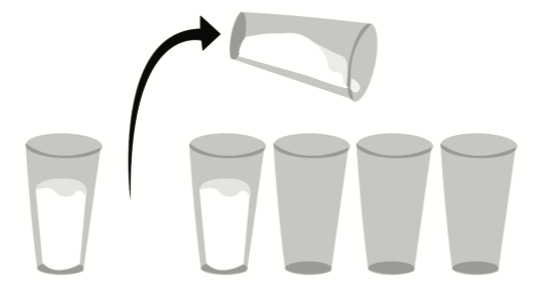
This puzzle helps us understand the second dimension of a person’s mental tool kit: something called heuristics. If perspective is how we see a problem, heuristics are how we go about solving it. You can think of heuristics as “rules of thumb” or problem-solving strategies.
The way a chemist’s brain instinctively attempts the milk puzzle is likely going to be different than the way, say, a forklift operator’s brain does. This isn’t to say that forklift operators wouldn’t be able to solve the milk puzzle. What it says is that if you move objects around all day with a forklift, your first strategy for rearranging glasses of milk is likely going to be different than if your job is to pour liquids in and out of containers all day.
These two parts of our mental tool kit—perspective and heuristics—go hand in hand. And they explain what’s actually important when it comes to working together in law enforcement—and what’s really at play in our study of gender and cops.
To understand what I mean, let’s look at the following diagram of a mountain:
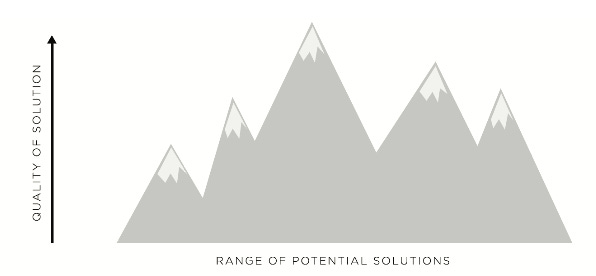
This mountain range represents the set of potential solutions to a hypothetical problem. Each peak represents a different solution. The higher the peak, the better the solution. Every problem in life or work can be represented by its own unique mountain range like this, with varying quality of solutions.
As you can see, some solutions to our hypothetical problem are not as good as others. And in this case there is one best solution—the highest peak in the middle.
Unfortunately, when we’re exploring real problems, it is as if we were hiking through fog. We can’t actually see the entire mountain range. This means that when we find a peak—a solution that works—we don’t know if we’re at the top of the range or just the top of one mountain. We have to decide whether to continue exploring for a better solution.
And here’s where our cake analogy comes back. Where we start out on the mountain—and what part of it we can see—depends on our perspective. It’s like getting dropped off by helicopter at a particular spot on the range:
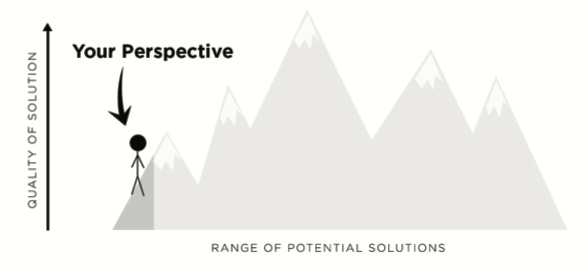
Now that we’re here, we need a strategy—or heuristic—to help us explore for solutions.
Let’s say you have one mountain heuristic, and it is to march in one direction until the mountain stops going up, and then to climb down the other side for five hundred paces. If the slope turns back uphill by then, you keep hiking, upward until you reach the next peak. But if you go downhill for five hundred paces and the slope keeps going down, you turn around and hike up to the last highest point you found.
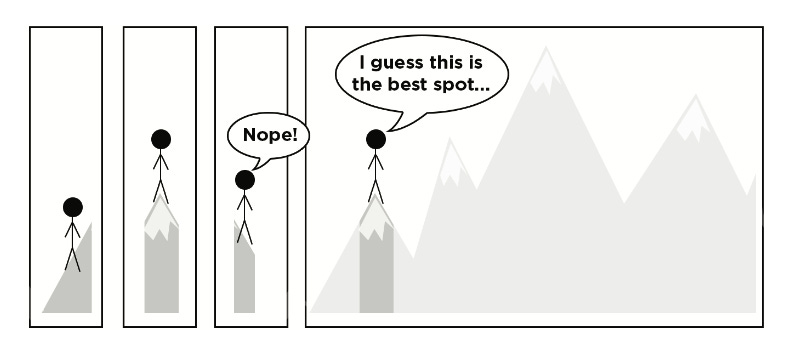
As we can see, your perspective and heuristic helped you find a decent solution, but little did you know there were other, better solutions out there.
This is where teamwork can help. Say you’re working with someone who shares a similar perspective on the problem you’re working on. He’ll get dropped off at the same place on the mountain range as you originally did.
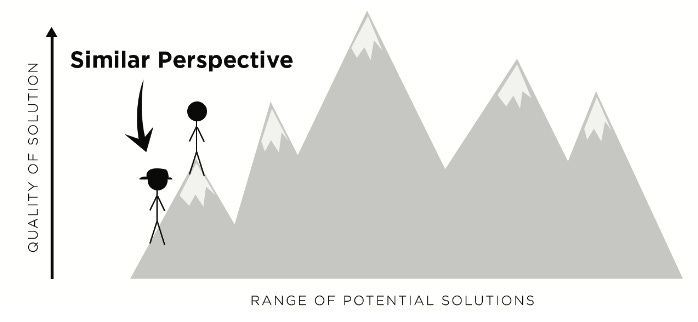
But let’s say that your teammate has a different mountain-climbing heuristic than yours. His strategy is to hike until he reaches the trough between two mountains, and then to go up whichever one is steepest. Using this technique, he might continue past you and find that the next mountain over has a higher peak.
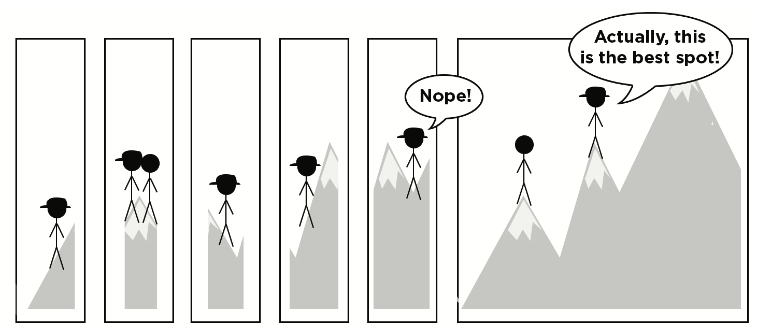
It turns out that our teammate’s diverse heuristic allowed him to find a better solution. He then calls down from his mountain peak at this point, and you join him.
This is how group work often happens. Whoever in the group has the best heuristic will eventually find the best solution, and the group (hopefully) follows it. This is why we put people with different specialties together—such as pairing a design expert and a programming expert together to build a website.
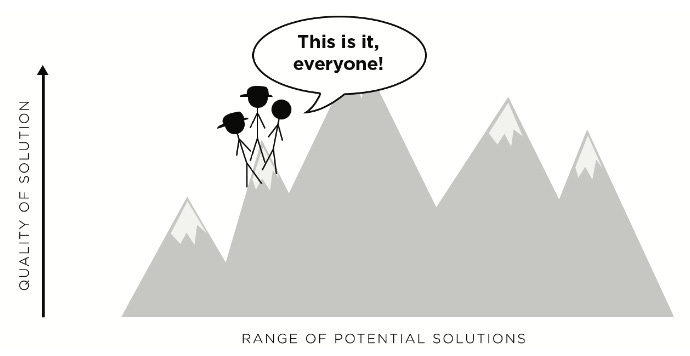
With this strategy, however, eventually your group will run into a problem. No matter how many people are in your crew, if you all start on the mountain from a similar perspective, the group will eventually get stuck together on one peak.
But this is where something interesting can happen.
When you introduce someone with a different perspective, it’s like she is getting dropped off on a different part of the mountain range altogether. She sees it from a point of view that the rest of the group doesn’t.
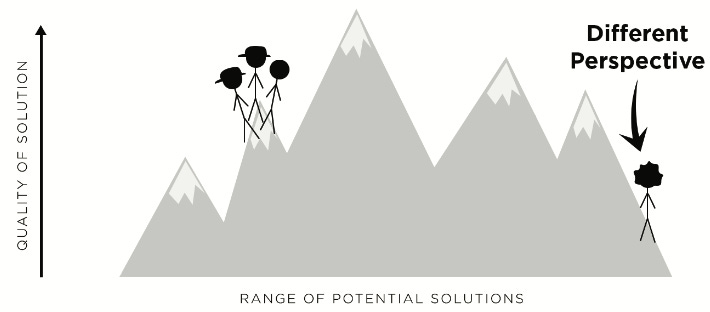
So let’s say this happens. One of your team members shows up with a very different perspective of your mountain range. Even if she has the same heuristics as you (say you went to mountain climbing school together) and explores the mountain using your “five hundred paces” strategy, she might end up finding a better solution simply because she started in a different place.
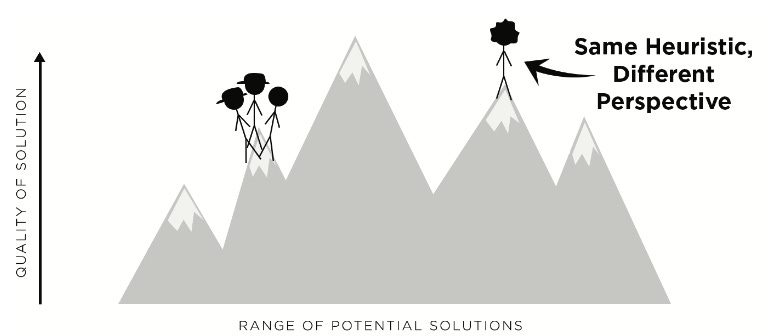
But even if she doesn’t end up finding a better solution than the rest of the group, her vantage point offers the group an opportunity. The group can now play with different combinations of perspectives and heuristics to test if there are higher peaks to be found. In this case, the heuristic of hiking to the trough and going up the steep way, combined with the new perspective, reveals the highest peak in the range.
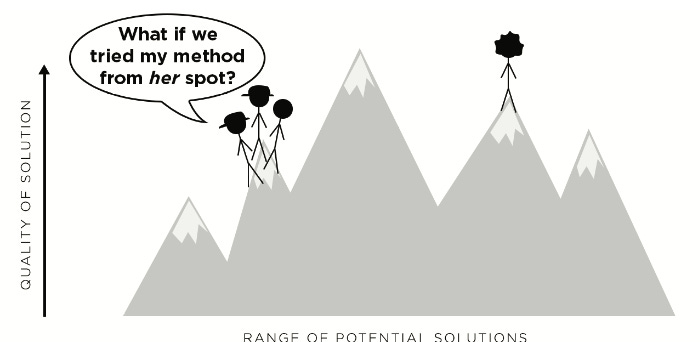
Thus, the whole group is able to get to a solution that nobody would have found on his or her own. The ne plus ultra of the mountain range.
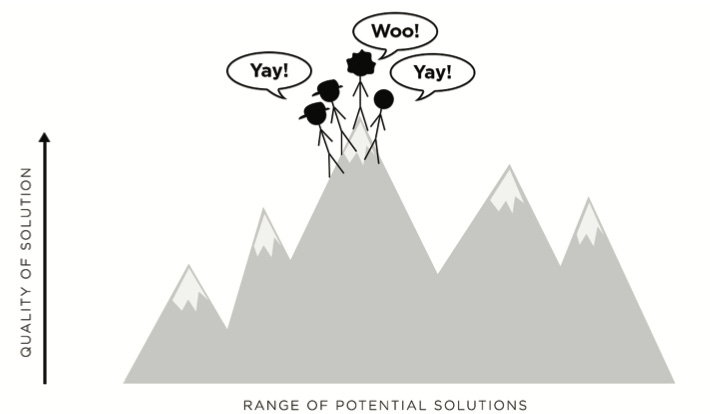
This is the math, as it were, behind the concept of “synergy.” The combination of diverse mental tool kits—looking at the cake sideways and moving the milk glasses differently—leads to the potential for a group to do better than the sum of its parts. It explains how a whole squad of smart people who think the same are less likely to find a higher peak on the mountain than a group of people who think differently. And it’s our first hint at why some police partnerships outwit more bad guys, and how teams like the Russian Five can beat competitors with better individual statistics.
Most great sports teams tend to rely on players having a diversity of skills in order to specialize in different positions, but as any expert or athlete will tell you, the difference between skilled athletes and world champions is not about who’s bigger or stronger. Just as it is with cops, world-class performance often comes down to an athlete’s mental game. The Red Army were great at hitting a hockey puck, but the way they thought together was different than other teams. Their style, their problem solving, their “mind reading” made a difference for the team. It’s not hard to see how Coach Tarasov’s ninja-hockey style, combined with Coach Tikhonov’s toughness, led a whole generation of players to play on a taller mountain peak than their peers.
The mountain analogy we just walked through comes from an acclaimed professor named Dr. Scott Page, who teaches “complex systems” at the University of Michigan. His research findings, from years of studying group dynamics, are conclusive: Teams with diverse mental toolkits consistently outperform groups of “the best and the brightest.”
Let’s put this together. By now we’ve seen that problem-solving smarts—not physical toughness—is key to a successful police squad. And problem-solving smarts are going to be a function of that squad’s cognitive diversity, its diversity of perspectives and heuristics.
Unlike some jobs where we want to just climb the same one mountain over and over—say, an assembly line—solving and preventing crimes is almost always a new, custom mountain problem. This is why adding women to law enforcement changes things, but it’s also why it wouldn’t be such a great idea if we suddenly made all cops and FBI agents women.
If every law enforcement partnership looked like Charlie’s Angels, we might indeed increase the negotiation skill of a lot of departments. But we’d also be shooting those departments in the foot (a thing male cops occasionally do). No men at all would mean increasing law enforcement’s likelihood of getting stuck on suboptimal mountain peaks on the other side of the range. We need lots of perspectives if we want to give our officers the best chance at solving hard problems. (And as someone who loses his keys a lot, I’ve learned that once in a while a team needs a guy with a good heuristic for kicking down a door.)
At this point, our discussion begs a rather obvious, but important question: Is gender the only kind of difference that leads to cognitive diversity in police work?
The answer is absolutely not. (And we’re not even getting into the fact—yet—that gender is not binary. We’ll address the deeper diversity of gender and its accompanying perspectives as we dig into future chapters.)
This brings us to an important subject to step back and discuss before continuing. As we’ve discovered, cognitive diversity is a key element of teams that exceed the sums of their parts. But the term “diversity” itself is a tricky one, and we need to talk about it for a moment.
“Diversity” technically just means “variety,” but the word has become a euphemism—especially in America—for one thing: race. It’s the term many people use to refer to race when they are too uncomfortable to come out and say it. And since race is still very much a hot-button topic, “diversity” has in turn become a word that makes a lot of people nervous.
Reality is, “diversity” doesn’t mean race. Nor does it mean gender, the second-most frequent thing people think when they hear the word.
Because it’s such a charged term, though, we’re going to use the word “difference” in this book as a catchall whenever we generally mean two or more things that are not the same. Whenever I use the word “diversity” from here on, I’ll try to pair it with an adjective for specificity. Like “demographic diversity” or “diversity of shoe sizes.” It’s a good habit that I’d encourage you to pick up, too, if you don’t already do it.
Now that we’ve explored the power of cognitive diversity, things are about to get interesting. But we need to be cautious about one more thing before we proceed.
Some people will be tempted to take our lesson in perspectives and heuristics and use it to jump over other types of differences—or even use it as an excuse to say that demographic diversity like race or gender don’t matter. That’s a bad idea. It’s a temptation we need to resist, and here’s why:
The most accurate way to predict cognitive diversity would be to open up someone’s head and poke around inside their neural makeup. But because we are not James Bond villains, we have to look for proxies for different thinking instead. We need to be able to make our best guess, based on other clues.
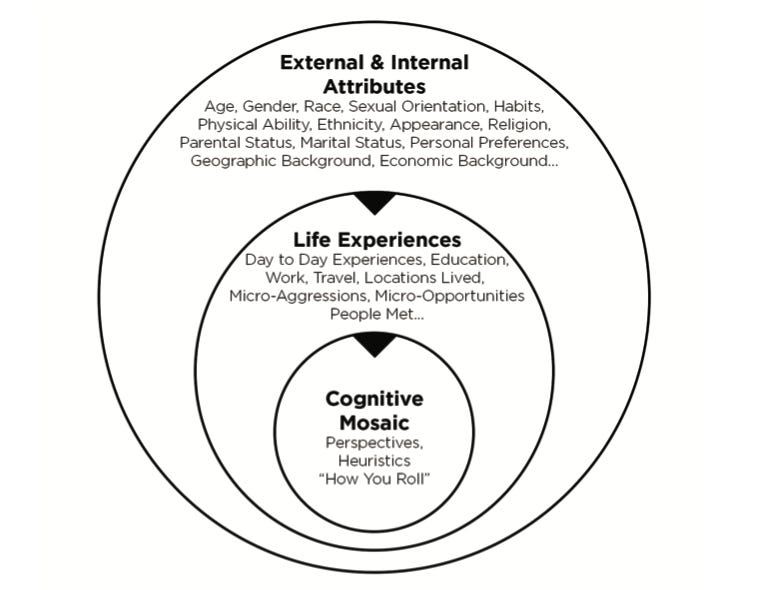
Our perspectives and heuristics come from our life’s experiences. Our neural pathways form as we live through stuff. So, the more we can identify differences in life experience, the more we can predict cognitive diversity.
Some of those experiences are obvious to spot: We studied different subjects, at different schools. We grew up in different kinds of towns. We had that crazy thing happen to us that one time.
But we can go deeper than that. Our experiences are shaped every day by all the micro-experiences we have, and those are affected by the way we see the world and ourselves. And how we see the world and ourselves is affected deeply by how the world sees and treats us. So, when we have a group of people who look different, or identify themselves differently in some ways, we can guess that they may think different in some ways, too.
In other words, if you and I are a different age or race or gender, it’s highly likely that we have experienced life differently. People look at us differently. They speak to us differently. They invite us to do different things. They include us—or exclude us—at different times. And in some cases like height, age, or physical ability, we may literally see things differently. Sometimes those different experiences are subtle, and sometimes they’re more blatant. But they slowly form a mosaic of mental wiring. That mosaic shapes our perspective and beliefs—how we define and predict things—and helps us develop our heuristics and skills—how we approach and deal with things.
So, it turns out that demographic differences end up being pretty good predictors of differences on the inside:
Let’s use another hypothetical scenario to illustrate how proxies for cognitive diversity work in practice:
Pretend that it’s the year 2010, and you’re making a movie starring Tom Hanks. At the last minute before you start filming, Tom tells you he can’t do the movie anymore. Who do you replace him with?
This is a question that Dr. Page likes to ask his University of Michigan students. But I’m a geek, so I decided to ask several thousand American adults who they’d pick in this same scenario. I collected answers online and then sorted them by the responders’ races.
White people chose a wide variety of Hanks replacements: Josh Brolin, Harrison Ford, Hugh Grant, Brad Pitt, and (my favorite) Ryan Gosling were common. Robert Downey Jr. received a slight plurality of votes, and Tom Hanks’s son Colin gathered a high percentage, too.
Black people, however, picked the same person 52 percent of the time: Denzel Washington.
It turns out that, race aside, Hanks and Washington are two of the most similar actors in Hollywood. They’re about the same age and height. They have similar demeanors and are longtime family men. They’re versatile performers and winners of the same kinds of awards. Each has done funny movies but is not a comedian. Each has done both blockbusters and Oscar bait. They even get paid about the same.
In fact, Denzel Washington may just be the best fill-in for Tom Hanks in Hollywood at the time of this writing. As with our cake puzzle, this is obvious once you see it. But it’s easier to see it from the perspective of a black person than a white person.
To be clear, being black doesn’t mean you will pick Denzel. There’s just a much higher chance that you will pick him than a white person will. Once again, what makes the difference is the way you think, which has to do with all the little things you’ve lived through.
Our life experiences add up to what legendary leadership transformation coach Keith Yamashita of SYPartners calls “how we roll.” Basically, this is our operating style: the day-to-day application of our unique mental mosaics. Yamashita says that great teams take time to understand as much as possible about how their members roll: How do they learn best? Do they do their best original work in the morning or afternoon? How do they like to manage their time? What do they need in order to thrive? How do they argue? What are their biggest strengths, their superpowers?
Then, anytime we face a challenge, Yamashita suggests stepping back and doing two things: “First, Take a moment to frame the problem.” Is it a routine problem? Does it require breaking new ground? How high are the stakes? Routine problems don’t require much (or often, any) cognitive diversity, while novel problems benefit from it greatly. “Based on that,” Yamashita says, “do a casting session.” He uses the word “casting” deliberately. A movie director doesn’t just grab whoever’s around or whoever was in the last movie she made. The cast for every movie needs to make sense for the plot and script.
Understanding “how we roll” not only helps team members to appreciate each other’s differences, but it also becomes a pragmatic way to figure out who might best contribute their mental toolkit. “I might be a gay, Asian dad, which is true,” says Yamashita, but a more relevant difference in a particular situation might be, “I’m a morning person.” Or, “I’m very empathetic.”
When we start think about team building as casting, we start to think of our differences as gifts, rather than statistics and numbers. “It’s not a Noah’s Ark mentality,” Yamashita says. We don’t need every kind of person in every meeting. The casting director’s question is, “What group of people will give us the best shot at a breakthrough?”
The most exciting part of this puzzle is not simply putting different kinds of people on the mountain range together, though. It’s what happens to them next.
8.
In 2013, professors from four US universities got 186 Americans who identified themselves as Republicans and Democrats—two groups that tend to think differently about many thing—to read a murder mystery. Each person was told to prepare to come debate the answer to the mystery with someone who disagreed with them. Half of the people were told that they would be debating with a member of the other political party. Half were told they would debate with someone from their own party.
And then something interesting happened.
It turned out that Republicans who were told that a Democrat would be debating the case with them prepared more clever arguments. And Democrats who went up against Republicans did, too. Even though the topic had nothing to do with politics.
The study concluded that being put together to work on something with people with different viewpoints “jolts us into cognitive action” that we don’t get when we work with people who we assume share our perspective. “Simply interacting with individuals who are different forces group members to prepare better, to anticipate alternative viewpoints and to expect that reaching consensus will take effort,” writes one of the study’s authors, Dr. Katherine W. Phillips, vice dean at Columbia Business School. “Simply adding social diversity to a group makes people believe that differences of perspective might exist among them and that belief makes people change their behavior.”
This is one reason why research studies from McKinsey & Company and Catalyst Group show that the more diverse thinkers in a company’s higher ranks, especially its boardroom, the more likely it is to come up with strategies that turn higher profits and avoid making stupid mistakes—like buying bad companies. It’s also a reason why cities with more immigrants from different parts of the world tend to produce more patents. People think more critically when when different people are around.
If you’ve got a group of people planning how to remodel a building, and a person in a wheelchair rolls in to join the planning session, everyone is suddenly going to think a little bit differently about the project.
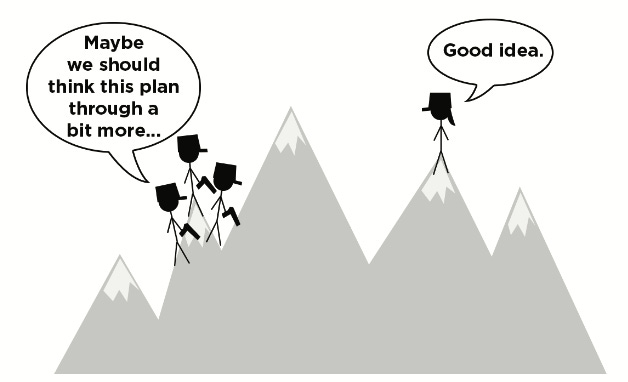
Or, when, say, a masculine group of law enforcement agents brings in women as collaborators, the men will suddenly begin to think more critically about the challenges at hand.
And, it turns out, vice versa.
9.
When Kate Warne first walked into Allan Pinkerton’s office in Chicago for an interview in 1856, Pinkerton assumed she was there for a secretary position. To his surprise, Warne—who was around twenty-three at the time—declared that she was responding to his newspaper advertisement for detectives.
Widowed at a young age, Warne had learned how to fend for herself in the tough streets of Chicago. She knew she had unique skills the detective agency could use.
But, Pinkerton exclaimed, “It is not the custom to employ women detectives!”
Warne knew. What she lacked in brawn she would make up in cleverness, she insisted. Women, she said, had an eye for detail and were patient. Plus, Warne argued, she could be “most useful in worming out secrets in many places which would be impossible for a male detective.”
Pinkerton thought about it that night. Despite the objections of his associates, he hired Warne the next day.
He didn’t regret it. Warne proved to be one of his most capable agents. “She has never let me down,” Pinkerton later said. And she changed the dynamic of the entire agency.
We should take note that there were two areas of advantage that Warne’s gender brought to detective work. The first was external. As a woman, she could walk under a bad guy’s nose without suspicion—much like Chris Jung did at the mob wedding. But second and more important, Warne brought a different way of thinking to Pinkerton’s enterprise—just like Jung helped the FBI come up with cleverer plans because she thought differently. Warne’s skill at disguises and logistical maneuvering was instrumental in saving Lincoln.
Warne changed the way Pinkerton thought about detective work and helped him build the most successful private detective agency in history—an agency that would lay the groundwork for the Federal Secret Service. Because of Warne, Pinkerton made his company logo an eye with the words “We never sleep” underneath it—a nod to her having stayed up all night watching Lincoln. This trademark caught the public imagination and became the origin of the term “private eye.”
Together, Warne, Webster, and Pinkerton formed a Dream Team. The agency, and those three in particular, went on to shape the private detective industry as it’s known today.
Warne’s contribution to Pinkerton’s firm was so valuable (one newspaper called her the best detective in America “—maybe the world”) that Pinkerton had her build a department he called the Female Detective Bureau, whose job was to supply women agents to collaborate on various male agents’ cases. Pinkerton wanted a Dream Team working on every one of his cases. The women and men remained in segregated hierarchies within the agency—reflecting the backward social norms of the nineteenth century—but the mere inclusion of women in detective work was remarkably forward thinking for Pinkerton’s time. More important to Pinkerton, including female agents this way was brilliant for solving cases.
He had been convinced of the power of cognitive diversity.
Coincidentally, the most notable proponent of cognitive diversity at the time was, in fact, President Lincoln. How Lincoln convinced his biggest ideological rivals to work with him in the White House has been well chronicled in books and films. Lincoln knew that his team’s different ways of thinking gave him his best shot at winning the Civil War and keeping the nation intact.
If only more presidents after him had understood that.
So far, we’ve seen how people can do extraordinary things together by combining cognitive diversity. You’ll notice how each Dream Team member we’ve met so far brought a different tool kit to her or his respective collaboration. Warne and Webster contributed very different things to Pinkerton’s Dream Team of detectives. Though they played like they could read each other’s minds, our Soviet hockey players (from our previous chapter) each brought very different things to the rink with them, too. And it’s not a stretch to say that the Red Army reigned because of the combination of their coaches’ heuristics and perspectives—Tarasov’s radical creativity and Tikhonov’s ferocity. There is still much more to piece together in our quest to understand Dream Teams, but as we’ve seen, without different mental tool kits, we limit how high up the mountain we can go.
Notice how this runs counter to the advice that we tend to get in many of our organizations. Get more people like that on the bus! we say. Let’s double down on our strengths! we proclaim. Let’s not hire her; she’s not a culture fit! we advise.
Unless you’re recruiting an army of hammer swingers to break rocks on an assembly line, this kind of advice is profoundly stupid. What does “fit” get us but homogeneous thinking? What does collecting carbon copies of ourselves do but stick more people on the same mountain peak?
“If you see your job and your work as primarily known things or small increments . . . [cognitive diversity] is not that important,” says Yamashita. But, breaking new ground, he says, by nature “requires different angles, different ideas, different ways of doing it, different backgrounds, different sensitivities, different layers, different slices.”
Indeed, breakthroughs happen when we break the mold.
We’ve learned that when it comes to making progress together, the differences that matter most are the ones inside our heads. And those differences are built by our experiences, which in turn are shaped by who we are.
Knowing this is good news for a couple of reasons. First, it gives us a concrete reason to collaborate with people who aren’t like us—a utilitarian excuse to be inclusive, which also happens to be a good moral choice.
It also helps us know what kinds of things to look for when building teams to solve problems together: different perspectives and heuristics, and the things that are proxy for them—experiences, identity, and biology. This gives us the foundation for the rest of our teamwork exploration.
But before we get to all of that—and to the other crucial factors that make regular teams into Dream Teams—we have something pressing to sort out.
If we’re going to conclude that our differences and the cognitive diversity that flows from them make us smarter together, then it turns out that we have a problem.
Why do differences almost always make groups worse?
Stay tuned for the next chapter of Dream Teams in a month!
Related / dig in further: