


This is one of my favorite chapters of Dream Teams, in which we explore the role of “provocateurs” in teams, relationships, and society—and how inviting people to push our thinking and show us what we can’t see creates psychological safety and progress (while unprompted provocation often does the opposite). If you missed the previous chapters, read them here:
Chapter 3: Chrysler, Wu Tang & The Subtle Art of Productive Conflict
Chapter 4: Soccer, Stopping Hate, and The Psychology of Depressurization
P.S. Though my latest work revolves around adaptation and managing change, I still frequently keynote about Dream Teams at conferences and leadership offsites. If you know a group that could use this message, learn more here.
Chapter Five: Angelic Troublemakers
1.
On a September evening in 1887 in New York City, a five-foot-five brunette named “Nellie” mysteriously showed up at the front door of 84 Second Avenue, her pupils the size of saucers.
Her clothes were stylish, but old. A gray flannel frock. Brown silk gloves. A straw sailor’s hat, and a gray veil. She had a low voice, a strange accent, and a distant look on her face. She carried no identification or personal effects.
The four-story brick building whose bell she rang was Matron Irene Stanard’s Temporary Home for Females. For 30 cents, a working-class woman could stay the night in safety.
An attendant set Nellie up with a shared room and a meal, but by the end of dinner, something was clearly off.
The girl—nineteen years and 112 pounds—seemed frightened, a “wild, hunted look in her eyes” according to the other women there that night. Upon questioning, Nellie’s story was strange. She was from the American South and her last name was Brown. But, she would later say she was from Cuba and her surname was Moreno. She had lost her trunks. She worried about all the murderers out there in the world, and all the people outside with so much work to do. She stared unblinking and whispered to herself over and over.
Around the time Nellie started asking if the other ladies in the home were insane, they decided she was dangerous. “I’m afraid to stay with such a crazy being in the house,” said one.
Another declared, “She will murder us before morning.”
Nellie didn’t close her eyes all night. She stared at the bugs in the windowsill while the ladies phoned the police.
Two court appearances and three doctor’s visits later, Nellie was lying on a bed at Bellevue Hospital, waiting to transfer to a mental asylum.
As she lay awake that night, Nellie heard the nurses talk about her and the other women. In the morning, a doctor asked her if she ever heard voices.
“Yes, there is so much talking, I cannot sleep,” she replied truthfully.
“I thought so.”
They declared Nellie “positively demented.” She soon found herself walking a plank to the ferry that would take her to her new home.
“What is this place?” Nellie asked the man who escorted her off the boat.
“Blackwell’s Island, an insane place, where you’ll never get out of.”
2.
Pablo Picasso was six years old when Nellie was committed to the insane asylum. It was only a few years later that his own mental health problems would begin.
He became severely depressed at twenty. His paintings for the next few years reflected this melancholy. They were washed out with blue.
Picasso managed his depression enough to become Spain’s most famous painter—and soon the world’s. But by the time he was sixty, his melancholy had worsened.
This led to a rather peculiar morning routine. As Picasso’s lover at the time, Françoise Gilot (who was forty years his junior!), wrote in her memoir, “He always woke up submerged in pessimism.” He’d lie in bed, groaning. Then, without fail, the following series of events would unfold:
His chambermaid would bring him his coffee and toast. Picasso would lie there, complaining. “Why get up? Why paint?” He was miserable. He was sick. Life was unbearable. He would stay under the covers for at least an hour, while Gilot pleaded with him to get up and paint.
“You’re not so sick as that,” she would say. “Your friends love you. Your painting is marvelous, everyone thinks so.”
Picasso would eventually reply, “Well, maybe you’re right . . . but are you sure?”
She would insist that she was. Finally, after a little more moaning, Picasso would drag himself out of bed and proceed to paint until dark.
And the next morning, the routine would start again.
Picasso painted more during the ten years he lived with Gilot than he did each decade before and after. During this period, he painted his famous Les Femmes d’Alger series, the last painting of which set a world record at auction in 2015, selling for $179 million.
We’d be justified in theorizing that this wouldn’t have happened if Gilot had not coaxed Picasso out of bed.
This little story teaches us something more than how to get a depressed painter to pick up his brush. Often we have all of the ingredients we need to do amazing work, but we are metaphorically stuck in bed.
This is what happens when we don’t have any cognitive friction on our teams. We may have all sorts of differences available for the harnessing, but we’re not making use of them.
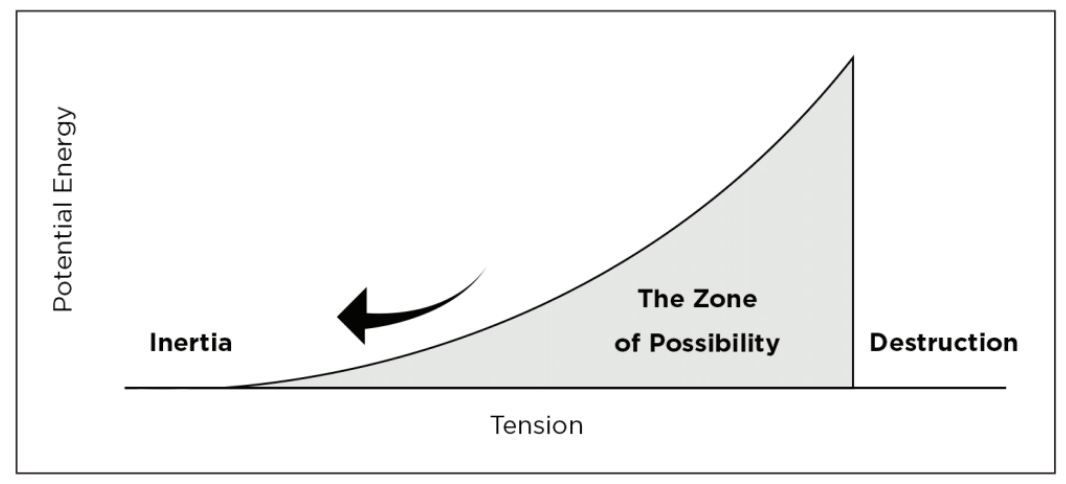
When it comes to team dynamics, depression isn’t usually the culprit that puts us in the Inertia Zone. More often than not, the problem is—ironically—prior success.
The more successful we are using a set of perspectives and heuristics, the more inflexible our brains become on that particular topic. Psychologists call this “cognitive entrenchment.”
People get cognitive entrenchment the longer they work on the same things in the same ways—and especially when those ways work. Research shows us that the longer people work together, the more similar their work styles tend to become. We may start out different, but the more time we spend together, the more we start speaking, behaving, and even dressing similarly. After a while, our perspectives have a tendency to converge. We learn and mimic each other’s heuristics. Over time, it is easy for us to get stuck in the same patterns of thinking. The business world often calls them “best practices,” but psychologists correctly call them “groupthink.” And groupthink, as we’ve learned, eliminates cognitive friction. We find good solutions on Problem Mountain and then settle down on them.
Research by Erik Dane, professor at Rice University, sums up the resulting irony: “Because of cognitive entrenchment, experts may be restricted in their ability to identify optimal solutions to problems, to adapt to novel situations, and to generate radically creative ideas within their domain.”
In other words, often the things that keep us stuck on a mountain peak are our own expert perspectives and heuristics that got us there in the first place.
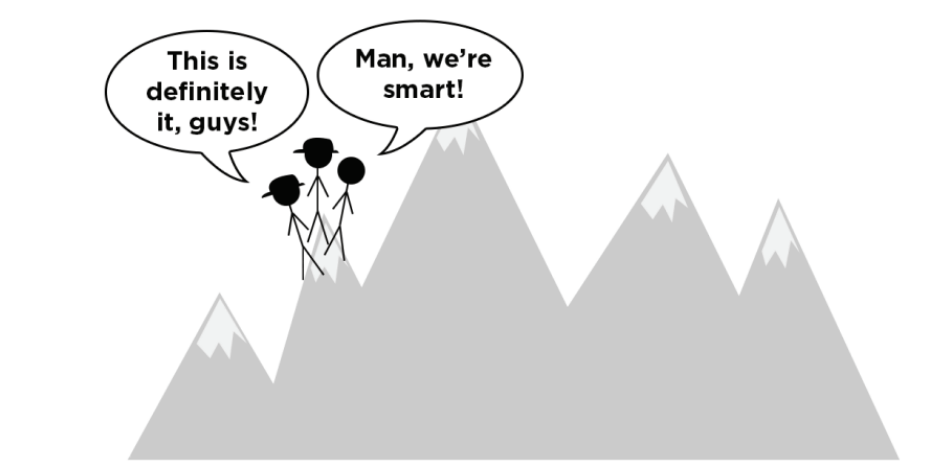
In these cases, like our Picasso story hints at, the thing that holds us back from our Dream Team potential is the lack of a teammate who can give us a certain kind of nudge.
3.
On the first night inside Blackwell’s Island, Nellie shivered uncontrollably.
The facilities were freezing. Inmates stood in hallways chattering from the New York cold. When Nellie asked for a nightgown, the nurse replied, “You don’t need to expect any kindness here, for you won’t get it.” She was doused in freezing water, scrubbed roughly, and forced to clean the nurses’ quarters.
The asylum had opened up in 1839, next door to the prison built there a few years earlier. It was the first city-run mental asylum, part of a push to provide living space and round-the-clock care for the mentally ill—and to keep them separate from the public.
By the time Nellie got to Blackwell’s, the number of committed patients around the country had shot to 150,000. New York had several packed asylums at this point.
Lunacy had become an excuse to lock away anybody that society didn’t want around. Vagrants and paupers were routinely thrown into the asylum without having committed a crime. Worse, any woman deemed “unruly” or who voiced strong opinions could be sent to the asylum on the word of a husband or brother. They were locked up with the schizophrenics.
Asylums like Blackwell’s were notoriously underfunded and understaffed. But officials like New York City mayor Abram Hewitt gave little priority to the matter—or even much thought. Hewitt was busy working on tax reform and planning the development of the subway system.
So for fifty years, the mental asylum system had run itself. And that was how New Yorkers liked it. Places like Blackwell’s Island kept unwanted neighbors, as the saying goes, out of sight and out of mind.
But in its decades-long inertia, the asylum system and its patients were going nowhere. Society had found a mountain peak and set up camp on it for good. Low standards were not improving. Patients like Nellie found themselves in prison-like conditions that offered little chance of help or pain relief—where the world no longer had to think about them.
Nellie had appeared disoriented and confused that night at Matron Stanard’s. But she had not done anything particularly dangerous. Regardless, her strangeness and paranoia sent threat signals to the collective amygdalae of the ladies at the shelter. Her unusual way of speaking and thinking bothered the police who subsequently dealt with her. So they locked her away.
Something was indeed off about Nellie. But it wasn’t what the Blackwell’s staff thought.
4.
The G-Corp executives were flabbergasted.
They congregated in a spacious, exposed brick loft in central London, eyes wide. The setting was the office of Sense Worldwide, a consulting firm tasked with helping expand the market for one of G-Corp’s struggling products.
The product was the “blister cushion”—a bandage that released ointment into a wound over time. Several years after blister cushions’ invention in the 1980s, sales had plateaued. G-Corp, a giant health goods company with products found in every major pharmacy in the world, couldn’t figure out how to make its blister cushion line grow. The company sat in the Inertia Zone, like Picasso lounging in his bed.
It wasn’t like G-Corp hadn’t tried to get out of bed, though. It had explored a few ideas here and there. But the company couldn’t come up with anything better than the existing blister cushion product. Or at least nothing that attracted more customers.
Dr. Dane’s research on cognitive entrenchment describes this scenario exactly. When we have a solution that has worked well for a long time, it becomes difficult to see any other way. “Problem solvers can become fixated on a particular method to their own detriment,” he says.
That’s why G-Corp had hired the Sense team, led by a man named Brian Millar, a British writer and game designer. He specialized in helping companies find radically better mountain peaks, so to speak.
After assessing the situation, Millar told the G-Corp execs to come by his office to talk with a focus group about blisters. Little did they know, Millar had a surprise prepared.
Instead of random demographically diverse people recruited from the mall—the kind of typical focus group that people at G-Corp would be used to—a group of beautiful women filed into Sense’s office. They sported long hair, makeup, and painted fingernails. And instead of shopping bags, they brought with them an array of spiky leather boots and heels.
They were professional dominatrices.
As the ladies took their seats, the executives shook their heads. This was not G-Corp’s target customer. People who got paid to sexily whip other people were not who they had in mind when they’d told Millar they wanted to expand their customer base. All the dominatrices in the world could only buy a tiny fraction of the blister cushions G-Corp wanted to sell. What kind of gimmick was this?

The history of focus groups dates back to World War II, when psychologists had people watch military propaganda films. The doctors would hide behind one-way glass to observe which messages were most persuasive to the average person. They wanted to know what kinds of language and imagery might best influence people.
After the war, a different kind of propagandist took up this practice: marketers.
Companies began recruiting people to test which products and campaigns were the most persuasive to the largest number of potential customers. These “focus groups” soon evolved into a way for companies to get inspiration for what to do in the first place. If you’re out of ideas, why not ask everyday people what they want, and then make it?
Brian Millar’s agency existed in part because these kinds of focus groups have a big problem: everyday people tend to come up with everyday ideas.
“Most average consumers are actually pretty happy with the product they’ve got,” Millar explained to me. “I was very happy with my late-nineties Nokia,” he says. “If you’d said, ‘What new features could we add to your phone?’ I would have said, ‘This phone is perfect. I can’t help you with that.’”
Our amygdalae will often cause us to be uncomfortable with exactly the kinds of ideas that focus groups are supposed to come up with. Anything creative or different is going to feel foreign, even scary. Studies find this in business all the time. In fact, people who introduce creative ideas, according to research led by Jennifer Mueller of the University of Pennsylvania, are less likely to be listened to or made leaders. That’s because “the expression of creative ideas is often associated with uncertainty.”
This explains the list of things that bombed in focus group research, according to Millar: PCs, Pop-Tarts, Seinfeld, nachos, and Aeron chairs. People didn’t like them. Until they got used to them, messy cheese chips and neurotic New York sitcoms were uncomfortable concepts for many people.
The Aeron chair is an excellent example, actually. For ages, business executives sat in big leather chairs. Aeron chairs, by contrast, were thin, low profile, and made out of mesh. So even though Aerons were more comfortable, flexible, and breathable, focus groups rejected them. A silly-looking chair with tiny holes in it was a threat to an executive’s powerful appearance. It made her look like part of the out-group.
Aeron’s popularity, therefore, started with people on the fringes. “The people who really liked them were very petite women, very obese people, and elderly people,” Millar explains. “Because you could get in and out of them very fast, because your skin breathes, and because they were so super adjustable.” Little by little, average businesspeople became exposed to Aeron through these not-so-average chair users. And little by little the chair became less threatening.
So, despite completely failing in focus groups, Aeron went on to become the best-selling office chair in the world.
Instead of focus groups of average people, Aeron needed people with a more extreme perspective. It turned out that very large or very small person could tell you more about the problems with office chairs than a very powerful person could.
“People who have those extreme needs are often the people who are the most articulate about things,” Millar said. They’re like someone who’s staring up from the foot of a giant mountain on the Problem Mountain range. Their extreme perspectives help them see farther through the fog.
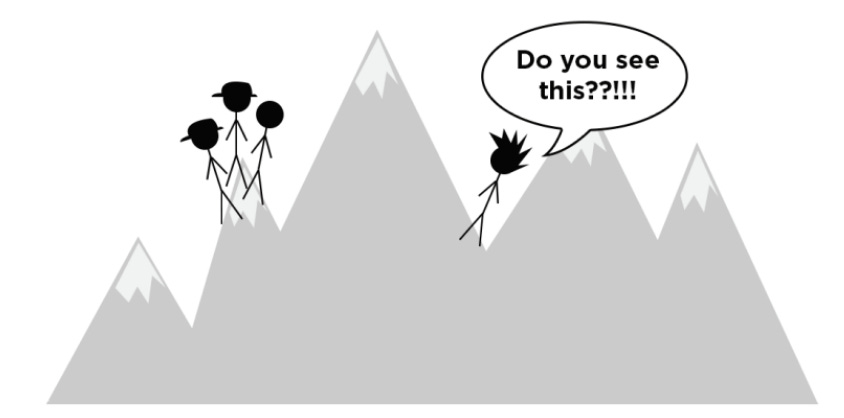
This is why, Miller explained, if you’re trying to make a better insect repellent, you won’t get as much from a focus group full of vacationers as you will by talking to people who live in shantytowns.
“Somebody once said to me, ‘Some days I have to choose between buying insect repellent and buying food. For a day my kids can live off a little bit of rice, but I can’t go a day without insect repellent, because if my kids get dengue, they might die,’” Millar recalled. “That’s somebody who will happily sit for three hours and tell you all of their issues with the current repellents on the market. They can tell you how to make a better one.” That’s somebody you want on your team.
After introducing the G-Corp executives to the dominatrices, he distributed Sharpie markers. He then made the executives kneel in front of the focus group members and draw circles around their blister spots.
This was not comfortable. But that was part of Millar’s point. G-Corp had been in the Inertia Zone for so long that its team needed a push.
They needed to experience an extreme perspective on blisters, Millar said. And who has more to say about the way a blister bandage looks and feels than someone who has to wear complicated, tortuous heels to work, and whose feet are inspected closely by their clients?
The executives got the point. But that was not the end of the focus group. To their surprise, a crew of Special Forces soldiers tromped its way through the doors. That’s because, Millar said, if you asked the question, “Who thinks ten times as much about blisters than a health care executive?” the answer would not be “Random shoppers from the mall.” It would be something like, “A person who has to run ten miles a day through the desert in combat boots.”
Millar’s tactic—bringing in extreme people to focus groups instead of average ones—is a clever way to get cognitive diversity. If we return to Problem Mountain, a dominatrix or Special Forces soldier is someone who looks at the problem of blisters like this:
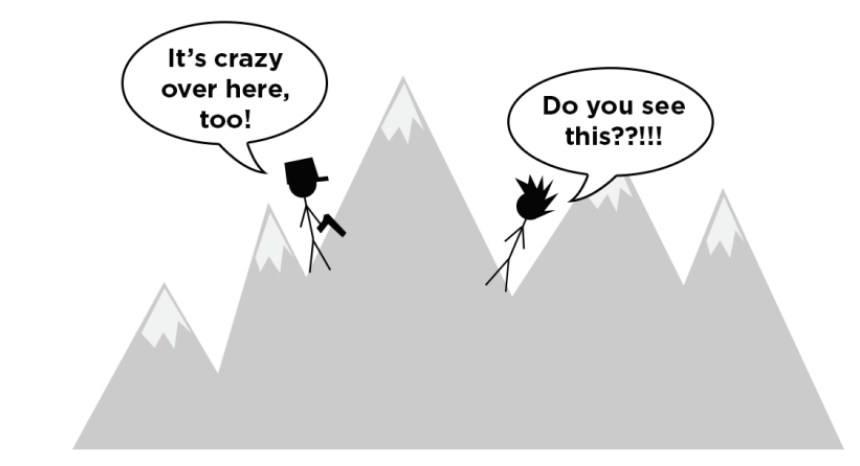
These people had spent more time than anyone exploring the blister mountain range, and thus developed a unique perspective on it. They could see the biggest mountains that the blister makers couldn’t. And to deal with those big mountains, they’d developed heuristics that could give G-Corp’s product designers a path forward.
The soldiers articulated an entire spectrum of type and severity of blister that one can have, depending on how the blister formed and how many days old it was. The dominatrices explained how they would cut and alter blister bandages into shapes that worked with their shoes and fit around the curves of their feet and ankles and still looked good.
G-Corp developed a new line of blister pads of different shapes and thicknesses based on what the dominatrices showed them. They made pads for different blister ages and severities based on what the soldiers taught them.
And it turned out that when you offered these types of blister pads to “average” people, they bought more of them. By tapping into the cognitive diversity of “extreme consumers,” G-Corp managed to find better solutions for regular consumers.
And they started making more sales again.

There’s an important thing we should note about this story. Millar could have interviewed dominatrices and soldiers and summarized their ideas in a report for G-Corp. But he didn’t. He made the executives get on their hands and knees and draw circles around people’s blisters with Sharpies. A key part of his extreme focus group exercise is the theater of having his clients experience them firsthand.
That’s because sometimes being aware of the path up the mountain is not enough. Sometimes we need to be pushed into The Zone, provoked to get off our peak, so we have no choice but to either retreat or make progress. G-Corp was paying Millar, in part, because he was the team member they needed to nudge them out of their comfy chairs. Viscerally.
5.
Blackwell’s Island Insane Asylum wasn’t just cold, Nellie quickly discovered. It was disgusting.
The food was unpalatable: hard black bread with insects, inedible butter, and rotting prunes. The tea tasted like copper.
The nurses were crude and rough. Attendants mocked, slapped, and choked the inmates. They “expectorated tobacco juice” and berated the patients when they weren’t gossiping about the doctors in front of them.
Nellie was locked in a room at night with six women, one who raved and paced all night and several others who seemed perfectly sane.
Nellie tried to tell the doctors that she wasn’t crazy. But the more she tried, the more convinced they were that she was nuts.
“What are you doctors here for?” she inquired.
“To take care of the patients and test their sanity,” an exasperated caretaker replied.
“Very well,” Nellie said. “There are sixteen doctors on this island, and excepting two, I have never seen them pay any attention to the patients. How can a doctor judge a woman’s sanity by merely bidding her good morning and refusing to hear her pleas for release? Even the sick ones know it is useless to say anything, for the answer will be that it is their imagination.”
They told her to shut up.
6.
Dr. Charlan Nemeth of UC Berkeley spent her career studying the science of human influence. Specifically, she’s an expert on how people with minority viewpoints can influence others.
Typically, when a team comes together to make a decision, the majority opinion wins out. But in the 1970s, Nemeth became interested in what kinds of influence people who disagreed with the majority had on group decision making—such as juries deciding whether someone was guilty of a crime or not.
She put together a bunch of experiments to find out. In one, she assembled groups of six people at a time to work on little puzzle-like challenges together. The object was to determine if there was a “hidden figure” inside whatever they were looking at.
What she found was surprising. Groups of people who tended to agree that there was no hidden figure on a given challenge were sometimes correct, and sometimes not. But groups that had one or two people who often disagreed with the majority opinion ended up getting more answers right. Having a naysayer in the group made the rest of the group think harder.
This should remind us of what we saw with our cops of different genders. Having someone with a different perspective helps the rest of the group think more critically. The subtlety that Dr. Nemeth discovered is that the person who thinks differently doesn’t always have to have the right answer for the group to get smarter. She or he just has to be a little difficult.
Nemeth’s experiments went on to show that the presence of a minority viewpoint—at least one person who vocally disagrees with the common perspective—tends to help groups look at issues “on all sides.” Meanwhile, groups that are very similar and have no dissenters tend to look for information “that corroborated the majority view.” In other words, when we are on the same page, we tend to see things that prove that we’re right. When we’re not on the same page, we become more likely to see parts of the picture we’ve missed.
“Dissenting views by a minority of individuals,” Nemeth writes, “stimulate the kinds of thought processes that, on balance, lead to better decisions, better problem solving, and more originality.”
Notice the word choice here. Dissenters stimulate the kinds of thought processes that lead to progress. They shake us. Spur us. They do for inert groups what play does for chaotic groups—move us into The Zone.
We might call this process Provocation:
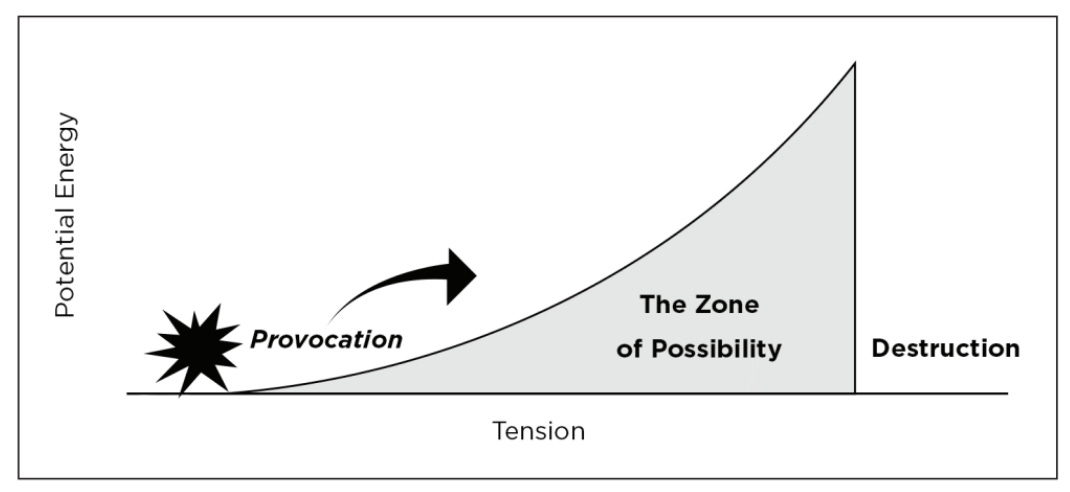
Provocateurs are people who force us out of inertia—like Gilot did to get Picasso out of bed, or Millar did to get the G-Corp execs off their comfortable mountain peak with their blister cushions. Whether it comes from our in-group or out-group, provocation stretches the rubber band.
In 2009, a group of researchers recruited a bunch of sorority and fraternity members from colleges for a study. Frats and sororities are notoriously good at cultivating conformity in their groups. It’s kind of the point. So their members are perfect candidates for experiments involving in-group and out-group interactions, and in this case, what can help a tight-knit in-group break out of its groupthink.
First, the students were given twenty minutes to study a murder mystery. Then, they were placed in groups of three people from their own frat or sorority to decide together who the murderer was. After twenty minutes, each group was joined by a fourth person—either from within their same frat or sorority, or from a different one.
What the researchers found was that having an outsider join the group led to team members feeling less comfortable, more agitated, and less confident in their answers. And it also led them to double their chance of getting the right answer.
The work felt harder when the groups were joined by an outsider. And that was precisely what helped those groups find better solutions.
Provocateurs, in other words, push us off our mountain peak. Sometimes this just makes life difficult. But sometimes it helps us discover that there’s a taller peak just ahead.
7.
Before they sent her to the asylum, the doctors at Bellevue had labeled Nellie “the most peculiar case that ever came into the hospital.”
That may be because she was only pretending to be insane.
“Nellie” was actually a twenty-three-year-old woman named Elizabeth Jane Cochran. To the public, she was Nellie Bly, a reporter for the New York World, run by the venerable Joseph Pulitzer.
For years, Blackwell’s had a reputation for poor conditions, but nobody besides the nurses and inmates had been able to get a close look. Not even city officials knew what was really happening there. And no one was working hard to find a better way to take care of its patients.
After ten days at Blackwell’s Island, Bly had gathered enough firsthand material for a tell-all report. Pulitzer rescued her from the asylum and published her seventeen-chapter exposé, which took over editions of the New York World.
“The insane asylum on Blackwell’s Island is a human rat-trap,” Bly summarized. “It is easy to get in, but once there it is impossible to get out.”
Some 1,600 women occupied Blackwell’s Island Asylum, and many of them were not crazy, she revealed. For example, one woman had been suffering from an illness that made her hair fall out. She was committed for not much more than her unusual appearance. Another woman, who spoke only German, was there because a doctor simply hadn’t been able to communicate with her. Another woman had been locked up after having gotten sick at a breakfast. And hundreds had been locked up just for disagreeing with the men in their lives.
The nurses were unqualified. (One reported the temperature of an inmate to be 150 degrees!) The doctors flirted inappropriately. And until Nellie Bly, hardly anybody gave Blackwell’s or the mental health system a thought.
The system was a “success” in the public’s eyes.
That’s why Bly’s series shook New York City Hall so hard. The severe condition of the asylum underscored the need for funding and reform at every stage of the mental health care system. Bly’s story was an act of investigative journalism—a practice she helped pioneer—that proved to be the provocation the city needed to take a fresh look at things. It resulted in a grand jury hearing, after which New York City apportioned $1 million to fixing Blackwell’s Asylum. Not long after, the whole asylum system was replaced with a more humane and effective national mental hospital program.
The doctors at Blackwell’s were ashamed and furious when Bly’s report came out. But it was too late. The public—and the government—had been pushed out of bed. Whether they wanted to or not, they now saw mental health care from a new perspective. The only reasonable thing to do now was to search for a better mountain peak.

If it had been up to Blackwell’s, Bly would have been punished for sneaking into the asylum and exposing them. They would blame her instead of seeing what they needed to see from her. Fortunately, the government had established a process for allowing provocateurs like Bly to help with civic progress in this way: through the US Constitution’s right to a free press.
In America, the press is often referred to as the fourth branch of government. When the founders set up the executive, judicial, and legislative branches as the team that makes up the government, they created explicit protection for the press in the First Amendment of the Bill of Rights—because they knew that the press would be an essential teammate for a functioning democracy.
Investigative journalism’s goal, as the saying now goes, is provocation in a nutshell: to “comfort the afflicted, and afflict the comfortable.” It shows us perspectives that we don’t see so we can break out of inertia. Provocation like this can indeed be uncomfortable, but it’s an important piece of how the American republic has fought off corruption and made progress in many areas where other free nations have not.
The American founders had the foresight to set their team up this way. I’d dare say this is how we ought to think about setting up any good team. Continuous progress depends on leaders making it safe for provocateurs to make waves, for whistle-blowers to raise their hands, and for dissenters to speak up when needed.
Provocation prods an inert group into The Zone. It helps us to stretch the rubber band. This means that, contrary to our instinct, the collaborator who provokes or contradicts us is our ally. As Dr. Nemeth puts it, “One must learn not only to respect and tolerate dissent, but to ‘welcome’ it.”
There are a few ways to do this. We can “cast” team members who will push us to think or work harder than we would otherwise, like Gilot did to Picasso, or Coach Tikhonov did to the Russian Five. We can also invite outsiders with extreme perspectives to show us things we won’t be able to unsee afterward—like Brian Millar did with the G-Corp folks. And we can bring dissenters into our fold with the explicit instruction to tell us what’s up, like the US founders set up with the free press.
Once we start thinking of provocation as helpful, it changes the way we deal with it. In 2016, the Pentagon made a good example of itself in this regard. Though the Pentagon boasts to have the best computer security in the world, it did something many organizations would never dream of. It invited a group of hackers to try to poke holes in its systems.
The hackers, recruited by the company HackerOne, found the first security hole in thirteen minutes. They found 138 vulnerabilities in all.
“It proved to the skeptics who believed hackers are dangerous, childish, and intentional lawbreakers,” said Department of Defense agent Lisa Wiswell, that instead, hackers can be “extremely helpful.” By inviting provocateurs in, the Pentagon was able to build a better computer system. The project led the US Army to hire HackerOne hackers to do the same. “Take your best shot,” Secretary of the Army Eric Fanning told them when the project started.
Legendary civil rights leader Bayard Rustin, the man behind the 1963 March on Washington, once declared, “We need, in every community, a group of angelic troublemakers.” He was right. We need the dissenters, the whistle-blowers, the critics, and the extreme perspectives to help us get us out of inertia and into The Zone—and we need leaders who make it safe for them to do it.
This is how we make progress when we’re stuck.
But how far does this idea go? What about people who are mentally ill? Can teams benefit from including people who aren’t just pretending to be insane? Or people whose ideas are actually crazy?
It turned out that I was about to see for myself.
Stay tuned for the next free chapter of Dream Teams next month!
Make a great day—
Shane
P.S. If you’re enjoying Dream Teams, check out the book and my Dream Teams keynote videos here »
I love your examples - you need those people who shake things up. I wrote about team bonding recently. Looking to your next chapters. https://theleadwellcollective.substack.com/p/the-fast-bond?r=850skx&utm_medium=ios