



When is “difference” not useful to a team? If you’ve been reading along, you’ve seen how mathematical proofs back up what great stories in history show us: only by combining DIFFERENT ingredients can we exceed the sum of our parts. In this next chapter, we explore the question of when is it NOT worthwhile to seek out diversity, or to pursue a different perspective? The answer, I think, will surprise you.
If you missed the previous chapters, read them here:
Chapter 3: Chrysler, Wu Tang & The Subtle Art of Productive Conflict
Chapter 4: Depressurizing “Teams”—or—How Soccer Curbs Religious Hate
P.S. Though my latest work revolves around adaptation and managing change, I still frequently keynote about Dream Teams at conferences and leadership offsites. If you know a group that could use this message, learn more here.
Chapter Five: The Black Square
“His best friend is his clever but lazy dog that has the bad habit of urinating on Patrik’s rug.”
1.
Mark Tigan, civil servant of the village of Winooski, Vermont, was thirty-two years old when the president of the United States called to shut him down.
This was 1979. Tigan was a bit of a wunderkind in the field of small-town city planning. Having graduated as one of the nation’s first environmental studies majors at San Jose State, he’d developed a reputation for his enthusiasm for community projects. He’d even been on national television, in a Walter Cronkite report showing him burying automobiles to protest carbon emissions. Now he’d been put in charge of Winooski’s staff of city planners to try to boost its struggling economy.
With a population of seven thousand, Winooski was a blip on the map. The town was nestled in the shadow of its across-the-river neighbor, Burlington, which, though beautiful and known for its recently launched ice cream brand, Ben & Jerry’s, wasn’t very big, either. Burlington was the smallest city in any US state that was also that state’s biggest city.
Anyway. Nobody knew that Winooski existed until after the night Tigan and his staff got drunk.
Winooski was cold. Temperatures regularly reached twenty below. Its downtown area had just a couple of bars and a restaurant called Winooski Restaurant. These sat next to a handful of abandoned mills and factories from New England’s proud, lost industrial days.
The world outside was facing an industrial crisis of its own. Iran was in the middle of a revolution, with its shah having fled and massive protests and strikes slashing its oil refinery production. Global oil prices had doubled in less than a year. American gas stations had long lines. And the cost to heat Winooski had risen to $4 million a year—$14.2 million in 2017 dollars. By one calculation, heat for a family of three would cost more than $500 a month in 2017 money.
Burlington had just put in a request for government funds to build a hydroelectric plant along the river to help reduce its own heating bill. This plan, however, would leave Winooski’s creek bed dry. “Basically, ruin our downtown,” Tigan told me. With already high unemployment and declining commerce, Winooski might be done for.
It was amid this turmoil that Tigan took his staff out for a drink and a chat. How could the city-planning office pitch in to help their struggling town? One bottle of wine turned into two. Someone complained about the temperature. Someone else mentioned wishing they could “put a lid” on Winooski to keep the heat in. And that’s when Tigan came up with the bad idea of a lifetime.
“What if we built a dome over the city?”
Everyone was tipsy by then. They all thought it was a good plan.
A week later, Tigan left for Washington, DC, on business. On the way, he stayed the night in Baltimore. There he told his dome idea to a buddy who worked as a liaison between Congress and the Department of Housing and Urban Development. “You know . . . ,” his friend said. “The assistant secretary, Bob Embry, loves domes.” Dome houses had become briefly popular during the ’60s and ’70s for their energy efficiency and structural integrity. Though they were funny-looking, it was easier to heat a dome than a rectangular home and hard for an earthquake to knock one down. By this time, however, dome fever had faded alongside tie-dye and Pet Rocks, except among a few diehards. Embry was apparently one of them.
As fate would have it, Tigan’s friend was supposed to carpool with Embry and two other HUD people to Washington the next day. “I’ll call and cancel,” he said. “You take my spot.”
During the carpool, Tigan pitched Assistant Secretary Embry his idea to save oil costs by putting Winooski under a big, clear dome. They could make it with air locks for cars to enter—like a space station—and lower heating expenses like crazy. The frigid town could grow tomatoes all year-round.
Embry was the exact right person to say this to. He turned around from the front seat. “If you propose that, I’ll fund it,” he declared, according to Tigan. “I have discretionary funding.”
Tigan delivered the news to his flabbergasted staff. They eagerly put together a report and proposal.
Winooski’s mayor asked, “Are you nuts?” But when Tigan explained that this could mean millions in HUD funding, the city council signed on.
The dome story blew up. The day after the Burlington newspaper wrote about that council meeting, three television trucks showed up to Winooski City Hall. National newspapers followed. Time magazine called for an interview.
The Vermonters had few answers for the inevitable questions. They made up specifics on the fly. How high would it be? “Uh . . . two hundred fifty feet!” What about automobile exhaust? “We’ll have electric cars or monorails inside!”
Bags of mail started arriving from dome weirdos. An International Dome Symposium was scheduled in Winooski, where the famous crackpot inventor R. Buckminster Fuller would give a keynote.
Nobody had built a dome this big before. Nobody knew what it would be made out of. Would it have giant support struts? Would the town be pressurized like a balloon to hold it up? What if the dome deflated and fell on everyone? How was the city going to justify annexing the land surrounding of the town that would be needed for the dome walls?
It soon became clear that building and maintaining a dome large enough to fit Winooski, engineered to keep the heat in and not kill everyone, would probably cost a lot more than the heating bill savings it would generate. Plus it would, you know, ruin the view.
National newspapers wrote about what a bad idea the dome was. David Letterman mocked it on his show. There was even a song made about it, “Dome over Winooski,” making fun of the plan:
Dome over Winooski
Not far from the lake
Transparent and lasting
Still real and not fake.
Dome over Winooski
So fair and so true
Has anyone asked you
What’s cooking with you?
“The research money might give one guy a job,” said Hank Tetreault, co-owner of Winooski Restaurant, to the Christian Science Monitor. “Maybe he will eat here.”
The Winooski Dome soon became one of the top news stories in Saudi Arabia. Some in the Middle East started to panic about how America was putting cities under domes in order to stick it to the oil industry.
That’s around the time HUD assistant secretary Embry’s phone rang.
“What the hell are you doing?”
It was President Carter. He was running a tough election campaign against Ronald Reagan. International ridicule about the federal government paying millions to cover towns in Vermont with domes was not helping. The conversation, according to Tigan, ended with a presidential order: “You’ve got to pull this.”
2.
We’ve been talking about the power of cognitive diversity for half a book now. In the last chapter we discussed how provocation, dissenting viewpoints, and “angelic troublemakers” are often what we need to get a team thinking critically again. But the Winooski Dome story reminds us of an important reality: some “different” ideas, frankly, are quite bad.
“The more perspectives we collectively possess, the better our chances” of making a breakthrough together, points out our friend Dr. Page from earlier. But, he adds, “just because someone brings a different perspective doesn’t mean that it will lead to a better solution.”
Any perspective—even one that might seem crazy—has the potential to be useful under the right circumstances. But that doesn’t mean that it will be. So the question we’re going to explore in this chapter is: How can a team or its leaders discern when it should seriously consider a different way of thinking, and when it’s a waste of time?
After all, a city covered by a geodesic dome was a good idea somewhere. That place just happened to be Mars.
The perspective of a young activist who’d had a few drinks was unfortunately not one that could help cold old Winooski with its heat trouble and battle over its river. Thirty-two-year-old eco-warrior Mark Tigan’s cognitive diversity was just a little too far-out to be of any use.
Or was it?
3.
After tromping through Moscow’s streets for a bit more than an hour, I’d finally gotten out of the dreary March drizzle and into the massive Tretyakov Gallery, one of the biggest art museums in the world.
I was standing in one of its vaulted rooms, looking at another dumb idea.
This one was possibly even more expensive than Mark Tigan’s dome. Though it was much smaller.
As a member of the creative industry, I believed in the power of art to convey meaning and ideas. And I could appreciate that some things we create are simply about beauty for beauty’s sake. But even I had to admit that some art was hard to find something good to say about.
Case in point: the 79.5-centimeter-square painting that I had just traversed Moscow to see.
My problem with this particular painting was that it somehow managed to be one of art critics’ favorites, while at the same time regular people seemed to think it was ridiculous. Even my friends with fine arts degrees in New York could find little to say about it other than it was “famous” and “old.”
On the other hand, scholars like Phillip Shaw of the Tate Modern said things like this:
“The experience of viewing the painting involves a feeling of pain brought about by the breakdown of representation followed by a powerful sense of relief, even elation, at the thought that the formless or massive can nevertheless be grasped as a mode of reason.”
New Yorker writer Peter Schjeldahl called the painter’s touch, “ineffable sweetness.” He said, without irony, that the art was made with “a shudder of the sublime.”
Meanwhile, people on the Internet said things like, “I could have done that in kindergarten.”
The hype around this painting confused me so thoroughly that I’d gone through the hoops of getting a Russian visa to check it out. In the interest of open-mindedness, I’d decided that perhaps seeing the painting in person would help me understand.
And so, I braved winter, customs, and possible future invitations to join President Donald Trump’s cabinet (this joke will surely expire at some point!), to investigate.
Tretyakov Gallery has several buildings and thousands of paintings. There are meticulous landscapes and still lifes so realistic that I sometimes mistook them for photographs. Oil paintings of every boat, animal, and historical figure ever produced by Russia. A family of bears playing in the woods. Knights on horses. Dead knights after battles. And a hundred gorgeous, gold-foil, Renaissance-era Jesuses. There’s even a portrait of a Russian John Goodman with a white corsage, hanging next to a Russian Zach Galifianakis in a vest lounging on a red-and-white-striped beanbag.
Somewhere in Building 4 I turned a corner, and there it was in the center of a cavernous room.
I sat in front of it for an hour.
While soaking it in, I noticed something. Most of the museumgoers who came in ignored the painting. An elderly couple holding hands hesitated in front of it, then walked on. Two young lovers took photos of each other in front of every other painting in the room, but decided not to with this one. A portly gentleman beelined past it toward a couple paintings of young women.
Clearly, the visitors that day experienced neither shudder nor sweetness from Russia’s most infamous painting.
Perhaps that’s because the painting is just a big, black square.
That’s it.
Seriously. A black square. Nothing else. Just, you know, black paint. Painted in a square.
It’s not even that big, to be honest. It’s like one of those old televisions where the screen is fifteen inches and the wooden box around it is twenty-six.
I took a video on my phone as a dark-haired teenager in a turquoise top looked at the painting’s title plaque, which said—wait for it—Black Square. She made a face that said, “What?,” and moved on some more exciting paintings, which was all of them.
Her reaction was a much simpler way of putting another part of Mr. Shaw’s outrageous review: “The failure of the black square to represent this transcendent realm serves ‘negatively’ to exhibit the ‘higher’ faculty of reason, a faculty that exists independent of nature.”
In other words, the point of the Black Square is, literally, nothing.
On the way to Moscow, I’d picked up a book about the Black Square at London’s Royal Academy of Arts—with the appropriately snobby subtitle, The Climax of Disclosure—in the hopes of finding some sort of explanation for this painting of nothing. That’s when I decided that its creator, Kazimir Malevich, was out of his mind.
He was born in Ukraine in 1878 to poor parents and made his way to Moscow to seek his fortune as an artist. After dabbling in Impressionism he started painting faceless people and getting bizarrely spiritual about it.
“What we call Reality is infinity without weight, measure, time or space, absolute or relative, never traced to become a form,” he wrote, around 1920. “It can be neither represented nor comprehended.”
The stuff he said got more bizarre—and detailed—over the years. Here’s another example:
“Stimulus is a cosmic flame that lives in what is non-objective: only in the skull of thought does it become cool in real concepts of its immeasurableness; and thought, as a certain degree in the action of stimulus, white-hot in its flame, moves deeper and deeper into the infinite, creating its path worlds of the universe.”
Reality isn’t real. Cosmic flames stimulate the universe. Got it.
Malevich eventually tried to start a spiritual art movement called suprematism. The idea was to find “the zero point of painting.” The very edge of the artistic spectrum, beyond which nothing else existed.
The Black Square was his master work. It was, he claimed, the point where art ended. Anyone who continued beyond would fall off a cliff, like those old maps when the world was still flat. There was no art that said “nothing” better than the Black Square.
New Yorker writer Tatyana Tolstaya called this “one of the most frightening events in art in all of its history of existence.”
It wasn’t frightening, though. It was a quadrilateral.
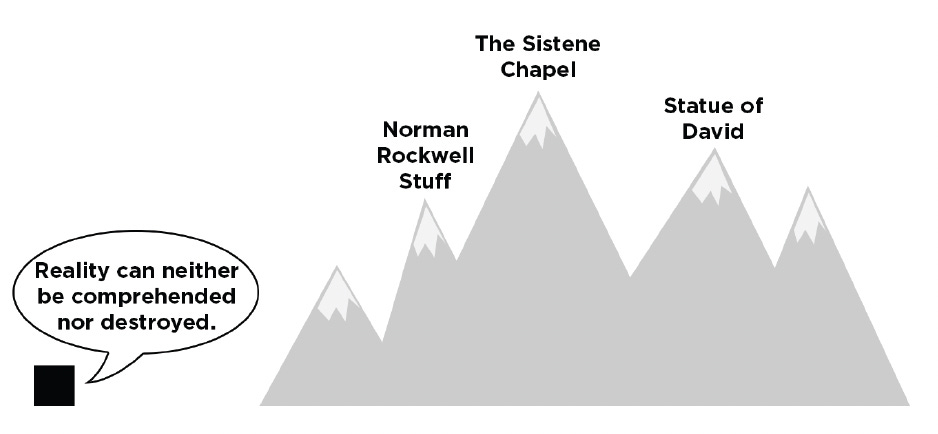
If the purpose of art was to be as beautiful as possible, I had just found a very low point on the mountain range. If the purpose of art was to communicate ideas, the Black Square is one of the most exotic perspectives I can think of. It was off the range. To an average person with an average perspective on art, the mountain diagram of Malevich’s work might look like this:
Of course, some art serves as more provocation than anything; it encourages us to do important things. It was a statue of Alexander the Great that inspired Julius Caesar to elevate his ambitions, after all.
But Black Square did none of this for me. Why would people revere this thing so much?
And, you may be asking yourself at this point, what role could a guy like Malevich possibly play in our exploration of Dream Teams?
4.
I returned to the Black Square in Tretyakov Gallery for another look.
It didn’t help. The Black Square was still a black square.
But after watching a few people ignore it, a college student with a punk rock haircut exuberantly walked up and took a photo of it.
“Do you like it?” I asked her.
“Of course!” she replied in a thick Russian accent.
“You are the first person I have seen be interested in this painting,” I told her.
She smiled. “That is because I know the story.”
5.
In the old days, we judged visual art by how realistic it was. Its purpose was to portray reality—to capture it like the cameras and printers that didn’t yet exist. Artists were commissioned by kings and wealthy patrons to make paintings and sculptures of beautiful things, using whatever materials they could come up with.
Even as technology developed, this idea persisted. Lithograph artists and printers were deemed good and effective if their output looked realistic. And though some artists eventually started exploring distortions of reality—art like Picasso’s that took life and twisted it to emphasize one thing or another—they were all judged by their ability to portray reality and beauty.
At a certain point, however, our idea of visual art’s value shifted. In the 1920s, the Bauhaus school in Germany became famous for its pioneering influence on what we know today as “graphic design,” which in turn has influenced everything from advertising to the apps in our pockets. Graphic design is about more than portrayal; it is “visual communication.” It has become an artistic language that helps us convey messages and persuade people in ways that words alone don’t. Without graphic design we wouldn’t have websites, movie posters, or Adventure Time GIFs.
And what many modern website users, movie watchers, and Finn and Jake fans don’t know is that the school that helped create this new artistic language owes its origins to the Communists.
Two years before Bauhaus launched, Vladimir Lenin and the Bolsheviks overthrew the Russian government. They were a minority group, and in order to stay in power they needed to persuade the Russian masses of their way of thinking. So they did something clever. They hired local artists to make dramatic, impactful propaganda posters to be spread throughout Russian cities.
Many of these artists happened to belong to a new group called constructivists. They favored bold shapes and colors—mostly black and red—and symbolism over realistic portraits. A lot of it looks like cutouts of construction paper arranged on top of each other.
For example, one of the leading propaganda artists, Lazar “El” Lissitzky, created a constructivist poster of a big red triangle breaking into a white circle, called “Beat the Whites with the Red Wedge,” to symbolize socialism defeating anti-communists. Lenin’s followers spread this sort of thing everywhere. It wasn’t “art” in the sense that people were used to, but it got the Bolsheviks’ message across, powerfully.
Lissitzky had an unusual perspective on art for his time; he believed that it could serve as the vehicle for a message. And that meant art could be detached from reality and still be valuable, perhaps even more valuable than just a pretty picture. “The space must be a kind of showcase, a stage, on which the pictures make their appearance as actors in a drama (or comedy),” Lissitzky explained. “It should not imitate a living space.”
The propaganda campaigns of constructivist-based art were extremely effective. Communism solidified, despite its initial minority support. But after it did so, Russia’s leadership began to see artists and their ability to persuade as a threat to its control. It clamped down on the art community, and many of Lissitzky’s colleagues began fleeing to Europe.
“The artists went west because of Stalin,” a curator explained to me at Tretyakov. Russian art was already heavily influencing Bauhaus and other places, but after communism won and Stalin began bulldozing art that he didn’t like, she said, “The Russian avant-garde became European art culture.”
Obviously, many things have influenced the history of graphic design. But crudely, we can say that modern graphic design came through Bauhaus, which was inspired by Russian constructivism, which was pioneered by El Lissitzky.
And why is that important? Because it turns out that El Lissitzky was the prize student of Kazimir Malevich.
Whereas Malevich’s spiritual search for the “zero point of art” resulted in some not very pretty paintings, it opened the door for people like Lissitzky to use art in a new way. As the Tretyakov Gallery explains, “Suprematism totally released painting from its function of portrayal.” Lissitzky passed through this door and made something exciting.

To most people, the Black Square itself wasn’t more than a black square. But between that square of nothing and what the rest of the world called art, we discovered a mountain peak nobody had ever seen.
Black Square, in other words, was useful after all. It expanded the art world’s range of possibilities.

The story of the Black Square teaches us something counterintuitive about cognitive diversity. It teaches us that sometimes bad ideas can be useful, if anything, because a bad idea can be very good at pointing us in a new direction.
The scientific term for this is “error-allowing heuristics.” The idea, as our friend Dr. Page explains, is that “sometimes, a new solution of lower value can point the way to a better solution.”
This is important enough to say twice. Sometimes a solution of lower value can point the way to a better solution.
There’s a subtlety to this idea that’s also important. You’ll remember that in our chapter about provocateurs, we discovered how certain collaborators can force us into The Zone when we’re stuck. The Black Square did not exactly do this. Nobody was provoked to meaningful action because of Malevich’s fringe suprematism thing. Many people didn’t like it. But Black Square didn’t force anyone’s hand.
Instead, it was when someone willingly paid attention to Malevich’s crazy ideas that new possibilities opened up and progress was made.
Do you see the difference? Provocation spurs us to action; it shows us something we can’t unsee. We might call what happened with Lissitzky and Malevich Cognitive Expansion. It happens when we look beyond our normal frame and decide to consider new perspectives and heuristics in our process. It happens when we are curious.
In essence, cognitive expansion happens when we add cognitively diverse people to our team and pay attention to them. And it turns out that the more divergent our perspectives, the more potentially interesting the mountain range between us.
We might say that Malevich was an important member of the “team” that created graphic design, even though his ideas were bizarre and not very useful on their own. Lissitzky was curious to seriously explore Malevich’s thinking. And this made all the difference.
Some people surely thought that Coach Tarasov was unusual for making his young hockey players learn dance and karate moves. And perhaps he was. But the Red Army invented a new way of playing the game because of it. He developed a culture of curiosity on his team—where everyone looked around the world for anything that could help them with hockey.
“Curiosity in a way [is] where some situation presents itself to you and it just doesn’t make any sense,” Keith Yamashita tells us. By definition it’s a willingness to explore things that might not be useful. But curiosity is considered a virtue because this act of explorations is often useful regardless.
A series of research studies from University of Leuven in Belgium shows us just how far this idea can stretch.
The Belgian researchers organized several group brainstorming sessions, with eight people each. Participants were put in rooms together and asked to come up with ideas for either mobile phone games or for a mobile payment app. They were then guided through the brainstorming activity by a moderator, who told them to write down, discuss, and sketch out as many good ideas as they could come up with.
Then came the twist. In the different sessions, the researchers added in various “inspirational material” to get things going. Sometimes the inspiration was straightforward, like an idea for a prepaid credit card to use with the app. The researchers would show this idea to the group as an example, then ask them to come up with more ideas.
Other times, the researchers showed the group bad ideas. One was a bracelet that physically injures you if you spend too much money on the mobile app. This was not an idea that would ever get approved by a company—or a court of law.
Other times, the researchers included wacky characters in the group exercise. One, for example, was a washed-up actor named “Patrik” who had been abandoned by his wife and kids. “His best friend is his clever, but lazy dog that has the bad habit of urinating on Patrik’s rug,” the researchers explained. “Patrik currently has a part-time job as private detective, providing him the income he needs to buy cheap cigars and brandy.”
Here’s the surprising thing. Remember how we mentioned earlier that brainstorming groups almost always produce worse ideas than their individual members will alone? Well, when the brainstorm groups in the Belgium study were given bad ideas like the injury bracelet, or crazy “collaborators” like Patrik, they came up with better ideas than they would have otherwise—together or alone.
Like the Black Square, the bad ideas helped point them toward ideas that they wouldn’t have considered otherwise.
In our Provocation chapter, we learned about Dr. Charlan Nemeth’s work on how dissent helps groups think harder about problems together. Groups with direct idea conflict are more or less forced to think more critically, to confront their issues.
But her research goes further than that. In various studies, she’s been able to show that adding ideas and viewpoints that obviously won’t work to a group’s deliberation process tends to lead to better ideas, too. “The benefits of minority viewpoints do not depend on the ‘truth’ of the minority position,” she writes.
Whether Malevich’s spiritual suprematism thing is real or not doesn’t matter if the process of considering it leads us to invent the field of graphic design.
Another key reason the Belgian studies with Patrik worked so well has to do with organizational silence. Often we have ideas in our brains that we consciously or subconsciously suppress because they fall outside what our group might deem normal. The brainstorm exercises that inject bad ideas, in a nutshell, increase the odds that we’ll break our silence with an idea that would normally feel unsafe to express, because someone has already expressed something even farther out.
This should remind us a bit of what we learned about our female police officers. If you recall, we saw that the perspective of a police officer who is not in the majority—in the case of an all-male squad, an officer who is not a man—is often useful to a group that has been solving problems the same way for a long time. What Nemeth’s research shows is that even if a minority perspective happens to be wrong, it can still help the group find better ideas as long as the group is willing to pay attention.
And this is the lesson, it turns out, all those news trucks would have learned if they had stuck around Winooski a little bit longer.
6.
The last thing the world heard about Winooski after President Carter ordered the kibosh on Mark Tigan’s dome . . . was nothing.
The news correspondents drove back home. The bags of mail from dome lovers stopped coming. The First International Dome Symposium became the last International Dome Symposium. The only thing left of the Winooski Dome was the occasional aside in a magazine story or blog post saying, “Remember the time those crazy Vermonters wanted to build that crazy dome?”
But it turns out that when we dig a little deeper, we learn something even crazier:
That dome that was never built helped save Winooski.
When HUD assistant secretary Embry called Tigan to relay the bad news that the dome was through, he called with another proposal.
“We can’t give you the grant for the dome,” Embry told him. But he knew about Burlington’s proposal to build a hydroelectric plant on the river. What if he gave some federal funding to Winooski to build a hydro plant on a different part of the river that could power the area without ruining Winooski’s downtown?
The enthusiasm around the dome—inventors and politicians flying in to talk about it—had ignited the town and its supporters, key of among them Embry. “It demonstrated that we’re willing to try things outside the box,” Tigan said. With his dome, Tigan was looking at Winooski’s challenges from far outside the normal range of solutions on Problem Mountain. He was so far out, in fact, that when people looked his direction—when they started considering his far-fetched plan—it became easier for them to consider other mountain peaks hiding in the fog, from a hydroelectric plant downstream to various other projects. The dome had sparked their curiosity.
“Maybe it’s not a vision of the dome, but it’s a vision that these mills could be rehabbed. It’s a vision that we could fill an industrial park,” Tigan said. Ideas that had before gone unconsidered were not so easily dismissed anymore. “All of the sudden we were sledding downhill.”
They built the hydroelectric plant, which helped Winooski save on its heating costs without ruining downtown or causing a war with Burlington. They used some of the HUD funding to convert the old factories into energy-efficient office spaces that helped attract local businesses to the town. Tigan took a bus full of townspeople up to Montreal to tell small businesses there about how great and inexpensive the new Winooski was and convinced several to open up shop there.
Even though the dome was a rather extreme—we might even say awful—idea, it ended up being useful after all. Considering such a radical idea opened Winooski and its supporters (like HUD) up to considering more workable solutions to its problems that might not have happened otherwise.
Over the course of the next couple years, unemployment in Winooski went from 15 percent to 7 percent.
And when Mark Tigan left in 1982 for his next job in Santa Monica, Winooski named a street after him.
7.
Allegedly, when Albert Einstein was asked the difference between him and the average person, he replied that the average person would stop searching for a needle in a haystack once she or he found one. Einstein, on the other hand, would keep looking through the entire haystack for all possible needles.
On the face of it, this seems like a waste of time. Why would someone ever do that? And yet, as Einstein kept marching relentlessly up and down the Problem Mountain of physics, he found a combination of perspectives that gave us the groundbreaking theory of relativity—and more.
It’s often hard to recognize great perspectives even when they’re in front of us, because genius and insanity often look so alike. The record companies, for example, initially rejected the Beatles amid the slew of other musicians vying for their attention. The telephone, radio, automobile, and television were each dismissed as dumb ideas by the investors of their days. Many of our most successful modern companies—from Apple to Airbnb—seemed like bad ideas in the beginning.
This leads us to back to the question we started this chapter with: How do we sort useful cognitive diversity from the useless without accidentally discounting the Einsteins, the Beatles, and the other voices we need to become better?
And as we’ve learned, it turns out that that’s the wrong question! The lesson is that Dream Teams don’t try to figure out which perspectives to ignore. They realize that if they are going to maximize the chances of making progress, the important thing is to not ignore any perspective, no matter how weird it seems.

Mark Tigan still likes radical ideas. He spent his career using them to get stuffy city council members to stretch their minds.
Like Soviet national team captain Valery Vasiliev—who blurred many lines on the hockey rink, doing things like getting purposely ejected from games while taking out opposing players—Tigan played at the margins of the “rules” or conventions of his profession. And this helped him to expand the possibilities for the teams he worked with.
With Tigan’s help, Winooski ended up securing the second-most federal funding per capita of any town in America at the time. After Winooski, Tigan went on to redevelop Santa Monica’s waterfront and build a famous shopping mall. Eventually he became one of the most successful community planners in America, and HUD hired him to write its books on economic development.
When I called him up in his late sixties, he was teaching college in Massachusetts. He told me that he was still convinced that Winooski could have gotten some version of his dome to work. But more important, he said, was that they considered it. That’s been his philosophy ever since. “There will be mistakes,” he said. “We’ll go down some wrong alleys, but I have a stomach for it, and if the organization does, too, then we’ll get something done.”
Seemingly bad ideas like the Black Square or the Winooski Dome aren’t always going to end up pointing us toward useful things. But Malevich and Tigan show us just how important it is for us to seriously consider perspectives outside of our norm. That’s how regular teams become Dream Teams.
Now the question is, how do we get wild cards like them—or anyone, for that matter—to join our teams in the first place?
Stay tuned for the next free chapter of Dream Teams next month!
Make a great day—
Shane
P.S. If you’re enjoying Dream Teams, check out the book and my Dream Teams keynote videos here »