


Welcome to The Snow Report, and happy Q4 Eve. I propose we make this a holiday and take the day off from now on. In today’s report, we dig into the science of Intellectual Humility—or how humans can change their hardcoded viewpoints.
If you missed the previous chapters, read them here:
Chapter 3: Chrysler, Wu Tang & The Subtle Art of Productive Conflict
Chapter 4: Depressurizing “Teams”—or—How Soccer Curbs Religious Hate
Chapter 6: When Is Different Too Different? (The Tale Of The Black Square)
Chapter 7: Welcome To Pirateland (How Diversity Saved America In 1814)
P.S. Though my latest work revolves around adaptation and managing change, I still frequently keynote about Dream Teams at conferences and leadership offsites. If you know a group that could use this message, learn more here.
How Malcolm Changed His Mind
On Balance Theory, and The Science Of Intellectual Humility
1.
Four-year-old Malcolm Little’s earliest memory was of white supremacists burning down his house.
It was 1929. The Ku Klux Klan had recently broken the windows of his parents’ home in Lansing, Michigan, threatening worse if the family didn’t move out of the neighborhood. They hadn’t moved. But now they did.
Instead of searching for the arsonist, the local police locked Little’s father up “in case” he was the one who did it. They had nothing that resembled evidence, so the judge let him out.
Not long after, Little’s father was run over by a streetcar. The police ruled his death an accident. The locals, on the other hand, said a KKK member pushed him.
His mom couldn’t afford to feed all seven children now that Dad was gone. She cracked. By the time Little was a teenager she was living in a mental hospital.
He told his school teachers that he wanted to be a lawyer. But racism stood in the way of that one, too. “You’ve got to be realistic about being a n****er,” his English teacher told him. “A lawyer—that’s no realistic goal. Why don’t you plan on carpentry?”
Angry, Little dropped out of school. He went to live with his half sister in Boston, a woman who had faced several criminal prosecutions. She, too, soon ended up in a mental hospital.
He started smoking drugs. Then selling drugs. Then stealing to pay for drugs. At age nineteeen, he got caught trying to fence a watch. Little went to trial for burglary.
By the time his white girlfriend sold him out from the witness box—and the judge gave him the maximum sentence because, as the prosecution put it, “you had no business with white girls”—Little decided that he hated white people. He had six to eight years to let that hate fester from inside a federal prison.
Little was surly and uncooperative for his first year in the joint. Other inmates gave him the nickname “Satan” for his foul mouth. He smuggled in drugs. When he couldn’t get high the regular way, he snorted nutmeg, which has a cannabis-like effect at high concentration. He was full of hate.
An older inmate named Bembry took Little under his wing, and convinced him that if he got educated, he might get his sentence reduced. Seeing Bembry as a father figure, Little took the advice. He started taking mail-in courses, reading books, and memorizing dictionary words. He started writing letters, and, to the guards’ bemusement, he stopped cursing.
Around this time, Little began a correspondence with the leader of a tiny new religious group. His siblings had recently joined. The group preached a mixed-up new version of Islam. It called for no pork, no booze, no extramarital sex, and other items of strict self-discipline, but mainstream Muslims refused to recognize it because of some of its new ideas and its lack of basic tenets such as believing Muhammad to be the last prophet. But Little had no way of knowing that. He was drawn by the fact that the group’s leader—a man named Elijah Poole—claimed that God had taught him the truth about white people.
Thousands of years ago, Elijah’s story went, everyone in the world had dark skin. Then a disturbed man named Yacub created white people as a sort of primeval science experiment. They were all devils, the leader taught. And so were their descendants today.
At first, Little found this story hard to believe. Whites had cited a similar story for centuries as justification for slavery and racism of black people.
Yet the more Little thought about his interactions with white people so far in his young life, the more he realized that almost every one he had met had treated him badly. He had an epiphany. They were devils.
Little joined the fold and was soon trying to convert other convicts. He began spending all his time studying and debating religion. He got especially good at preaching about the badness of white supremacy and the newfound truth of black supremacy.
When Little got paroled in 1952, he moved to Detroit to become a minister. He’d been reborn. “I don’t think anybody ever got more out of going to prison than I did,” he said. “I have fully awakened.”
With his rebirth, he got rid of the name Little.
He now called himself Malcolm X.
The group’s leader, Elijah, claimed to be the infallible Messenger of Allah. He claimed to have seen God and given the duty of becoming supreme leader of the “Lost-Found Nation of Islam.” Elijah’s Nation required strict obedience and donations from his four hundred followers.
X had developed impressive speaking skills from debating in prison. The history of Yacub was a great attention getter, he learned. But the more he preached, the more he emphasized another message that underpinned the religion, and the growing Black Muslim movement in general: that the black man deserved self-respect.
This message resonated with poor African American males especially. It gave many downtrodden black men hope they desperately deserved.
Unfortunately, the Nation of Islam’s doctrine at the time dovetailed this message with militant violence and a disdain for anyone who preached racial integration. It was also pretty sexist. This put the group at odds with the growing civil rights movement in the Southern United States.
But it gave NOI followers hope nonetheless. X’s sermons for this newfangled brand of Islam soon attracted larger crowds than Messenger Elijah’s.
With this knack for preaching, X helped grow the NOI’s membership by one thousand people in a year. Soon he was attracting one thousand a month. He set up a Boston chapter, then New York and Philadelphia chapters. Before he knew it, he was giving speeches to crowds of four thousand at a time.
Elijah’s bank account grew. He bought a mansion in Chicago, then another in Arizona.
The little church was becoming a full-fledged religion, and also a paramilitary group. Suddenly X was overseeing legions of volunteer enforcers. They trained in karate and would brutally beat members who disobeyed Elijah.
Things were getting a little out of hand. The Nation of Islam wanted their own country, a few states that could break off from the United States. Or ideally some territory in Africa they could run themselves. X preached that the black man should “take matters into his own hands” and use violence against the white government to get that separation. He decried the nonviolent civil rights movement of Dr. Martin Luther King Jr. in the South, accusing King of being a puppet of the white devils. From his pulpit, X called Jews evil, Christians evil, and women weak.
While Dr. King and his colleagues pushed for equality and integration, X and the Nation of Islam pushed for the opposite. They negotiated alliances with the Ku Klux Klan and the American Nazi Party to promote the thing all three groups wanted: to keep blacks and whites far apart from each other. Unlike King and his followers, X did not believe that white people could ever stop hating black people. How could they, after all, if they were literally devils?
As X’s profile grew, he had a series of public debates with Bayard Rustin, a key member of Dr. King’s civil rights team, whom you may recall from our Angelic Troublemakers chapter. X and Rustin represented the edges of two schools of thought among black advocacy groups in the mid-twentieth century struggle for rights. On the left were liberal types who argued for racial integration and even socialism—Rustin being on the fringe of this as a former communist. On the right were conservative types who argued for black business ownership and independent communities—the fringe of which advocated for a separate nation for black people entirely. The Nation of Islam’s militant point of view on this was so far right, it was almost over the cliff.
In their debates, Rustin argued for nonviolent revolution. X advocated the reverse. “We are not to turn the other cheek,” he said. Instead of joining the famous 1963 March on Washington for civil rights, X denounced it, saying it was a waste of time. Peaceful marches were what the “white man” wanted, he said.
When an airplane crash in Paris killed 121 white people, X called it “a very beautiful thing.” He called President Kennedy “a prison warden,” and American whites who supported racial integration “snakelike.” When Kennedy was assassinated, Little told the press that he had it coming.
Dr. King and other civil rights activists denounced X for this. “The hatred expressed toward whites by Malcolm X is not shared,” King declared. “While there is a great deal of legitimate discontent and righteous indignation in the Negro community, it has never developed into a large-scale hatred.”
Black civil rights leaders backed away from X. White leaders on both sides of the political spectrum were terrified of him. The Nazi Party kept showing up to his rallies to support his separatist agenda. The FBI put him under surveillance. And angry black supremacists kept flocking to the NOI and training in guns and karate.
And then something impossible happened.
X went off the grid for a little while. When he came back, he began talking very differently.
“A man should not be judged by the color of his skin,” Malcolm X declared in an interview, “but rather by his conscious behavior, by his actions.”
What?
His followers were dismayed. Was this a joke? Or perhaps a ploy?
It wasn’t. X clarified himself. “I believe in taking an uncompromising stand against any forms of segregation and discrimination.”
Had the separatist just taken up the integration torch of the civil rights movement? Was he going to join Rustin and King?! That couldn’t be right.
While his fans waited for him to say, “Just kidding!” X kept saying things like, “I believe in a society in which people can live like human beings on the basis of equality.”
People on both sides were shocked. What prompted this? Where was the fiery preacher who’d taught so many to fight white supremacy with black supremacy?
He was gone. X renounced the label “Black Nationalist.” He even started saying that women in his organization should have an “equal position to men.” He abandoned the Nation of Islam and became a Sunni Muslim. He declared that it would take “Christians, Jews, Buddhists, Hindus, agnostics, and even atheists . . . to make the Human Family.” If we wanted to make a better world for oppressed black people, he said, we all needed to work together as a team.
With this change of heart, X began writing newspaper articles with titles like “Racism: The Cancer That Is Destroying America.” He told the press, “I do not advocate violence.” In another surprising turnaround, he also declared, “Whoever a person wants to love, that’s their business.”
In interviews, X expressed remorse for many of his past views and actions. “Remember the time that white college girl came into the restaurant—the one who wanted to help the Muslims and the whites get together—and I told her there wasn’t a ghost of a chance and she went away crying?” he said to a local reporter. “I’ve lived to regret that incident . . . I’m sorry.”
Malcolm X’s transformation was so complete and so upsetting to the NOI leadership that many people were not surprised to hear the news when, on the afternoon of February 21, 1965, a man stood up in the front row of the Audubon Theater in Harlem during X’s speech, and pulled a shotgun out from under his coat.
2.
How does a person change deeply held views despite knowing that it could be the death of him? What prevents so many of us from doing the same with much lower stakes?
This is perhaps the most crucial question in our journey to understand Dream Teams. Teams are made up of individual people, and in order to maximize our chances of those people coming together and making progress in The Zone, we need them to be willing to consider and adapt because of each other’s diverse perspectives and heuristics. We need this kind of flexibility if we’re going to make breakthrough progress together. No matter how well we get along, if we aren’t willing to change our minds when necessary, we may as well work alone.
But what does it take for humans to become open-minded like that?
Philosophy professor Jason Baehr of Loyola Marymount University defines open-mindedness as follows:
“An open-minded person is characteristically (a) willing and (within limits) able (b) to transcend a default cognitive standpoint (c) in order to take up or take seriously the merits of (d) a distinct cognitive standpoint.”
Dr. William Hare, one of the pioneers of research into open-mindedness puts it another way. “It means being critically receptive to alternative possibilities,” he says. “Being willing to think again despite having formed an opinion, and sincerely trying to avoid those conditions and offset those factors which constrain and distort our reflections.”
Open-mindedness is not something a scientist can see by scanning your head. And, as I discovered when I conducted another one of my surveys (which we’ll get to in more detail later), we’re bad judges of how open-minded we actually are. Ninety-eight out of one hundred people claim to be more open-minded than average. By definition, of course, that can’t be true.
For decades, the best thing psychologists had for measuring open-mindedness was a personality test called the Big Five. It asks people a series of questions like “To what extent do you agree with the following statement about yourself: I am always prepared.” Or “I am curious about many different things.” Based on how strongly you agree or disagree with the questions, you get a score for five categories. Agreeableness, Conscientiousness, Extraversion, Neuroticism, and Openness to Experience.
The trouble is that the test questions that determine openness to experience are things like “I have an active imagination,” and “I have excellent ideas.” Open-minded people generally say yes to these things, but so do other people. Openness to experience is about being willing to take in new information, not change our minds about it. Being willing to try a new flavor of ice cream is very different than becoming not racist or reversing course on a business strategy.
Typical personality tests for openness to experience, in other words, don’t explain why Malcolm X changed course. Or why many people never change their minds about anything, from politics to religion to everyday opinions. X was open to debating his ideas with people who were very different from him, like Bayard Rustin. But debating over and over didn’t change Malcolm’s mind. Something else did.
Let’s think about the magnitude of Malcolm’s change of heart for a minute. He went from being a violent, racist fringe preacher to denouncing all three of those things. These—racial supremacy, violent separatism, and belief in the fringe leader Messenger Elijah—were part of his identity. They’re what helped him get through prison and cope with the atrocities that white racists had done to him and his family. They saved his life.
This isn’t a story about trying a new flavor of ice cream. He denounced his defining life philosophy. He went from the violent conservatism of racial separatism to integrationist and peacemaker. He went from disparaging the civil rights movement to becoming an invaluable part of the team.
If the Big Five’s openness to experience isn’t a good measure of that kind of open-mindedness, then what is?
The answer is something psychologists call “intellectual humility.” As they put it, IH is a “nonthreatening awareness of one’s intellectual fallibility.” It’s being willing to change our viewpoint without freaking out—and as of very recently, we can measure it.
As Drs. Elizabeth Krumrei-Mancuso and Stephen Rouse of Pepperdine University put it, “An intellectually humble person is able to find the right balance between dogmatically rejecting the dissenting viewpoints of others and yielding too quickly in the face of intellectual conflict.” In 2016, Krumrei-Mancuso and Rouse published an assessment for IH that proved to be a breakthrough.
It turns out that ranking high on their IH test is associated with a whole bunch of open-minded things. Openness to revising one’s important opinions, curiosity, tolerance for ambiguity, low dogmatism, lower judgment of others based on their religious beliefs, less likelihood to demonize others for changing their attitudes, and being better able to detect the validity of persuasive arguments.
Basically, it’s the ability to keep one’s own brain in The Zone.
This is exciting stuff. Tolerance for ambiguity. Lower judgment of others. Intellectual Humility isn’t just the ability to change. It makes one more likely to correctly judge when it is time to change.
So now that we have an idea of how to measure open-mindedness, the big question is how do we get more of it?
3.
In the Bible, a militant religious enforcer named Saul went about persecuting and locking up followers of Jesus. Until one day, that is, when he had a miraculous change of heart. While he was traveling on the road to Damascus, the Angel of the Lord appeared to him.
After that vision, Saul the Christian persecutor became Paul the Christian apostle. He spent the rest of his life promoting the faith he once ridiculed. Half of the New Testament stems from Paul and the people he influenced.
The day Malcolm X’s heart began to change, he didn’t see an angel. He saw the hosts of heaven.
In 1964, X was in the middle of a crisis. He’d learned that prophet Elijah had been keeping a cadre of mistresses and fathered at least six children out of wedlock. He’d been abusing his power, taxing the members for his own gain. X wondered if Elijah wasn’t a prophet after all.
He was put on probation for, among other things, discussing this with other ministers. While suspended, X decided to do something he had aspired to do for a long time—make a pilgrimage to the holy city of Mecca.
The pilgrimage involves journeying through the desert of Saudi Arabia and reenacting rituals established by the prophet Muhammad, in remembrance of Abraham and his family. It culminates in gigantic gatherings of Muslims from around the world praying together in harmony.
X was moved by the experience. “Islam brings together in unity all colors and classes,” he wrote in his diary. “Everyone shares what he has, those who have share with those who have not, those who know teach those who don’t know.”
He saw pilgrims of every skin color treat each other with kindness. He saw people who in America would be classified as white who “were more genuinely brotherly than anyone else had ever been.” And he saw brown and black people smiling and praying with them. It was like they even liked each other!
And when he saw this, his heart started to soften.
Study after study shows that we have a hard time scrubbing our beliefs in things, even in the face of information that refutes them. This is how we preserve our self-identities.
Yet something interesting happens when we travel away from our identity-protecting home turf.
Research by Dr. Adam Galinsky of Columbia University and several of his colleagues finds that people who travel become better at “idea flexibility” or being able to solve problems in multiple ways. Travel, their studies show, also “helps overcome functional fixedness.”
In other words, being away from our safe home turf makes our minds more receptive to rethinking our old ideas.
Why is this? What’s happening in our brains when we’re in travel environments?
The first thing that occurs is the same thing that makes it easier for people to swear in a foreign language than their own. Research from University of Warsaw finds that our “home” language is more emotionally connected to our identities, but when we speak in foreign languages, we become psychologically disembodied. When we’re in unfamiliar places, the lens through which we see the world becomes less connected to our precious identities.
This opens the door for something else to happen.
There’s a concept in psychology called “balance theory” that explains why we like or dislike people and things by association, and how travel can help us change our minds about things that are connected to our identities.
Balance theory says that our brains don’t like inconsistency. So when something is out of balance, our brains adjust to put it back.
It’s like this:
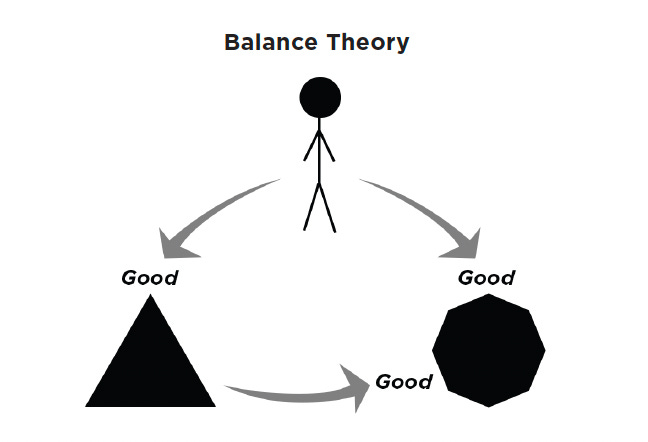
Say you have two beliefs. You think Triangles are good. You think that Octagons are good. You find out that Triangles are big fans of Octagons. This is great news for you, because you like them both. You are in balance.
However, if you find out that Triangles think Octagons are bad, you become out of balance. You can’t think highly of both Triangles and Octagons if Triangles think Octagons are bad.
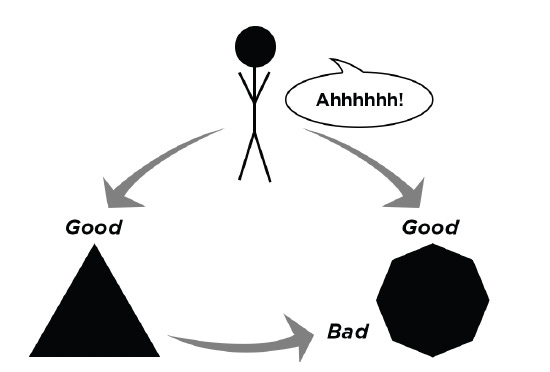
This will bother your brain until one of two things happens. Either you’ll decide that Octagons must be bad:
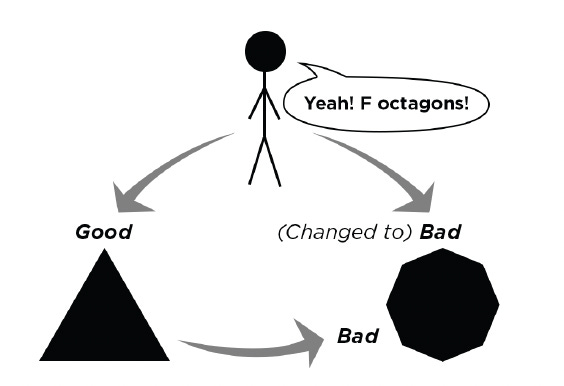
Or you’ll decide that you’re wrong about Triangles:
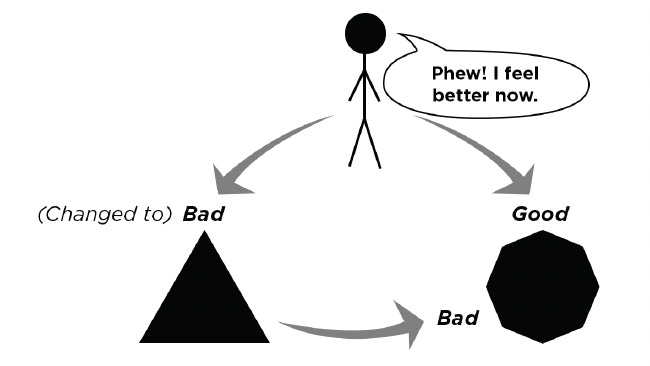
When we embed ourselves in places with a different culture from our own, we often get confronted with paradoxes about our beliefs. We realize that the way we have balanced the world may not actually line up. We’re faced with the choice of either rebalancing the equation, or decoupling the things we’ve associated—which can be extraordinarily difficult.
Laboratory research shows that many of the things we are biased about—the negative associations we have with things—are the result of our brains trying to balance things out with our prior beliefs, not the result of rational arguments.
For example, when psychologists put people in rooms and have them list arguments on both sides of a tricky issue—say, abortion or animal testing—people tend to list more arguments in favor of whichever side they believe in. But then when researchers prompt them, most people are able to come up with additional arguments for the opposing side without difficulty. “It seems that individuals have these counter-arguments stored in memory but they don’t draw on them when first asked,” write researchers from University of Pennsylvania.
When we travel outside of our home environment, our brains can start to let go of the barriers that prevent us from properly analyzing the information for or against our prior beliefs.
This can lead to a couple of results. Since we’re less tethered to our ego, travel experiences can make it easy for us to change our minds about things:
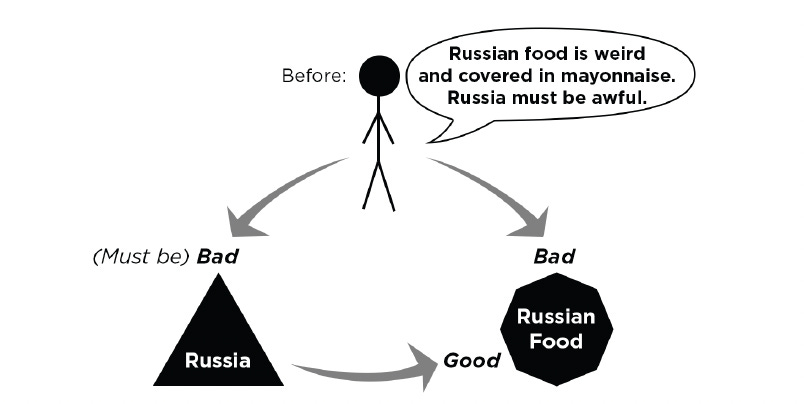
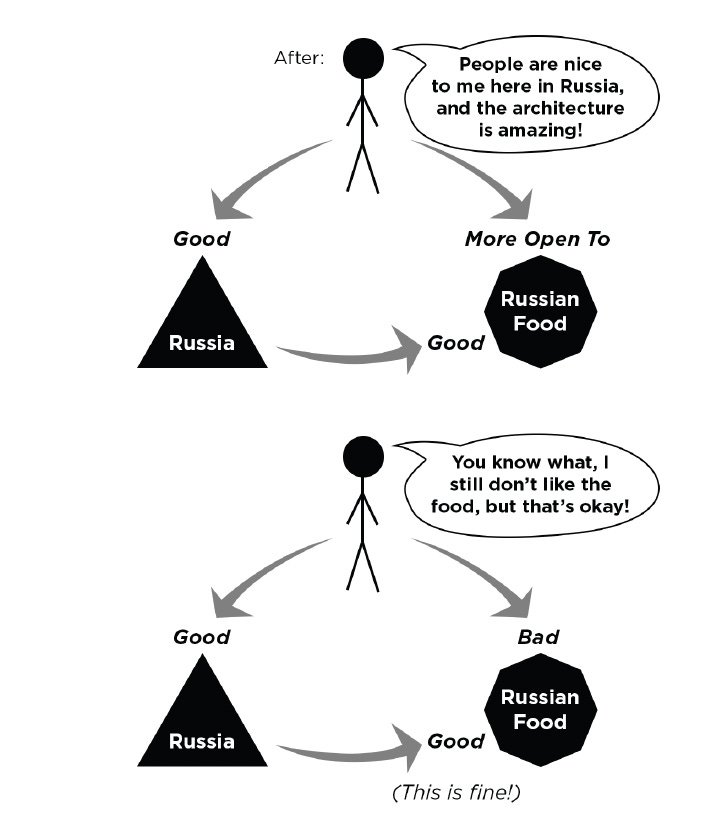
Visiting unfamiliar places primes us to decouple things our brains automatically link via balance theory. Traveling helps us to decategorize people and cultures and pick apart stereotypes from individuals, like the Eagles and the Rattlers did with each other did during scout camp.
This was the big epiphany that Malcolm X had when he went to Mecca.
“I have eaten from the same plate, drank from the same glass, slept on the same bed or rug, while praying to the same God . . . with fellow Muslims whose skins was the whitest of white, whose eyes were the bluest of blue . . . [for] the first time in my life . . . I didn’t see them as ‘white’ men,” he wrote. It “forced me to ‘rearrange’ much of my own thought-pattern and to toss aside some of my previous conclusions.”
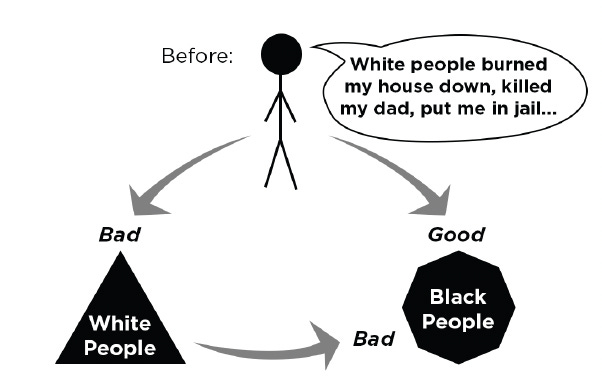
It was impossible to hold on to the idea that white people were all bad after hanging out with and feeling connected to so many good ones. The only choice X had was to either decide that Muslims were bad, or that he was wrong in his generalization about white people. In other words, he had to break apart the elements of his balance theory loop.
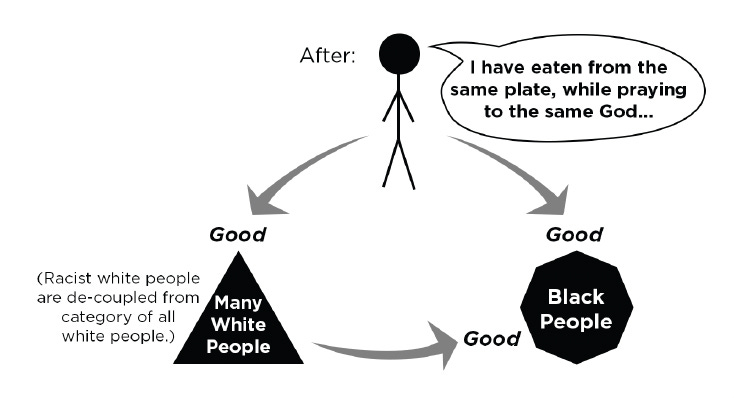
X’s daughter would later say, “The more he traveled, the freer he became. The freer we all became.”
This is where the prevailing narrative on Malcolm X’s transformation generally stops. He traveled and, like Saul, he saw the light. However, the 2011 Pulitzer-winning biography by the wonderful Marable Manning makes an important distinction that most people miss—and data confirms. Travel alone isn’t always enough to change our minds. And it wasn’t quite enough for Malcolm, either.

A half century after Malcolm X came back from Mecca, a young white man from southern Florida made a similar journey, in reverse.
Derek Black was the godson of David Duke, the head of the Ku Klux Klan, and the son of Don Black, the founder of Stormfront, the world’s then-largest white nationalist website. At an early age, Derek got heavily involved in the white nationalist movement, writing essays, calling into radio shows, and working to convert other young people to the cause of separating the races. By age nineteen he’d won a county election on a thinly veiled white nationalist platform and embarked on a quest to get other white nationalists in office to combat racial integration around the United States. He was seen by the Klan and other groups as something of a “chosen one” among separatists, anti-Semites, and white supremacists.
And then he moved across the state for college. He started hanging out with kids from all sorts of backgrounds, with all sorts of beliefs. He made friends with an observant Jewish student who invited him to Shabbat dinners. “He just wanted to let me see a Jewish community thing so that if I was going to keep saying these anti-Semitic things that at least I had seen real Jews,” Black later told the New York Times.
And then he changed his mind.
Living among these other kinds of people opened his heart. He allowed himself to consider information he wouldn’t have before, such as evidence disproving the erroneous “science” he relied on about race and IQ.
“I have these two experiences, and I have a lot of trouble reconciling them sometimes,” he said. But balance theory sorted him out, and Black soon became a spokesperson against the thing he once campaigned for.
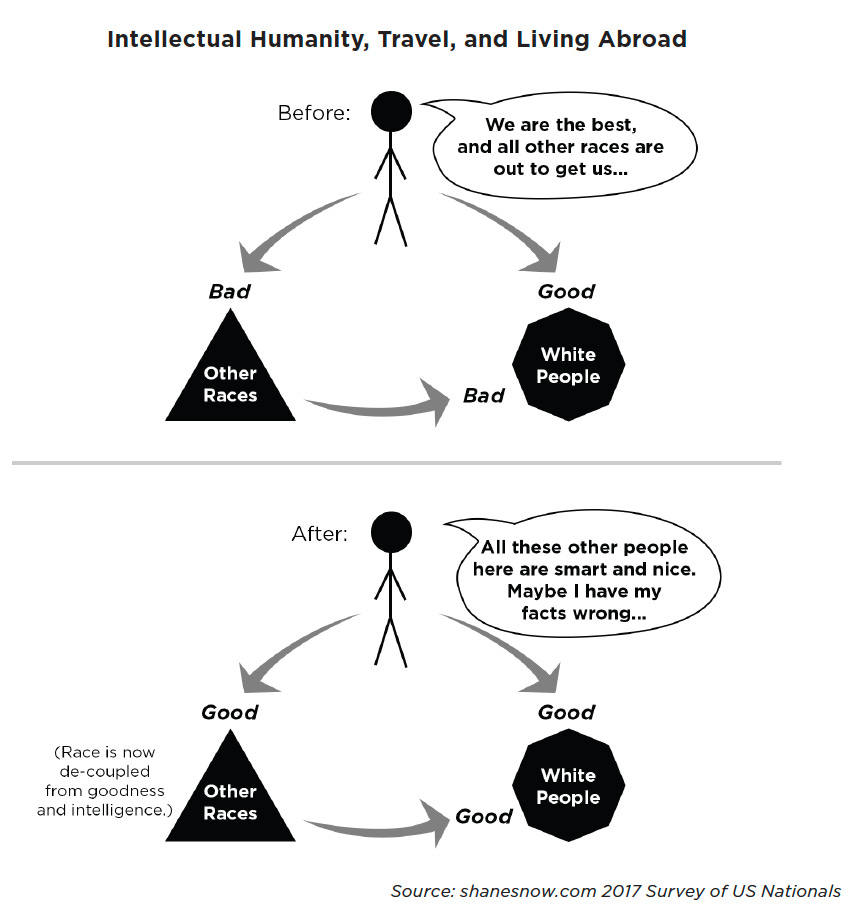
Stories like these are encouraging. But certainly there are plenty of people who travel to Mecca or move to college who don’t change their entire lives around. What’s really going on when a Malcolm X or a Derek Black changes his mind?
In 2016, armed with Krumrei-Mancuso’s and Rouse’s research, I put together an IH assessment with some additional questions of mine, to dig into this question. I ran a study of thousands of people around the United States to look at the ways that people with different amounts of open-mindedness live their lives.
Predictably, my study found a strong correlation between being well traveled and having intellectual humility. However, it unearthed an even stronger correlation that helps us understand what makes the difference between those who travel and change their minds, and those who travel and don’t.
It turns out that people who actually live in foreign places are even more likely to have high IH than those who just visit. Living in a foreign country for three to six months has a stronger effect on IH than visiting ten countries.

This confirms for intellectual humility what other studies had deduced about openness to experience: just visiting other countries and observing their cultures as tourists is not nearly as good at building openness as becoming embedded in those cultures. (Unless, as we can see from the data, you visit a lot of countries, which in turn would mean you’ve probably spent a significant amount of time outside of your own culture.) You can visit a new or strange place without trying the food or opening up to the idea that the way people live and speak and think in this new place is valid. But it’s hard to live somewhere and not become a little more open to the culture.
Dr. Galinsky and his colleagues found that graduate students who had lived abroad were more likely to consider out-of-the-box solutions to problems in group projects than people who didn’t, or who just visited. Fashion designers who lived abroad produced more creative and successful designs than those who didn’t.
We might on the one hand conclude that open-minded people would be more likely to travel in the first place, which is probably true. However, my study found something very interesting that indicates a more causal relationship. Not everyone who had high IH had traveled, but almost everyone who had lived in multiple countries ranked high for IH.
The key insight about becoming open-minded through travel is not mere exposure. It’s the idea of becoming “multicultural.” Being able to hold multiple cultural ideas in one’s head at the same time. Being able to live with multiple balance theory charts at once.
Dr. Galinsky and his colleagues found that “biculturals,” or people who identified with two cultures, “exhibited more fluency, flexibility, and novelty on a creative uses task and produced more innovations at work than did assimilated or separated individuals.” They were able to demonstrate that people who came from multiple cultures or who could identify with two or more cultures were more able to use lateral thinking—the application of open-mindedness—at work.
And it turns out that when an individual’s head is diverse in terms of languages spoken, that individual becomes physically more open-minded.
I don’t mean that one’s head literally opens up. But neuroscientists find that that multilingual people’s brains do look physically different. Learning to speak multiple languages helps us to realize that there is not just one right way to say something, and that the way of saying something that we grew up saying can be less precise than someone else’s way. This leads our brains to wire up a little more linguistic humility. As linguist Gabrielle Hogan-Brun explains, “The left inferior parietal cortex—an area of the brain heavily involved in the processing of language, forming concepts, and thinking abstractly—is denser in bilinguals than monolinguals, and becomes denser as language proficiency increases.”
This change in brain makeup leads to more emotional understanding of other people, less fear of loss—meaning more progress in the war between oxytocin and the amygdalae—and more rationality when it comes to changing one’s mind. The more we adjust our balance theory charts, the more our brains change, and the easier it gets to adjust in the future.
In other words, the key to intellectual humility is increasing the cognitive diversity inside our own heads.

When Malcolm X made his pilgrimage to Mecca, he had already taken a bit of a hit to his ego. He’d been edged out of the spotlight at his own mosque, and he’d warmed up a bit to the idea that Elijah might not have all the answers he said he did.
As we saw from his first conversion from drug dealer to preacher, X had the ability in him to change his mind. But his views had calcified over the years. His heart had hardened toward a whole lot of people.
The trip to Mecca started softening it. But when you look at his letters and interviews and sermons in 1964 and 1965, it’s clear that X’s subsequent five months living in Africa were what truly opened his mind.
After Mecca, he spent some time in the United States formulating new ideas, and then he went to Ghana, Egypt, and other countries in Africa to develop a more multicultural perspective. It was there that X fully embraced what would become his new rallying cry. The struggle for equality wasn’t just about civil rights, he realized. It was about human rights.
“His Middle East and Africa experiences had greatly broadened his mind,” wrote Marable in his Malcolm X biography. “It was the romance with Africa itself, its beauty, diversity, and complexity” that helped Malcolm transform.
X’s philosophy on race, X wrote, changed after living among “thousands of people of different races and colors who treated me as a human being.”
4.
Malcolm Little was thirty-nine years old the second time racists burned his house down. This time, however, he wasn’t surprised. He’d known the dangers inherent to changing his mind and breaking with the Nation of Islam. He did it anyway.
Before he split from the NOI, X had already become an amazing case study in coalition building. He’d used powerful shared hatred of a common enemy to attract listeners to his speeches. He then used those speeches as a platform to get his ideas on the superordinate values of the Nation of Islam to a mass audience.
Unfortunately, when his values changed, his former allies turned on him.
After the house burned down, X moved to a hotel. He continued building the mosque he started after his conversion to Sunni Islam, and he went to work on his nonreligious organization to advance human rights. It was during one of his public speeches for this that a gang of Nation of Islam members—possibly with ties to law enforcement who knew of X’s change of heart but were still afraid of him anyway—shot him to death in front of his family and friends.
Malcolm X’s autobiography would go on to sell millions of copies—despite the fact that a small percentage of his life was spent living along the lines of Islamic orthodoxy. (In fact, people flocked to his book in large part because of his transformation story.) And X’s teachings would influence tens of millions, helping generations better understand racism, human rights, Afro-American culture, and the perspective of a people who’d been beaten down and abused for centuries.
Despite his untimely death, X made a sizable contribution to the Dream Team that pushed civil rights forward. The movement needed X’s cognitive diversity, his perspective on the poor, Northern black man, self-empowerment and pride, and his heuristics for motivating and mobilizing. Combined with the perspectives and heuristics of the pacifistic Bayard Rustin, the eloquent King, and many others, the movement made historic progress.
As we see from the history that ensued, civil rights needed more than a group of angry separatists to succeed. It needed moderates and liberals and conservatives to mobilize together. It needed them to link arms with people of all races to fight together as a team. It needed what Malcolm X realized in his most powerful epiphany from living in Africa:
“Separation is not the goal of the Afro-American,” he told a packed crowd of 1,500 people at Chicago’s Civic Opera House shortly before his assassination. “Nor is integration his goal. They are merely methods toward his real end—respect as a human being.”
The superordinate group of mankind could only come together with that respect. “The true believer,” X wrote in his diary while traveling, “recognizes the oneness of humanity.”
In order for him to get to that point, X needed to put himself in an environment where his mind could become open to the truth—that the world was not as black-and-white as the KKK or NOI or balance theory would have him think.
Dr. King said X’s murder was a “great tragedy” and that it had deprived “the world of a potentially great leader.”
This is striking, because King and X had been philosophical opponents for years. X was becoming more nonviolent and King-like in his last months, but he was still more hardened than King ever was.
In all those years, King had respected X even though he disagreed. But over time, King began adapting some of his own ideas because of X. In his later speeches, King started preaching about black self-pride, an important message of X’s that the civil rights movement had hardly emphasized at that point. Shortly before King was assassinated, the journalist David Halberstam reported that King “sounded like a nonviolent Malcolm X.”
While King was a political revolutionary, X was a cultural revolutionary, says author James Cone. That cultural revolution eventually became part of King’s political philosophy. “Malcolm changed how black people thought about themselves. Before Malcolm came along, we were all Negroes. After Malcolm, he helped us become black.”
X’s change of heart allowed him to help push civil rights leaders a little further than they might have on their own. And X’s personal journey of open-mindedness made him a catalyst the movement needed.
It’s clear from the mountains of books and essays written on X and King that they each had a high amount of intellectual humility. They were both willing to change, accept, and hold steady when occasion needed. King was able to use that—and Malcolm X’s contributions—to build the Dream Team coalition of people and ideas that got the Civil Rights Act passed.

I’ll confess something uncomfortable: I’m a cliché when it comes to Malcolm X. Growing up, I initially liked him because of the part where he stopped calling white people “devils.” (As a youth, I was unaware of so much of how white America had wronged Malcolm and others of African descent; I was taught that after slavery ended, everything was fine. Which is of course, a lie.)
But as I dug into Malcolm’s story, something else happened to me that helped me open to other parts of his message and made me love the man beyond what was in my personal interest because of my identity.
I would have my own change of heart about Malcolm X, and perhaps more important, about the art of respect and working together because of him. Buried in my IH data was the surprising reason why—and a key to developing open-mindedness in ourselves and in others that doesn’t require the privilege or funds to travel across the world…
Stay tuned for the next free chapter of Dream Teams next month!
Make a great day—
Shane
P.S. If you’re enjoying Dream Teams, check out my Dream Teams keynote videos & more here »