


Nothing in the past is a perfect analogy for the disruption that artificial intelligence is reaping. But where we’re at now with generative AI maps precisely to a historical pattern I gave a speech about years ago during the rise of Twitter and Facebook. Recognizing this pattern again in gen-AI has helped me navigate the AI onslaught with a little less panic. I hope it can do the same for you.
The pattern is called The Garbage Cycle. And it starts with a story about Edison.
In the 1890s, Thomas Edison invented a new gizmo called the kinetoscope. This technology enabled an exciting new medium of expression: motion pictures.
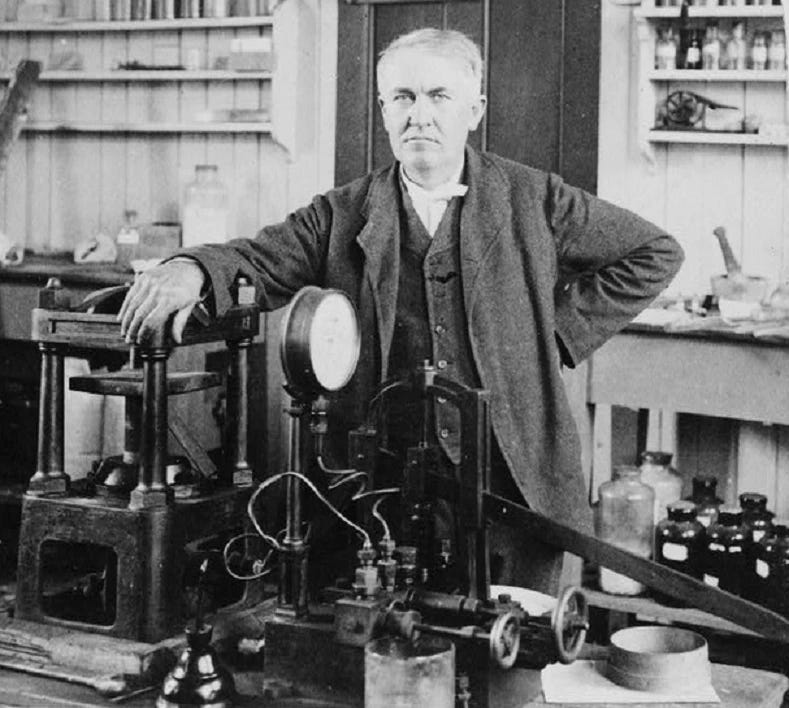
Being something of a proto-Steve (Jobs) type, Edison would often debut his new technology (for which in proto-Steve fashion, he’d not done the inventing part himself but would receive the credit) on a stage in dramatic fashion. He would then, as they used to say back then, promote the shit out of it.
He set up a Kinetoscope Parlour on Broadway in Manhattan, near Madison Square park. He hired workers to produce short films, and put those films on stage in between vaudeville acts at famous theatres around New York. Announcements with sensational descriptions went out. And thousands of people put on their finery and showed up to the theatres to see these films.
Early on during this new motion picture craze, Edison showed an audience of fancypants theatregoers this video:
(Video courtesy of the US Library of Congress)
It was a two-minute film called “New York City Dumping Wharf.”
It is what it sounds like: two minutes of men shoveling garbage on a barge on the Hudson River.
And this film took people’s breath away. Stories go that people literally gasped as they saw these moving pictures. As the famous quote goes, this new technology was indistinguishable from magic.
But not to put too fine a point on it… it’s a video of garbage.
People put on three-piece suits to go see it. They cinched up corsets and stood in line in the cold. They talked about it for hours at brunch the next morning.
And it was literally garbage.
This is not the only time this has happened. In fact, throughout history, every time technology has enabled a new medium for expression, this has happened. Anything—literally anything—that gets created in a new medium is interesting to people. Because it’s novel.
Even garbage.
This is wired into our pesky human brains. Novelty lights us up. Neurons fire, senses focus, memories encode. It’s part of our survival schematic; when a new thing shows up we need to figure out real fast if we can eat it or if it can eat us. So we pay attention. We get jacked up on emotion: excitement, anxiety, delight. And we interpret all of that as meaning, “This thing is important.”
But the thing about garbage is it’s only interesting when it’s novel. And it’s usually not important.
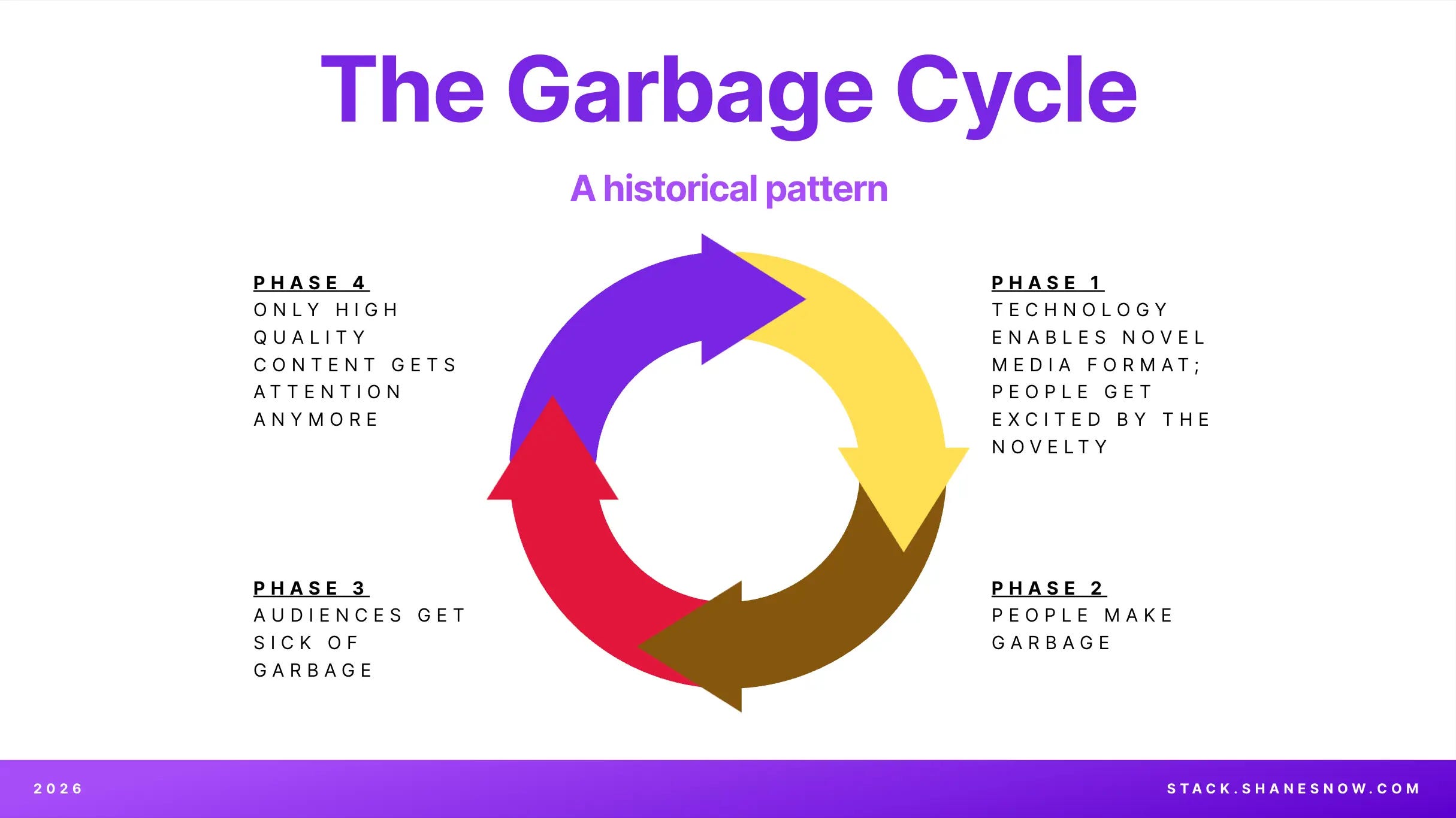
Hence: The Garbage Cycle.
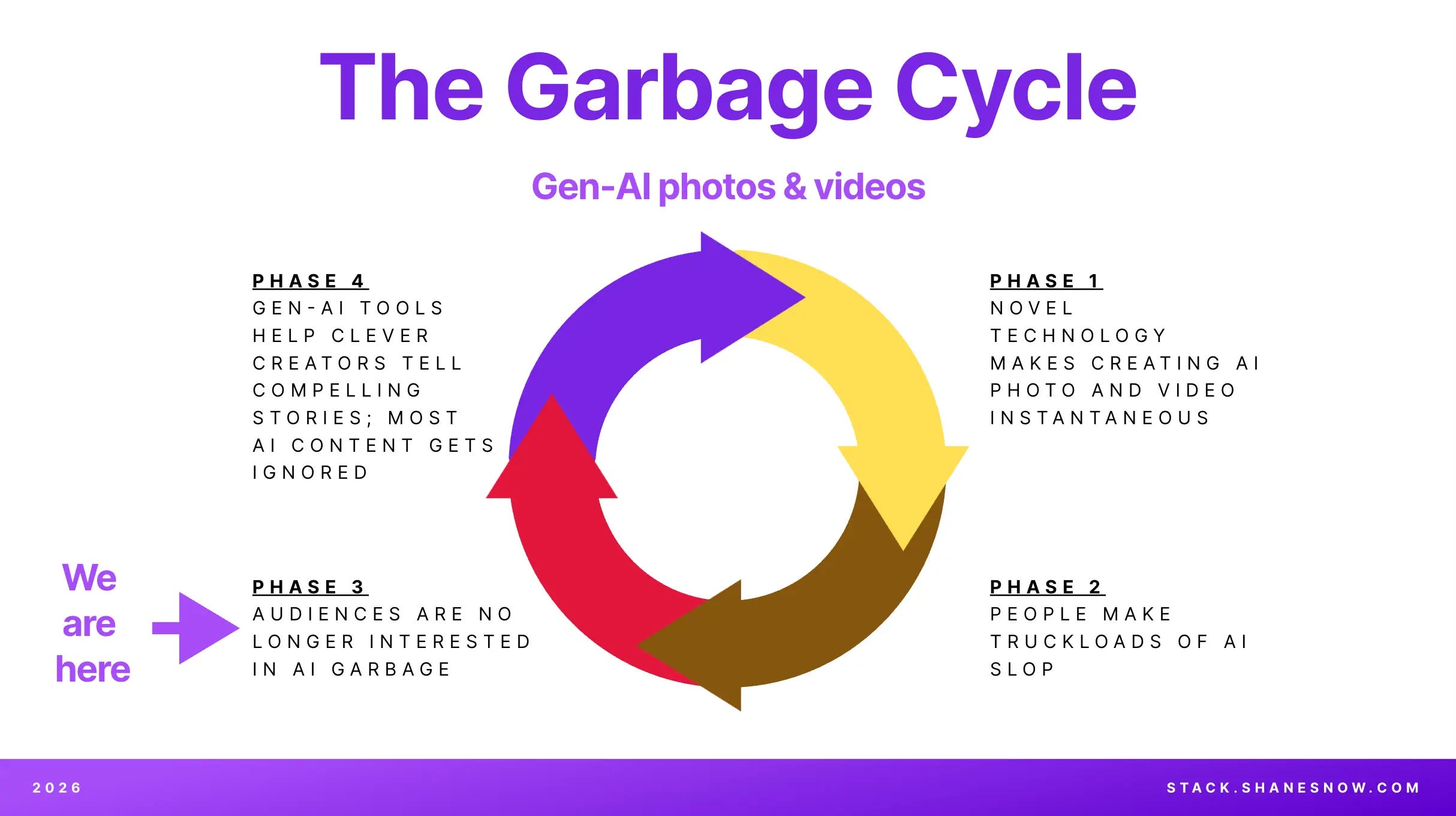
It’s happened dozens of times before and since Edison, and we’re in the middle of it right now with gen-AI. Here’s how it goes:
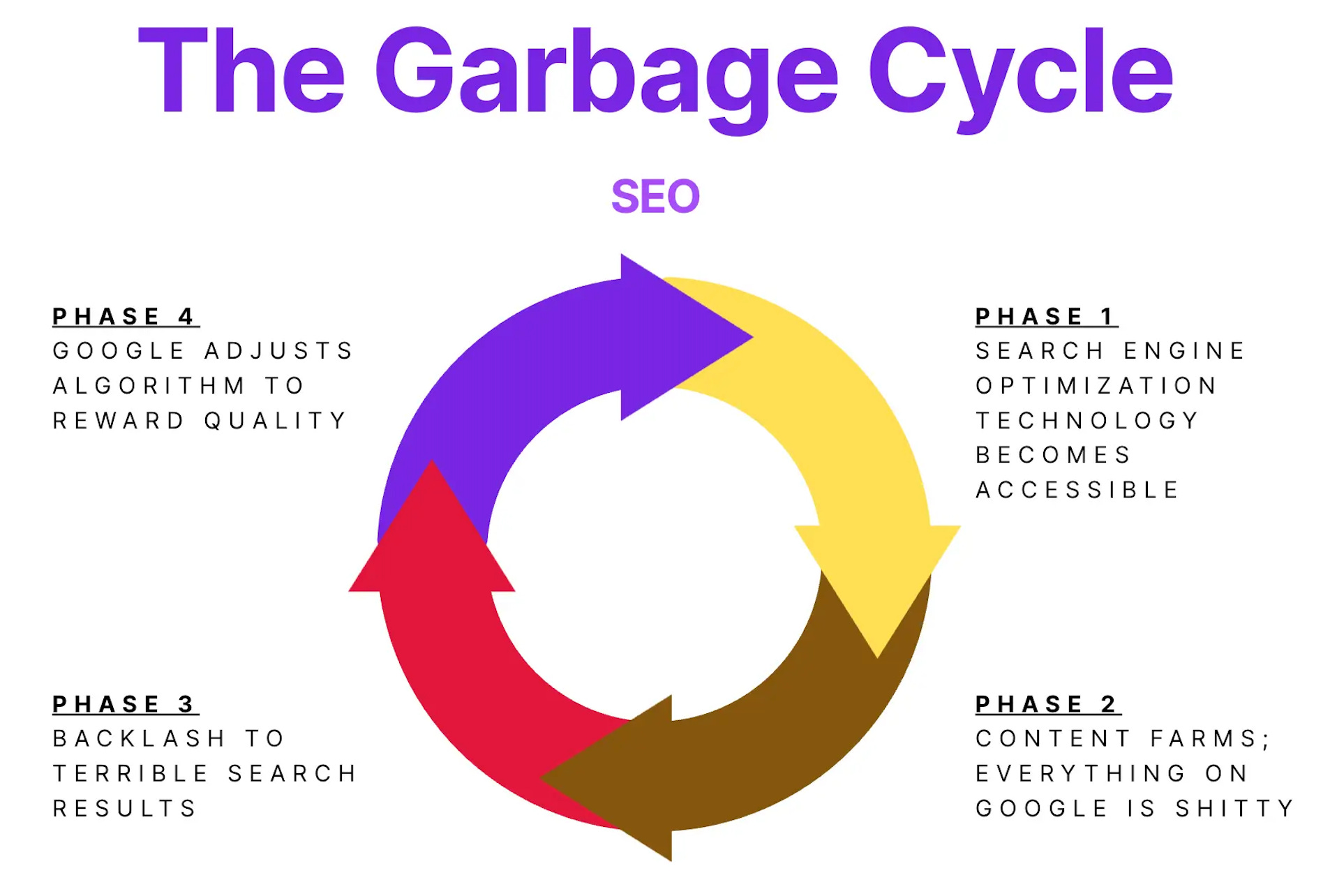
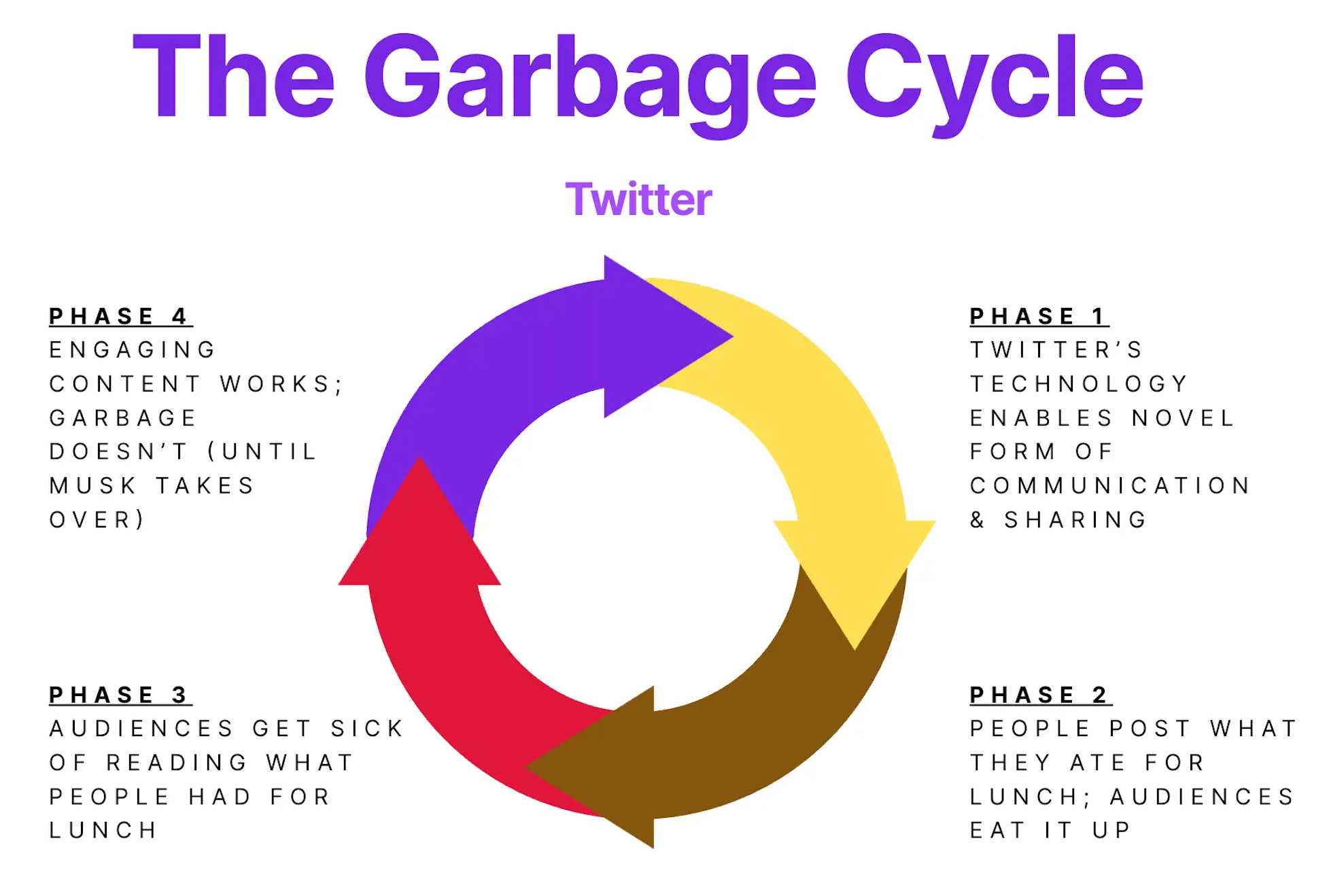
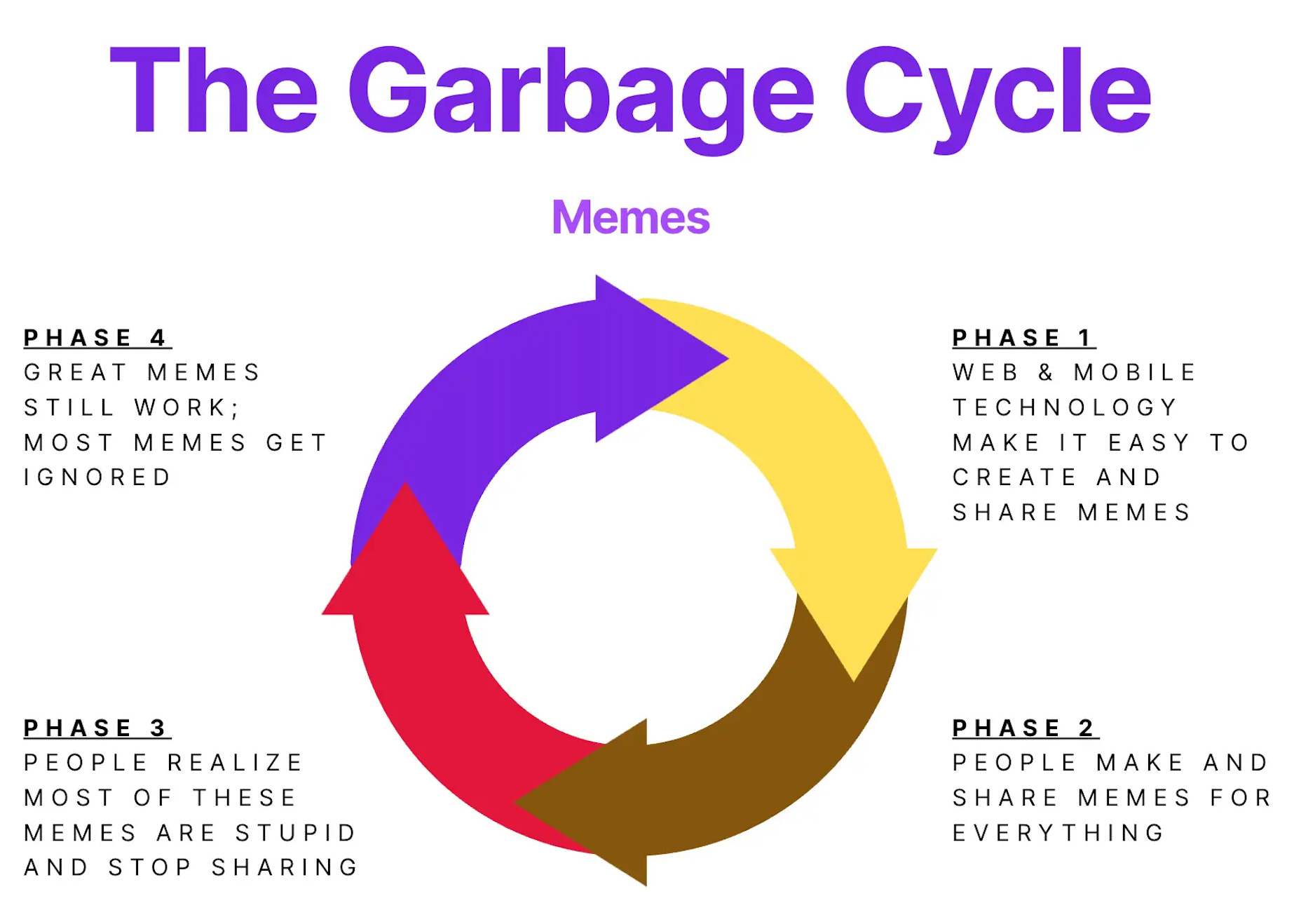
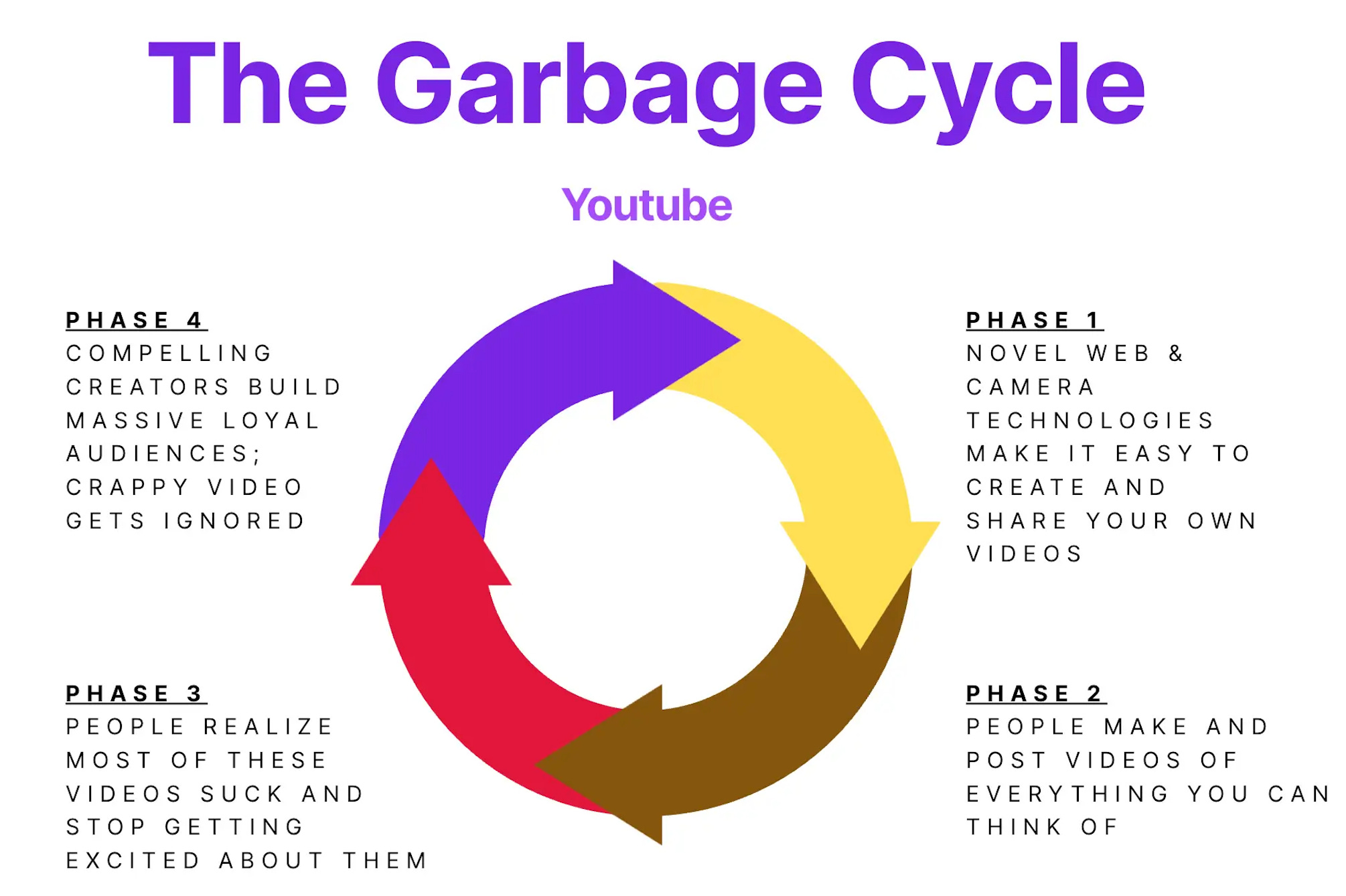
Phase 1: Technology enables a novel form of expression. No matter what gets made with it gets attention. (Even garbage.)
Phase 2: Creators make lots of garbage. (Anything gets attention, so lots of “anything” gets made.)
Phase 3: Audiences get sick of the garbage. (Novelty fades. Attention dips.)
Phase 4: Good storytellers figure out how to use the medium in high quality ways, and this becomes the only stuff that gets attention anymore. (Audiences become choosy, algorithms filter out garbage, etc.)
The medium may continue to evolve, and its technology may improve, but by Phase 4 the medium itself is established as a “real thing”, and garbage creators move on to the next novel thing.
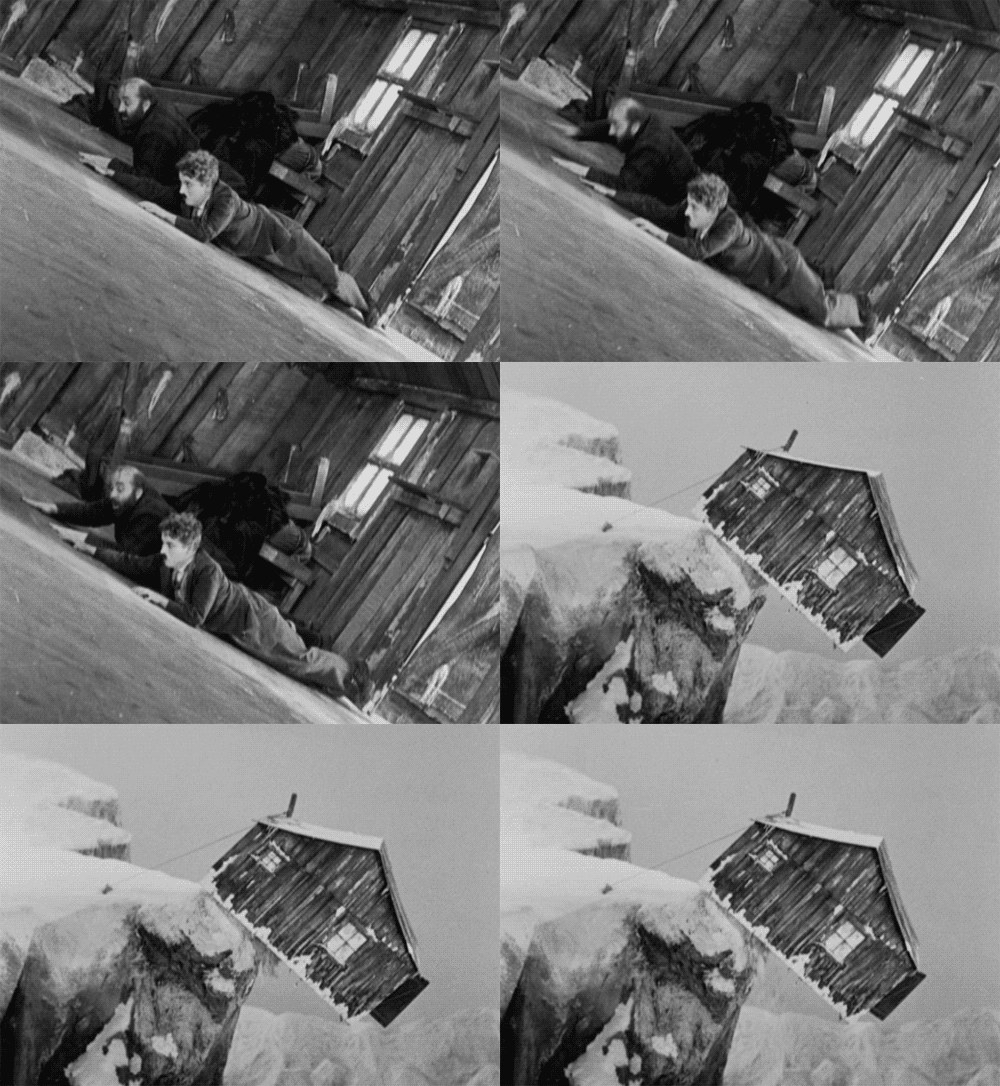
After Edison debuted the kinetoscope, he put hundreds of garbage films into theatres. And soon enough people stopped going to see moving pictures just for the sake of it. Videos of horses walking down the streets of New York were only exciting for so long. (And this was the kind of thing that most of these films were.) The medium only became established as something here-to-stay when artists like Charlie Chaplin came along and told great stories with it.
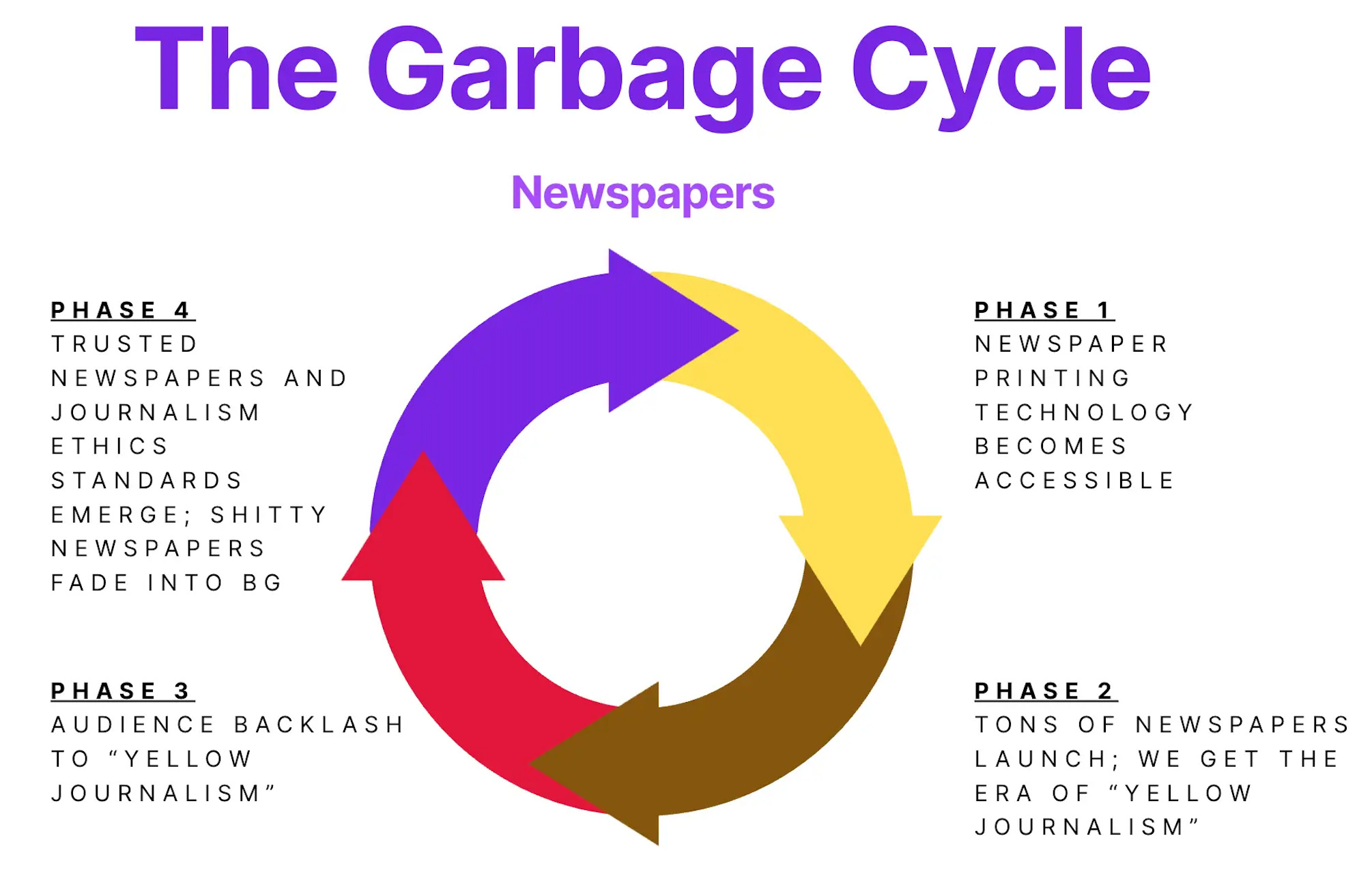
We saw this same pattern with newspaper printing technology:
And with websites and SEO:
And with social media:
The Garbage Cycle also happens when people figure out how to use existing technology to create a new twist on a format within a medium. We might call this, The Subgarbage Cycle. For example, memes:
Even within each medium, the Garbage Cycle repeats itself every time a new technology has come out and “leveled up” the form. In film, it happened with the advent of fancy camera lenses, rear projection, and special effects. And again with digital cameras. And smartphone cameras. And of course Youtube:
In general, the cheaper and more consumer-friendly media technologies get, the more garbage gets created. In today’s Creator Economy, more people than ever can pursue the profit (or attention) incentive of creating content. And they can do this regardless of the Garbage Phase we’re in, because the cost of creation is so low.
Youtube is the perfect example of this: there is still a lot of garbage going up on Youtube. Millions of people still treat the medium as if it’s 2005 and anything you upload could go viral. But Youtube is on Phase 4 of The Garbage Cycle. The only thing that gets attention is quality content that people actually want to see for some other reason than novelty. (And yes, stupid funny videos can still count as quality; though often it’s simply novelty that’s working for them.)
Which brings us to generative AI.
Remember when this came out and we lost our minds?
But this stuff ain’t interesting anymore. When these early AI videos came out, we mistook novelty for usefulness (and I think we overestimated how quickly the capabilities would improve).
When Sora came out, it gave me existential panic as a producer.
And now I see the videos on Sora and I’m bored.
The incredible hype around the novelty of gen-AI led to massive adoption, faster than any technology in history. The massive adoption has led to more hype. That hype has led umpteen startup companies to take billions of VC dollars to make tools to help people generate with AI. That hype convinced OpenAI it was a good idea to make Sora into a Youtube-like social network community… thing.
But we the people are no longer interested in garbage.
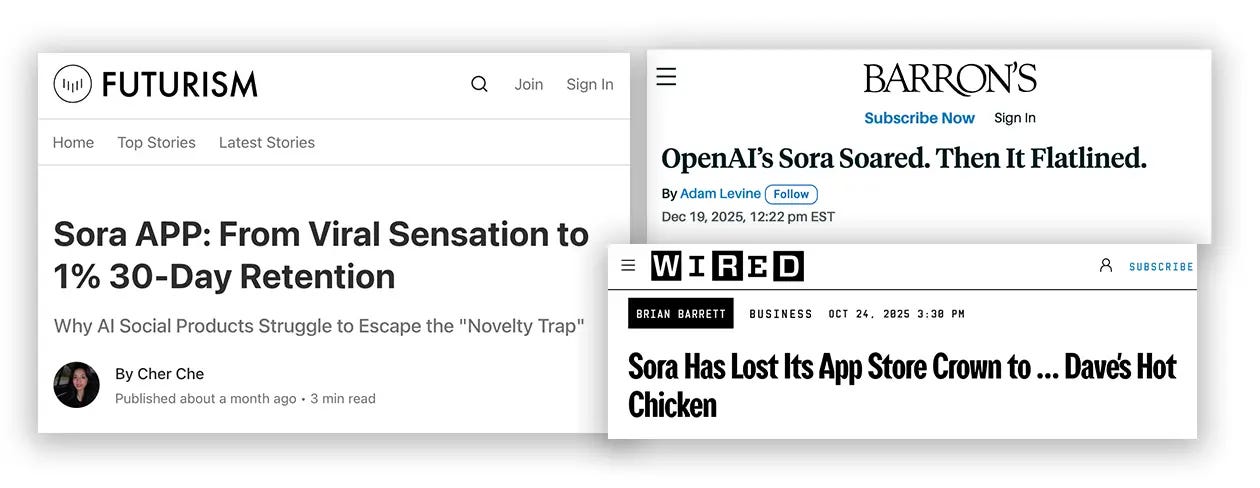
In other words, Generative AI is at Phase 3 of the The Garbage Cycle. We’re literally calling it “slop.”
But there is a difference this time.
Generative AI is so cheap (to the end user, who is at arm’s length from the true cost that the planet and our electric bills are bearing) that people are going to continue to create lots of garbage with it. More than is even still happening with Youtube.
But history tells us that all that garbage isn’t going to matter to anyone.
Soon enough we’ll get to Phase 4, where thoughtful storytellers use these tools to make things that people actually want to consume. Phase 4 is where we get The Welles, the Kubricks, the Spielbergs, the Humans of New Yorks, the Heather Cox Richardsons, the Mr. Beasts.
And with gen-AI tools this powerful, that Phase 4 storytelling is going to have to be really good. Content that feels like anyone could create it instantaneously is only going to be interesting while it’s still novel.
Shane Snow is author of Dream Teams, Smartcuts, and The Storytelling Edge.
Post Script: An interesting twist on the pattern, to me, is Substack. By designing its platform from the beginning to reward content people are willing to directly pay for, Substack has largely skipped Phases 2 and 3 of The Garbage Cycle. Attention means very little if it doesn’t convert to loyalty. (Versus platforms where ad impressions matter more than if your content is garbage or not.) Though I have seen people fall for garbage as the Notes feature caught on—people creating garbage in the hope that it will convert novelty-based attention into paid subs—the audience behavior with Notes maps to the Garbage Cycle well, and the mechanics of the Substack platform itself have largely led Notes through Phases 2 and 3 quickly. People aren’t willing to pay for garbage.
Brilliant and thoughtful -- not garbage!
I love the fact that phase 2 is represented with a brown arrow! 😂 Somehow I think that was not accidental.