


If you’ve been following my work, you know that intellectual humility is one of my favorite topics. In this week’s Snow Report, I’m sharing the results of my latest study on the topic. You can take an intellectual humility assessment yourself here to see where you can particularly improve—and be part of our next cohort.
What prevents us from changing our minds when it’s the right thing to do?
The results from a 5-year study of 14,500 white collar workers tells us that—in America, at least—by and large it boils down to two things: Ego and confidence.
This is a good news / bad news situation. The good news, research reveals relatively simple habits can go a long way to helping us overcome our natural human resistance to changing our minds.
The bad news... the problem is deeply rooted in the American workplace, where we’re generally rewarded for being right, or acting like we’re right.
Since 2017, I have administered assessments of subtle psychological traits of open-mindedness and willingness to change—aka intellectual humility—to thousands of business professionals, using the Comprehensive Intellectual Humility Scale developed by professors at Pepperdine University. With the most recent cohort of test takers, I’ve been running this assessment with various accompanying scenarios and lifestyle questions. The goal was to test hypotheses on what correlates to more or less intellectual humility in people’s day-to-day.
The results of this study reveal where most of us have work to do (I say “us” meaning Americans, as that’s who this study focused on, but I’d dare predict the conclusions hold true elsewhere). They also point to some specific interventions that can help us get better at change and change management.
The full results of the study are at https://shanesnow.com/intellectual-humility#study. Below I’ll share a few of the highlights.
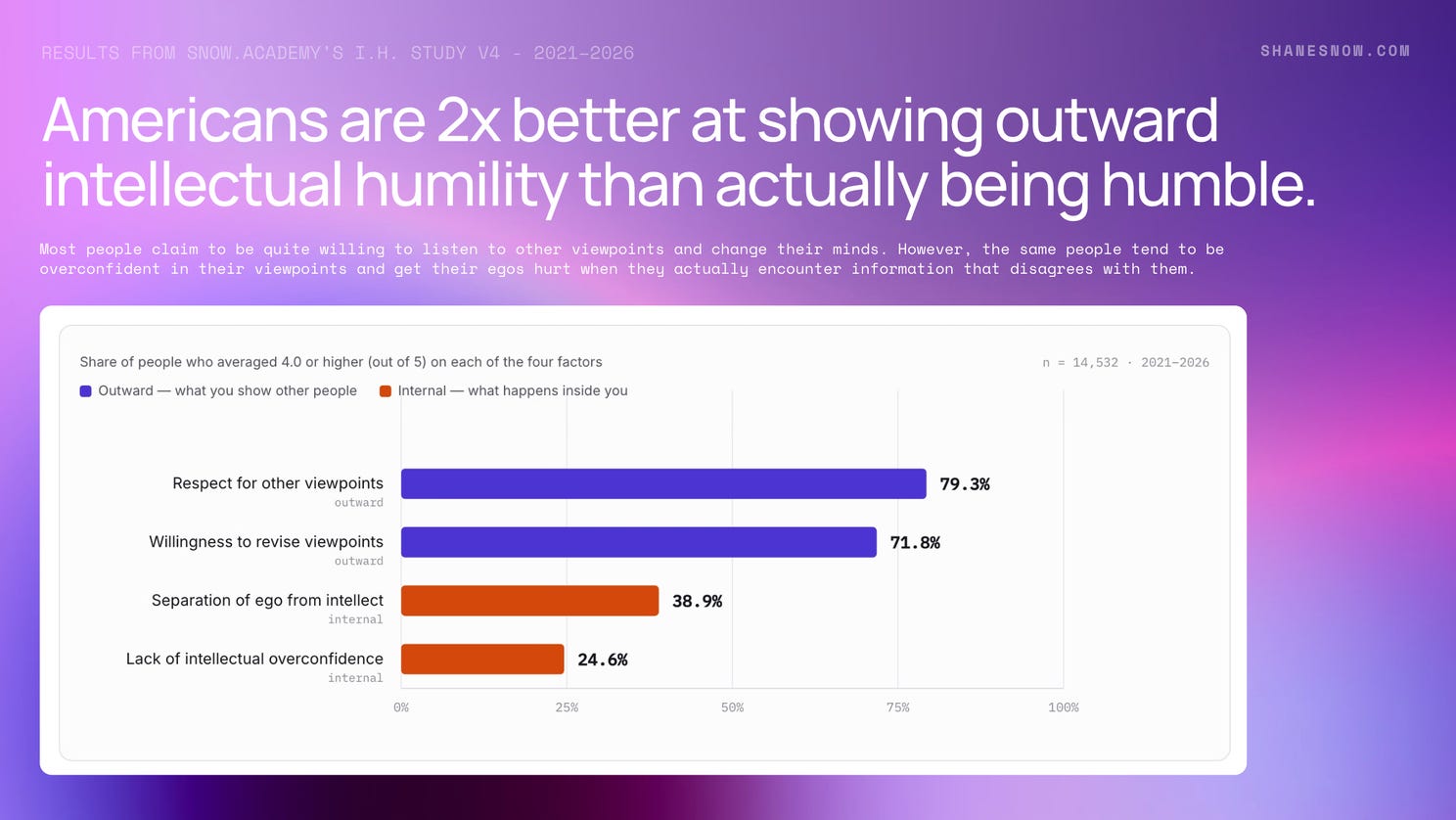
Americans are 2x as likely to say they’ll change their minds than to actually do it.
71.8% percent of people said that they were highly willing to revise their important view points in light of new information. 79.3% percent said they were willing to listen to opposing viewpoints with respect.
But only 24.6% scored high in “Lack of Intellectual Overconfidence.” This means 3/4 of people believed they were already right about their important views with very little chance of being talked out of it.
In other words, most people will listen to things they don’t agree with. But they aren’t actually open to changing their minds on things they’ve already decided.
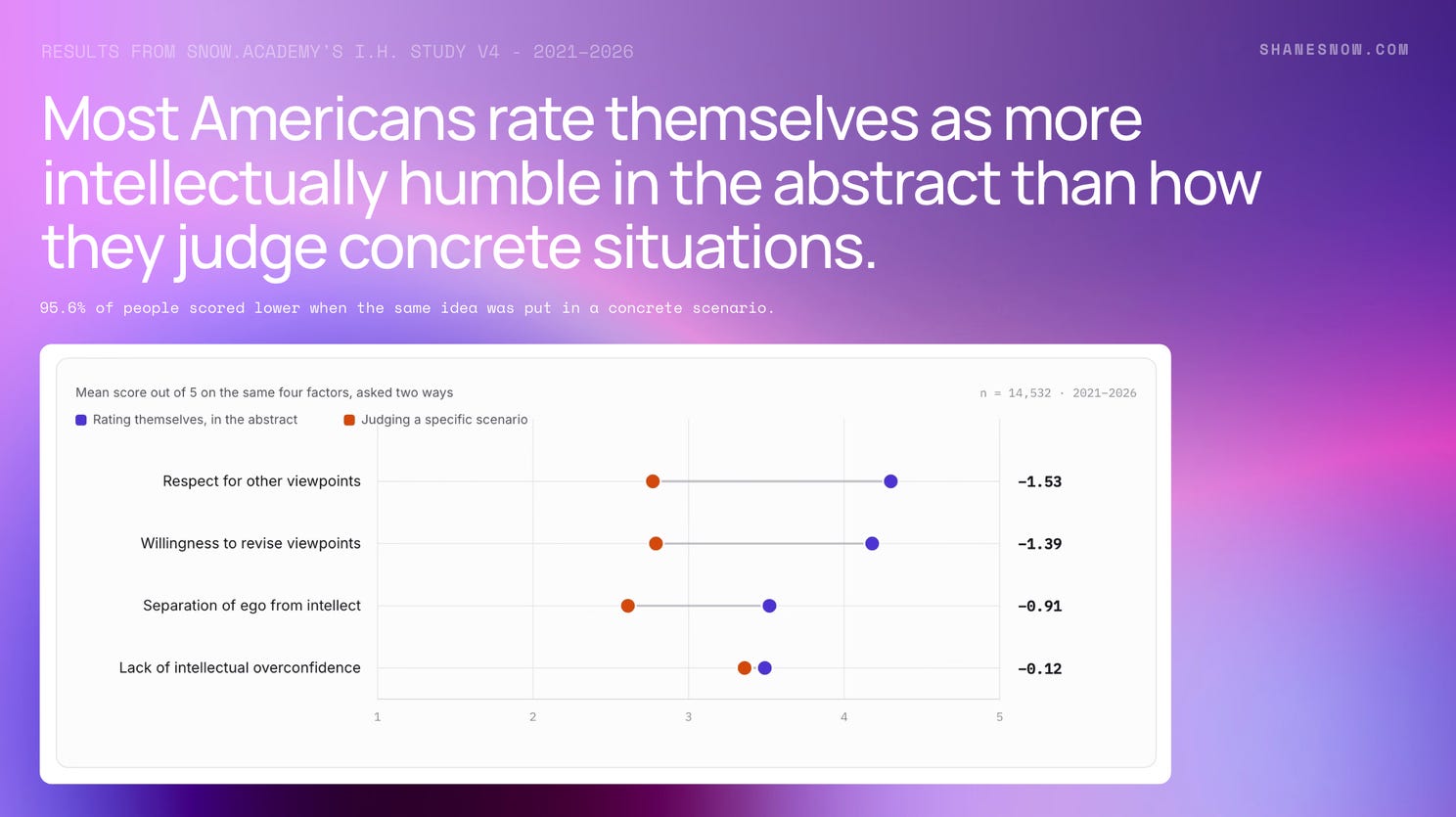
Nearly everyone rates themselves as more open-minded in theory than they actually behave when judging concrete situations.
One could assume that the working professionals who took the intellectual humility assessment have taken a lot of tests on their way to their eventual jobs. I suspect that most people taking this assumed that the “right” answers were the ones that indicate you’re open to changing your mind, etc.
That’s why we added a bunch of scenario based questions, asking what people would do or what they think others should do when confronted with disagreement at work, extreme opinions, or people leaning on authority to win arguments. In these scenarios, people displayed less intellectual humility than in their answers to the abstract questions.
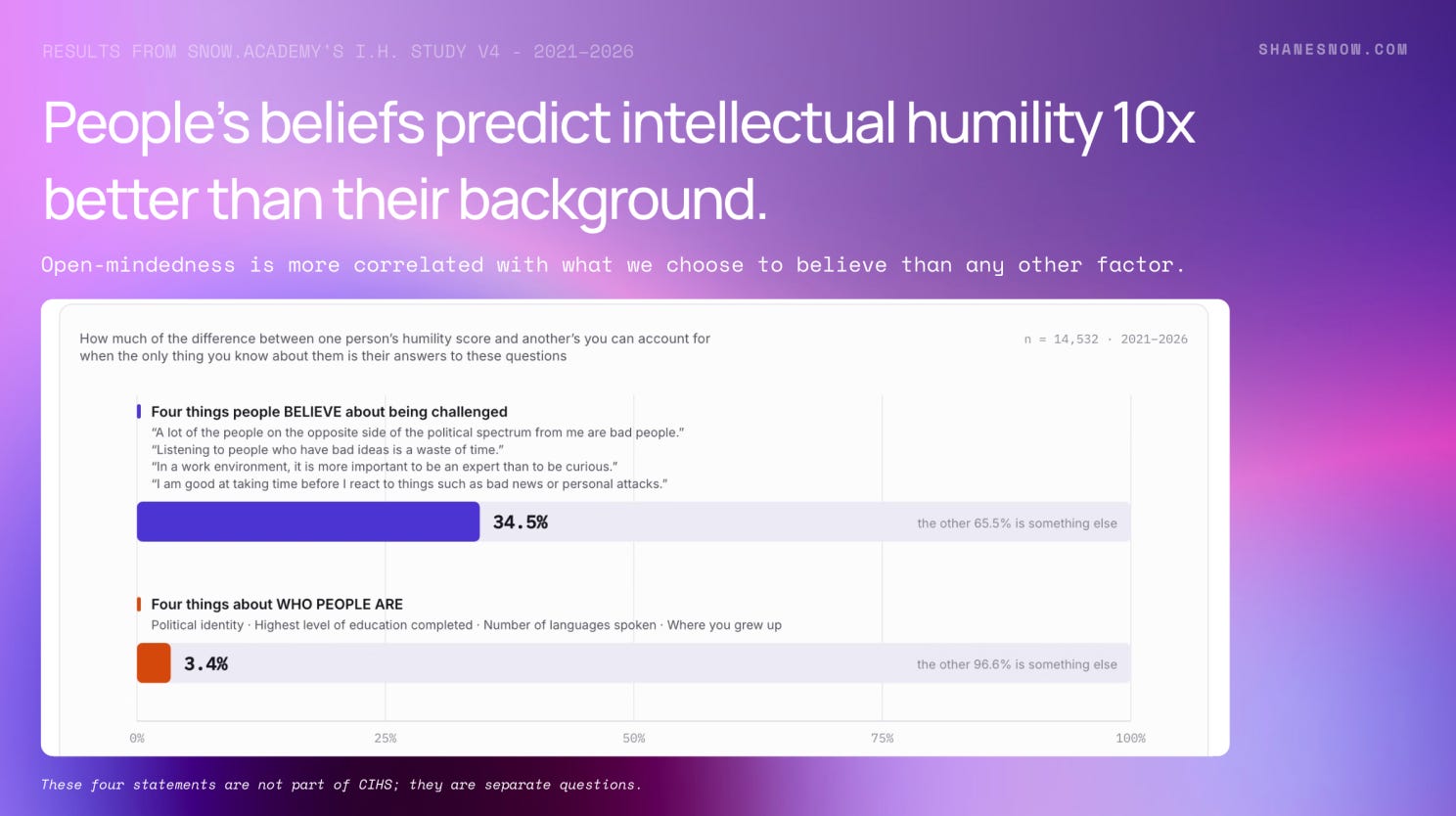
People’s beliefs predict their open-mindedness 10x better than their demographics do.
From the study data, all things being equal, one’s identity or background is much less correlated with intellectual humility than what one believes about themselves and other people.
This one deserves a whole post itself. But for now I’ll suffice with two conclusions:
Take heart! Intellectual humility is not hard-wired into us. It’s something we can develop and control no matter who we are or how we grew up.
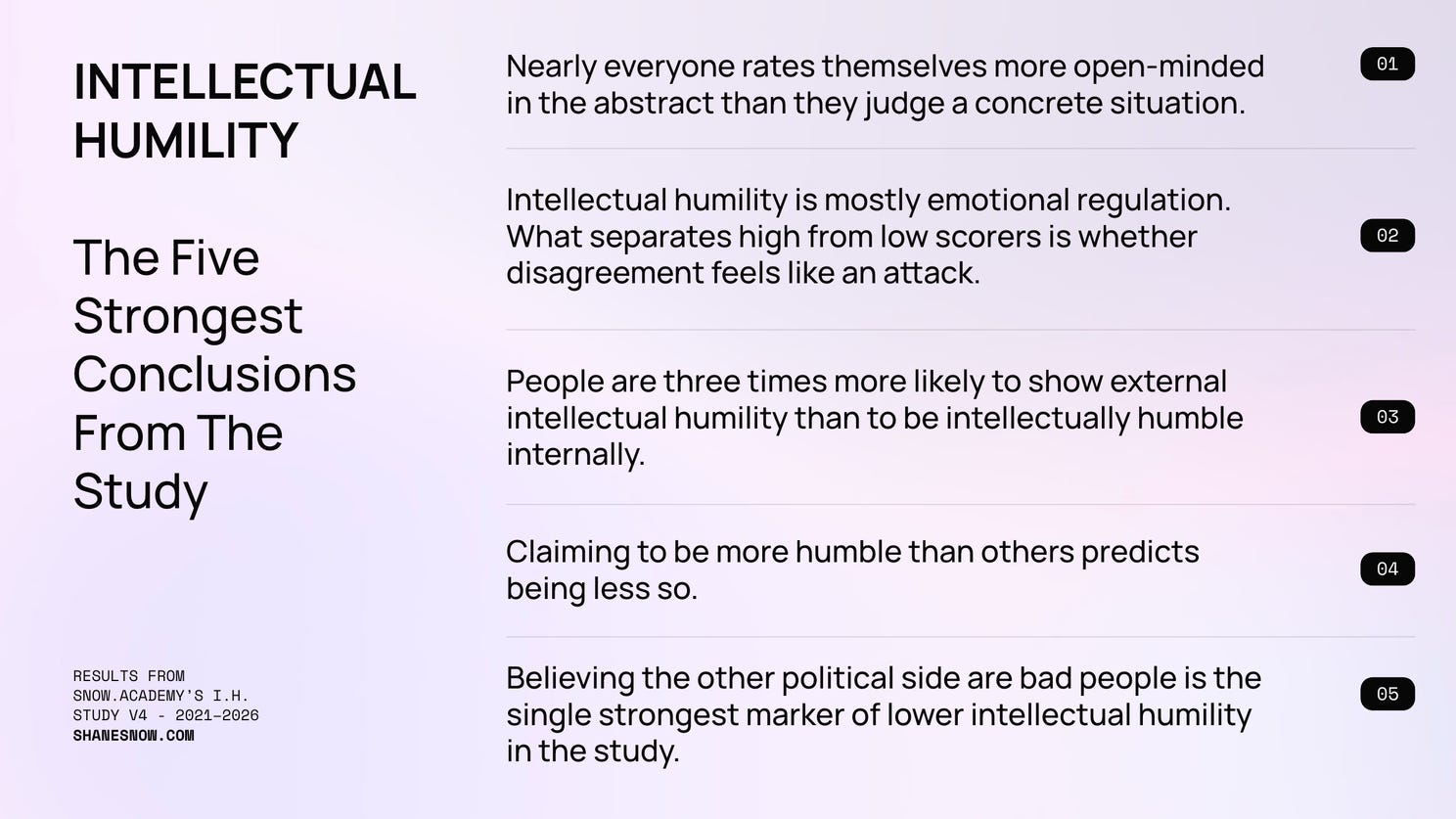
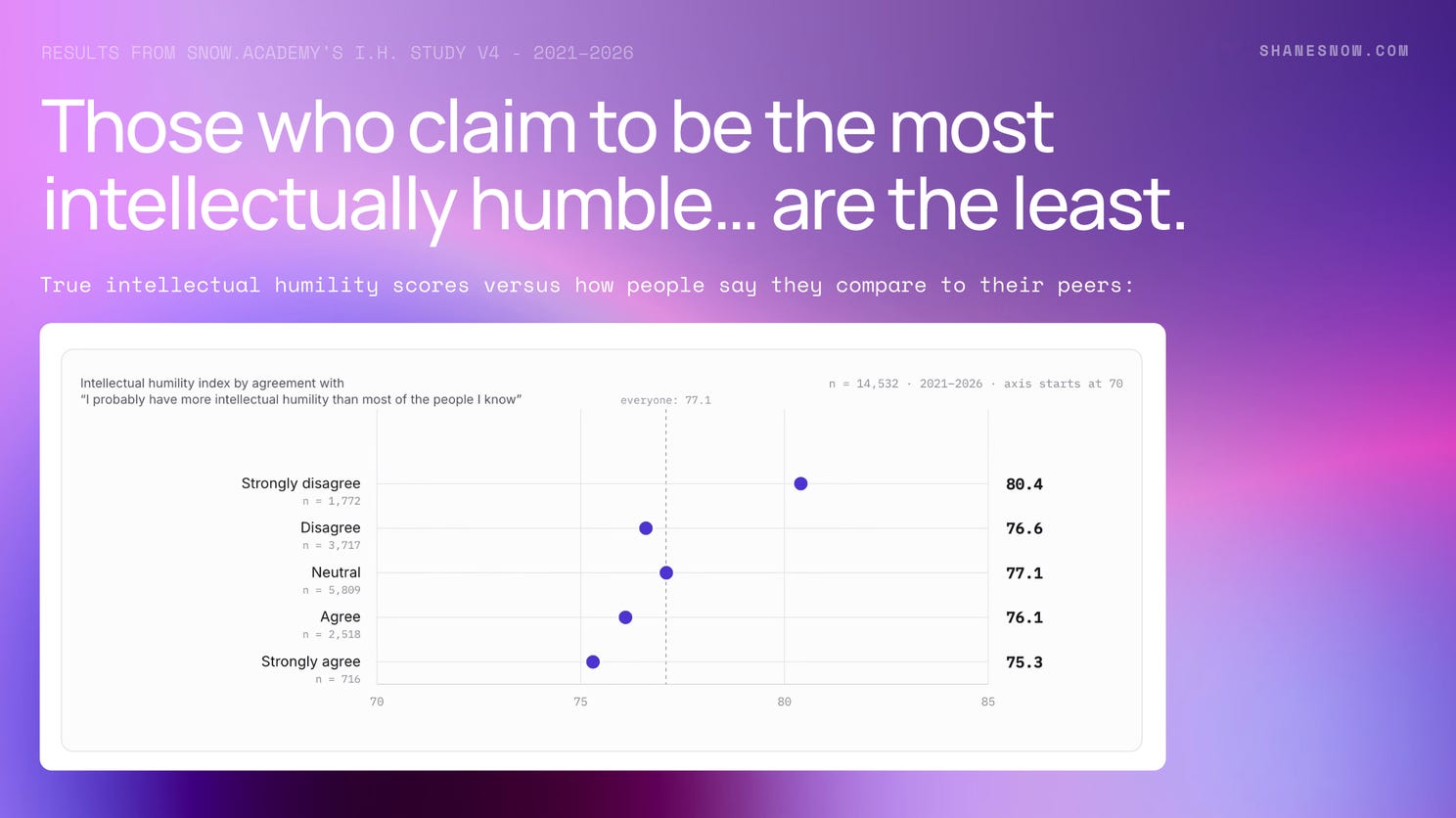
Claiming to be more humble than others predicts being less so.
This one shouldn’t be funny. And it presents a paradox. Because if being intellectually humble is a good thing, we should aspire to it. And if we aspire to it, we’d take steps toward it, and we should become better at it. People who do this would likely become more intellectually humble than those around them.
But in our study, the people who were most confident that they were better than their peers… were not.
I don’t think this means that in order to be humble you have to say you’re not. I think it simply means that a lot of us are not very self aware.
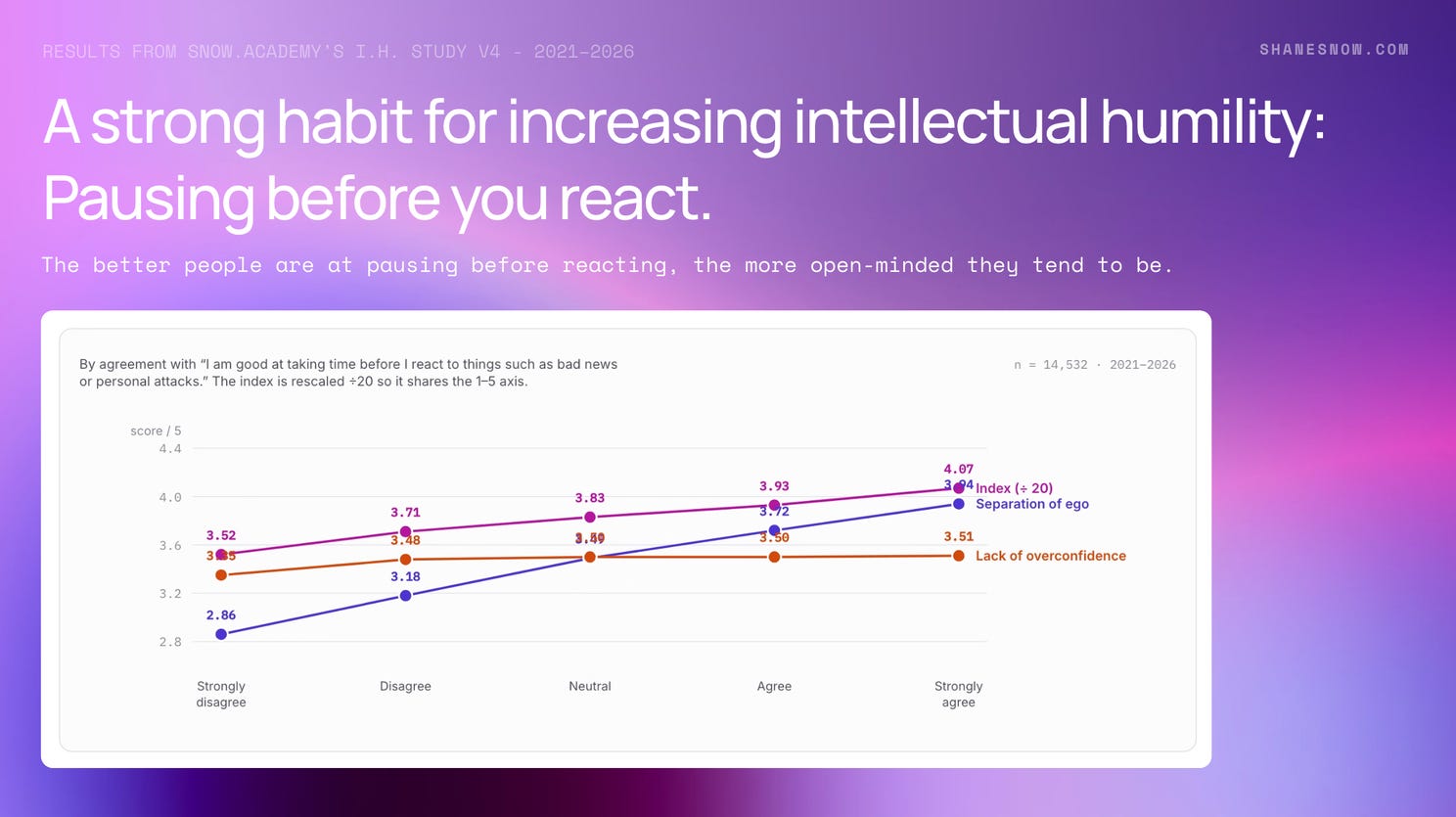
A strong habit for increasing intellectual humility: Pausing before you react.
There are plenty of habits that can lead to more intellectual humility in day-to-day life. (And I’m working on a big ol’ book project about the science of change if you’d like to follow along the journey on my Substack.) But in our study, we zeroed in on one habit that is highly correlated—and that appears to help people override natural tendencies toward a bruisable ego (which I have a hard time with myself): pausing before you react.
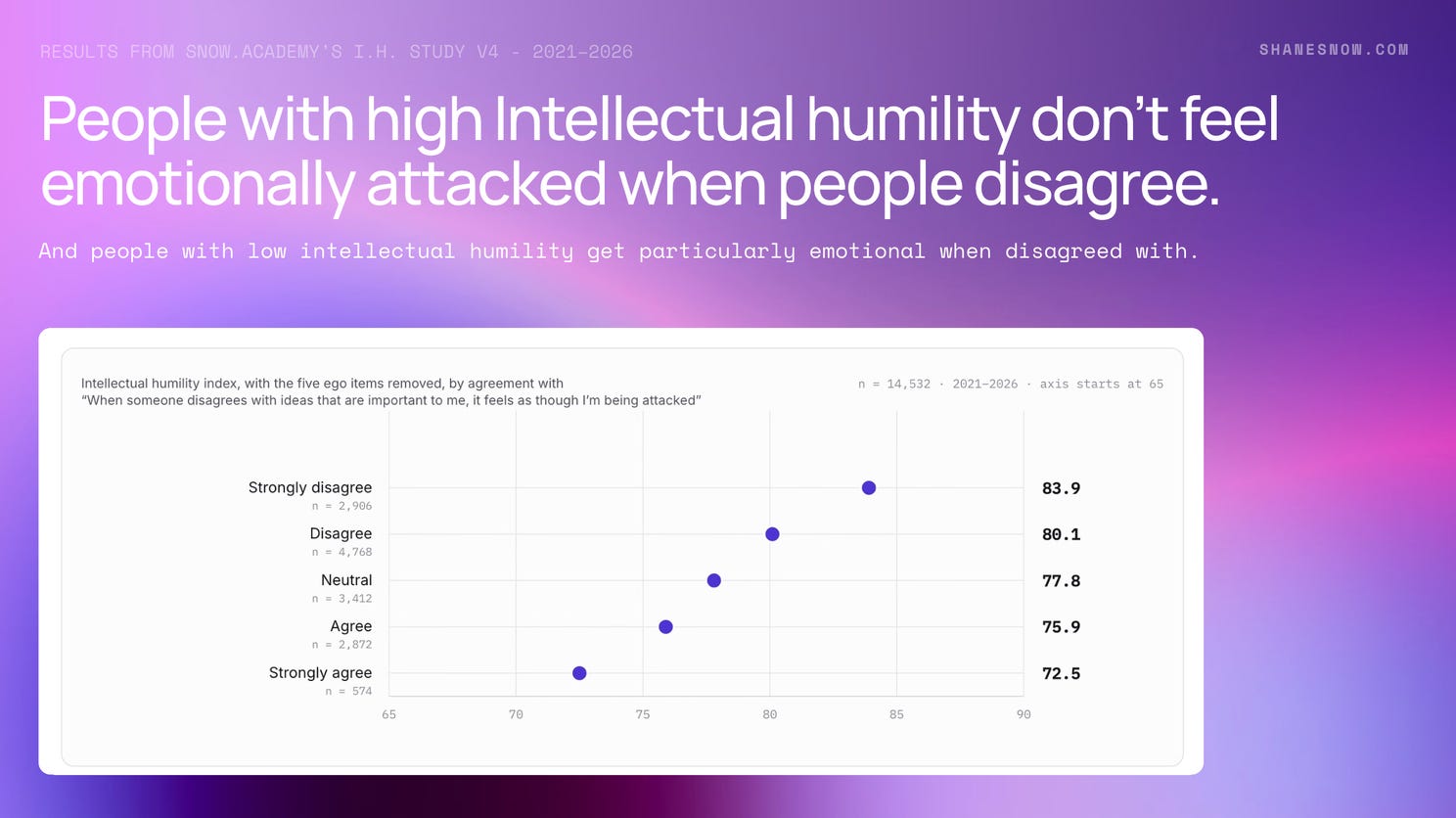
A related takeaway: people who don’t feel emotionally attacked when others disagree score higher on all factors intellectual humility. My hypothesis is that putting space before our reactions can help us feel less attacked. Especially those of us who have a particularly hard time not taking things personally. This allows us to react once our amygdalae have calmed down a bit.
The big conclusion: We don’t change because it hurts, not because we don’t know better.
Widely cited research from Harvard Business School shows that some two-thirds to three-quarters of startups fail to change course when things aren’t working. Founders show patterns of an “escalation of commitment” more often than a willingness to rethink their fundamentals. So whereas “pivot” is a Silicon Valley buzzword, like the subjects of our intellectual humility survey, entrepreneurs appear to be more likely to pay lip service than put it into action when it’s hard.
But why wouldn’t you change course if you knew your business wasn’t working?
The reason is it hurts our social standing. Or rather, we feel a deep-down fear that it will.
For entrepreneurs it’s especially hard. You’ve told all the friends and family and LinkedIn bros in your life that you’re doing this. You’ve projected confidence, convinced people to back your venture. Forbes said you were one of 30 most brilliant people still living on their parents’ insurance. So if you admit your business isn’t working, it’s going to be socially painful.
Side note: Just today as I typed up this report, I read a brilliant and heartbreaking post by Foursquare founder Dennis Crowley about selling his company for $0 after 17 years. I think it’s a masterpiece in intellectual humility and retrospection. Most companies don’t sell for millions of dollars. Foursquare literally changed the world and still couldn’t make its shareholders rich. How Dennis is both willing to tell the world about this and create a powerful teaching moment is an example any leaders reading this should take a look at.
Only 38.9% of people in our intellectual humility study scored high in “Separation of Ego from Intellect.” In other words, most people take it personal when they aren’t right. Especially true when this happens in front of other people.
Psychologically, for someone who has trouble separating ego from intellect, being wrong feels like an attack. And when we feel attacked, we kneejerk to defend. This defensiveness closes us off from changing our minds, even if we are presented with information that should lead us to change.
For those who can get over the embarrassment of admitting you were wrong about something you spent social capital on, there’s an even sneakier ego trap. Admitting you were wrong—even in private—to many people is synonymous with not being smart enough. Many entrepreneurs start businesses in the first place because they think they’re smarter than the other people out there. Being wrong about that is a real kick to the ego.
And so smart people come up with logical, smart reasons why they’re not wrong. We just need to persevere. Grit! That’s it! Steve Jobs got fired from Pixar and everyone said the iPod needed buttons!
See also: the overconfidence stat above.
Intellectual Humility Is About Wisdom (And A Long-Term Perspective)
Wise people realize that changing our minds is a skill that makes us smarter in the long run.
Wisdom allows us to weather bad luck because wisdom recognizes that we don’t have complete information. There is always the potential to learn more, and therefore to reevaluate.
Positive psychology actually defines the “virtue” of wisdom as containing four parts:
Perspective
Curiosity
Creativity
Love Of Learning
After all, what is Wisdom if not being willing to look at things from different perspectives? Weighing situations with curiosity and creativity? Loving learning enough that you’d rather gain new insight and grow than be right about what you already think?
When you put it that way, wisdom sounds a lot like intellectual humility to me.
Shane Snow is a keynote speaker and author of Dream Teams: Groups That Exceed Their Parts and other books about business and science.
The gap between 71.8% saying they'd revise their views and 24.6% scoring low on overconfidence is the whole study in two numbers. It also explains why most client feedback sessions go fine and still change nothing.