


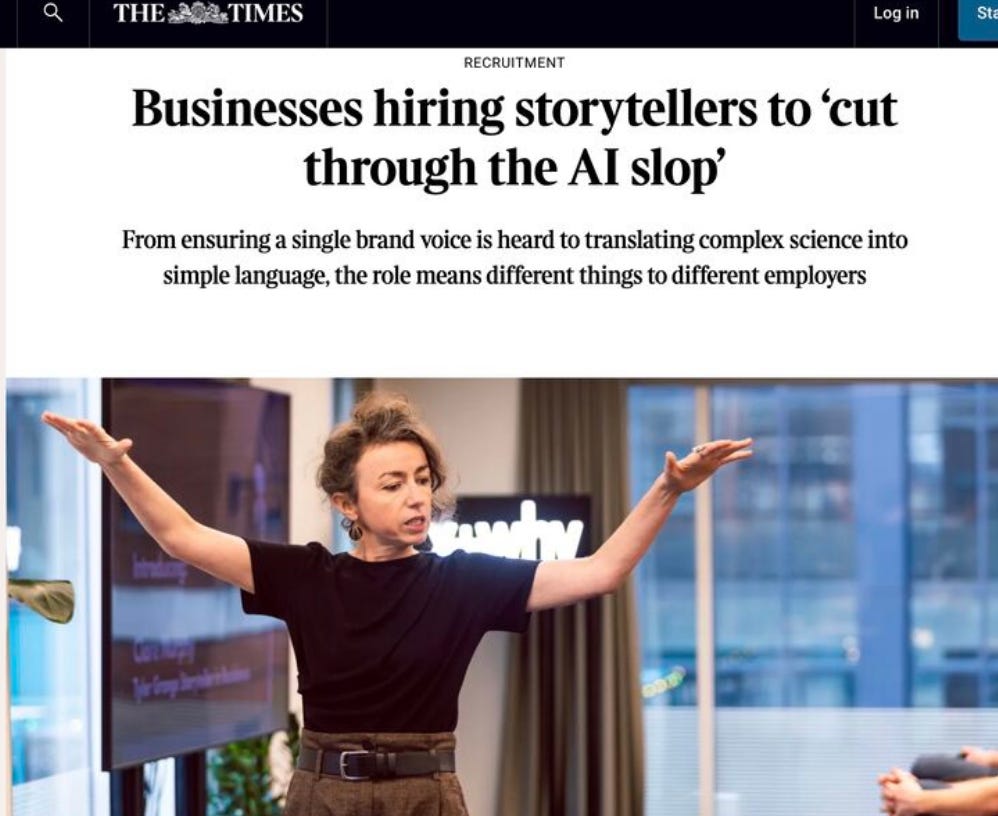
Headline above from The Times of London
The Super Skill Of The AI Age
A couple years ago, my friend Joe Lazer (co-host of The Art Of The Zag) took a book proposal out to the big New York publishing houses. It was the sorta-early-days of ChatGPT, when I was busy freaking out about losing my writing career to the robots.
Apparently a bunch of big New York publishing houses were, too. Because they told Joe the entire premise of his book was wrong.
Joe’s premise: “Storytelling is going to be the ‘super skill’ of the AI age.”
The ability to draw from our own human experiences and connect with other humans through story, Joe argued, was going to become more and more valuable as AI got smarter and ate up all the technical jobs.
“BuT cHAt gpT CaN WRitE bLog pOSts noWWW!” everyone said. “Writing is nigh deceased. We shalt be looking for the exits.” (I’m paraphrasing.)
Cut to 2026, and the publisher who did say yes to Joe’s book—Super Skill: Why Storytelling Is the Superpower of the AI Age—looks like a genius.

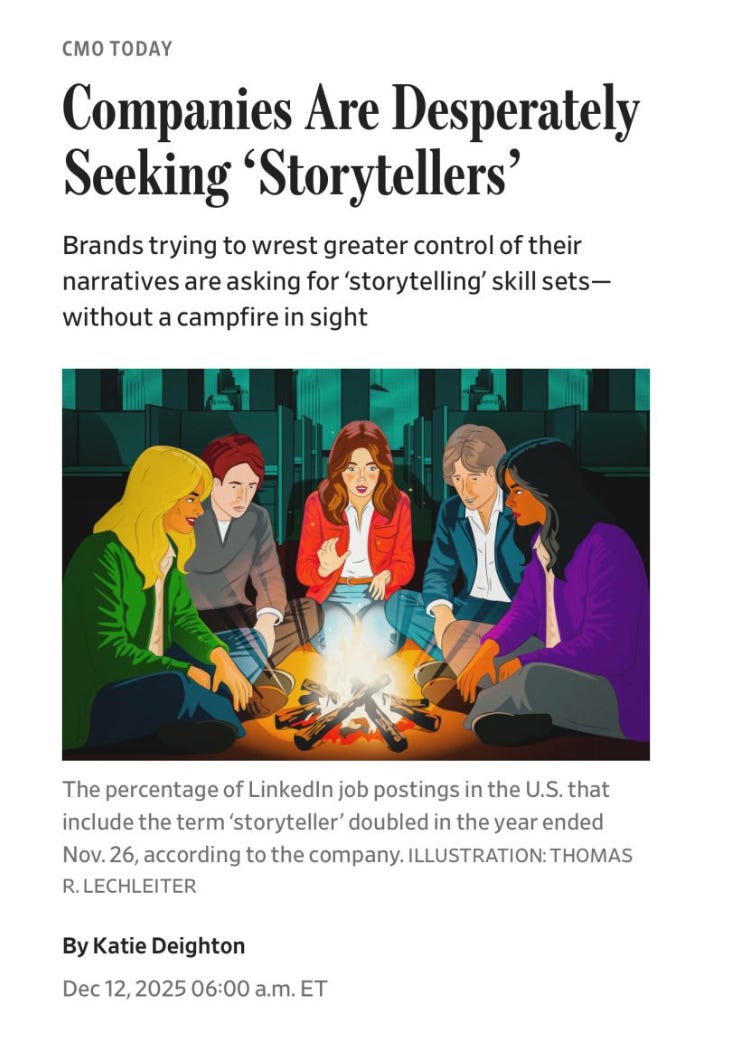
That’s because Joe is right about this super skill thing. Case in point: All the big AI companies have been hiring storytelling executives lately. Chief Story Officer. Head of Brand Storytelling. Etc. And they’re hiring them for massive salaries.
Turns out ChatGPT can’t shape its own company’s brand narrative in any kind of compelling way.
Anthropic’s job description for a $400k/year Creative Officer role overseeing company storytelling included this: “We care about craft, making things by hand…”
More interesting—to me—than the fact that the big publishers predicted this wrong and Joe predicted it right, is the question Why?
Why would human storytelling be such a big deal at a time when AI seems like the only deal the business world is talking about?
The answer actually starts with a book Joe and I wrote together 8 years ago. In The Storytelling Edge we explored the emerging neuroscience research of how great, relatable, novel human stories help us build relationships and make people care. And you know what kinds of stories don’t make us care? Generic, watered-down, machine-washed stories spat out by a chatbot. Our brains simply don’t light up without the novel and relatable human component.
Around that same time, Derek Thompson made a similar case in Hit Makers for how human relatability and novelty are responsible for hits in music, TV, and culture. Meanwhile, Allen Gannett laid out how to find the sweet spot of human relatability for creating art that people love in The Creative Curve. Science is quite clear that generic and un-scarce doesn’t get our brains going.
Joe’s work since then has built on this science, and in his book, he lays out several compelling truths (and tactics) based on his storytelling work over the last 8 years—as well as his time embedded in inside the AI industry
Ten years ago, the #1 business skill was coding. Today, AI can write perfect code, but it struggles to tell stories that connect with people. And behavioral psychology, the neuroscience of storytelling, and the way AI is trained tell us that’s likely to continue.
An over-reliance on AI leads to cognitive atrophy, but there’s a flipside. If you use your brain first, and then use AI as a strategic amplifier of your abilities, you can gain an advantage over those sucked into the sycophantic black hole of ChatGPT.
There’s a practical science to telling stories that make people remember you and trust you, which Joe lays out in 15 actionable principles.
AI can mimic a lot of things—and it will get better at writing at some point—but AI cannot have unique human experiences in the real world and then draw from them to connect with people at the emotional level that real humans can.
This has all sorts of implications for leadership and motivation, for sales (where human trust is perhaps the biggest asset salespeople can have right now), and for us all not getting freaking depressed by how smart AI keeps getting. Storytelling is part of what makes us human. It’s something we should lean into as the robots keep getting upgrades.
Basically what I’m saying is you should buy Joe Lazer’s book. Super Skill comes out today, and it’s fantastic. Here’s a link:
https://joelazer.com/superskill
In honor of the book launch, we’re doing a special live episode of The Art Of The Zag where I’m interviewing Joe about storytelling in the AI age in a livestream this Friday.
Sign up here:
Make a great day!
Shane
Thank you Shane! You shaped so many of the ideas in this book over the years, and I've learned so much from you as a storyteller. I'm also giving away signed copies to people who subscribe to my Substack this week! Check it out: https://storytellingedge.substack.com/p/my-new-book-super-skill-launches