


Three years ago, on a random March day, a flurry of text messages started blowing up my phone.
I was part of a private Signal group of CEOs, started by a prominent investor who had invested in all of our companies. People posted occasionally about tech industry news or job openings. But on this day, our shared investor posted this:
“If you have money in Silicon Valley Bank, get it out now.”
(I’m paraphrasing, because the message has since disappeared.)
A scramble of questions ensued, along with reports from these CEOs after they’d successfully withdrawn from their SVB bank accounts. I didn’t bank with SVB, so I wasn’t faced with the moral dilemma of contributing to a run on the bank versus the rational self interest of not getting screwed.
Within two days, SVB went under.
This is the topic of this week’s The Art Of The Zag, with Dr. David Schoorman:

Listen to the whole episode on Spotify, Apple Podcasts, or watch on Youtube.
Ignorance Is Emotional Bliss
Depending on who you ask, 85 to 94% of Americans trust their banks. Compared to trust in media (which 28% of Americans do) and trust in the overall US government (which only 17% do), banks are killing it in the trust department.
Until they don’t.
Economists widely believe Silicon Valley Bank could have pulled through its rough financial situation had it not been for the unprecedented speed at which the tech bros in Signal threads like mine had pulled their money out.
SVB’s business problems didn’t kill it; panic killed it.
Runs on the bank are a dramatic example of the subtle psychology of trust that most humans don’t consciously grasp. I say this with confidence because it was only a few months ago that scientific research has properly broken down this psychology. In 2025, Dr. David Schoorman of Purdue University (whose groundbreaking work on trust psychology I wrote about a few years ago here) and colleagues published a paper in Academy of Management Review about “The Experience Of Vulnerability In Trusting Relationships.” Whereas Schoorman’s previous work broke down the psychology of how we decide to trust people and institutions, this new research delves into how we blow it in relationships where we’ve already decided to trust someone.
A bank is a perfect example. If you’ve put your money in, you’ve made a tangible decision to trust. You are vulnerable to the bank losing your money. But you trust that it won’t.
Once we have decided to trust in this way, we humans are pretty locked in. It takes a full-on betrayal to drop our trusting stance.
Or, Dr. Schoorman’s research finds, we just have to feel the emotion of ANXIETY.
We usually think of trust being broken by the one we trust—aka the “trustee”—Schoorman explained to me in an interview. But much of the time trust is dropped by the trustor—the one who chose to trust in the first place. Schoorman and his colleagues, Gary A. Ballinger of University of Virginia and Kinshuk Sharma of University of North Texas, modeled out how this occurs over a series of exercises.
“We can show the circumstances that may cause a trustor to bail out on a relationship,” Schoorman explained. “The model shows how processing new information about ability, benevolence and integrity can cause increases in hope and especially fear and lead to a premature decision to exit the relationship.”
A premature decision to exit the relationship is the perfect way to describe what customers of Silicon Valley Bank did… which tanked the bank.
If Wall Street analysts are correct, had people not exited the relationship, Silicon Valley Bank wouldn’t have tanked at all.
So what happened? According to Schoorman’s model, anxiety happened. And that anxiety was because of transparency.
If your bank is having business problems, Schoorman explains, “Your bank may be sharing that information with its investors and in turn the investors are spreading the bad news on social media,” Schoorman explained. “This increases the perceived risk of your investment and produces increases in fear which may lead you to withdraw your money.”
If instead your bank wasn’t as transparent about its problems (say, until it had solutions worked out), the panic wouldn’t have happened.
And this brings us to the thing in this newsletter I’m planning on getting more than usual number of angry replies about: location tracking.
Why Tracking Your Partner’s Location (Or Your Employees’ Work) Destroys Trust
Dr. Schoorman recently applied what I’m calling The Trustor Bailout Model to his own university students’ romantic relationships. He polled students about how many of them tracked their partner’s phone location. More than 80 percent did so, he said, citing safety as the main reason.
However, after digging in, Schoorman said, “Many were willing to admit that there was an element of control that they wanted to have.”
Regardless, here’s how location tracking erodes relationship trust:
The person being tracked knows they’re being tracked and goes about their life. Everything is fine. They are in a relationship where they are trusted.
Then the person doing the tracking checks their partner’s location, and what they see causes them to feel anxiety.
The Tracker—aka the trustor—then starts asking questions, driven by the anxiety, having lowered their trust in the trustee because of the story the trustor writes in their own head about what they’ve seen in the tracking app.
The person being tracked gets angry, believing that their partner is no longer trusting them like they used to.
Fun ensues.
Examining this situation impartially, you can see that additional information caused the trustor to lower their trust.
Schoorman reports that students who took the challenge of deleting their tracking apps “felt much better about their relationship since they stopped tracking.”
And the same goes for bosses who track their employees’ time rather than letting people self-report. A boss who can zero in on detailed tracking information is likely to lower their trust when their brain has to fill in a story about activity they don’t understand, which starts a downward spiral in the employer-employee relationship.
Some But Not All Transparency Is Good For Trust
This is a hard one to grapple with emotionally. I don’t like the idea of less transparency in my relationships. But the research is clear: information transparency often ruins trust when it doesn’t need to. (Or more specifically, we often feel fear and screw up our relationships when we get information transparency.)
There’s good news, though. This is not an either/or situation.
It turns out that like other virtues, transparency is good—and only good—when tempered with wisdom.
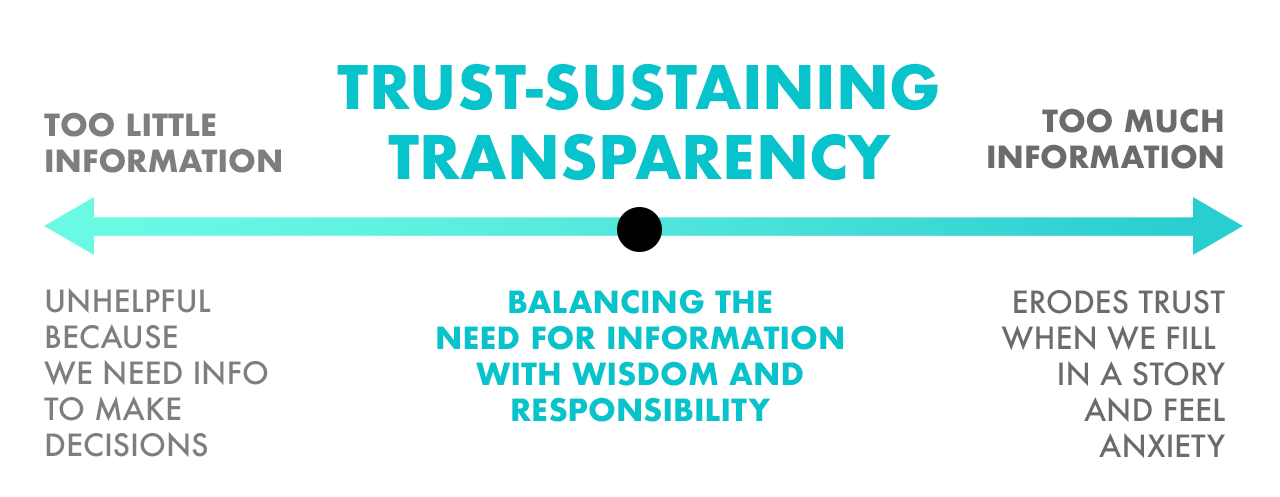
What does it mean to temper something with wisdom? It means that we bring in other virtues to weigh in on the dilemma. I have a gigantic nerdy essay on this here, but the habit I recommend is to take your list of values, and ask how they should balance out your decision.
E.g.
How would the virtue of kindness affect this decision around transparency?
How would the virtue of courage affect this decision around transparency?
How would the virtue of integrity affect this decision around transparency?
Weighing the decision of how much to disclose publicly about SVB’s business situation through these different lenses might have led to the conclusion that waiting until there was an action plan for solving the bank’s problems before outlining them in detail would lead to the least amount of harm to customers. (Of course, with banks we have the complicating factor of the law requiring certain disclosures; but I have a hard time believing SVB couldn’t have done more here… methinks that hubris was afoot in this case. And they did end up getting bailed out so…)
More important than all this, in my opinion, is the notion that we should take our responsibility as Trustors more seriously. If we panic and lower our trust in people we’ve already decided to trust, it’s our fault when the relationship starts spiraling.
Maybe just don’t check your partner’s location. If you trust them, why do you need to?
Listen to our new The Art Of The Zag episode on the psychology of trust Spotify, Apple Podcasts, or watch on Youtube.
Food for thought that I’m going to keep chewing on myself.
Make a great day—
Shane