


When my son Quentin was one month old, he loved watching Game of Thrones.
Actually, he loved this piece of cardboard with black and white spots on it. We called it “The Cow Card.” But he would watch it like it was HBO. He would lay there staring at it for episode-long stretches, totally immersed.
Turn the card over, and the zebra stripes on the other side would unleash an entirely new level of emotion. Episode 2.
My Google Home randomly displayed a picture of Q at that age the other day, and I got choked up as my brain transported me back in time.

Me and Q, age 0. Not pictured: The Cow Card
In neuroscience terms, what happened in both of these cases (Q watching The Cow Card and me going back into the memory of it) is called “immersion.” And there’s a reason this is built into human biology.
Now I’m going to share a more tragic family story. Fast forward to brunch last weekend, where my now moppy-haired, 3-year-old son was biting the ears off of Mickey Mouse pancakes, and I observed a bastardized kind of immersion. It was two parents and a kid, sitting at the table next to us, all mindlessly scrolling on phones and tablets. Not talking to each other. Not chasing their four-year-old around the restaurant. Not even paying attention to their food. And not emotionally engaged in whatever they were scrolling past, either.
At one point I saw the four-year-old try to get his dad’s attention. Heartbreakingly, he soon gave up and went back to watching what looked like an AI generated 3D cartoon.
Neuroscience explains this, too.
Attention, Emotion, and Immersion—It’s All Science
We all know at this point that there are tricks that can get our brains to glue into a content feed. Technology companies have figured out how to hack our attention through hits of novelty and dopamine—the same tricks that keep gamblers going at the slot machine.
But there is a massive, measurable difference between mindless attention and the kind of “immersion” that moves our hearts . The kind that inspires us to do hard things. The kind that brings tears to our eyes and reminds us how much we care about another human being.
Dr. Paul Zak is the researcher who cracked open the science of that difference. Twenty-two years ago his lab discovered that a particular molecule in our brains is a key driver of trust and compassion.
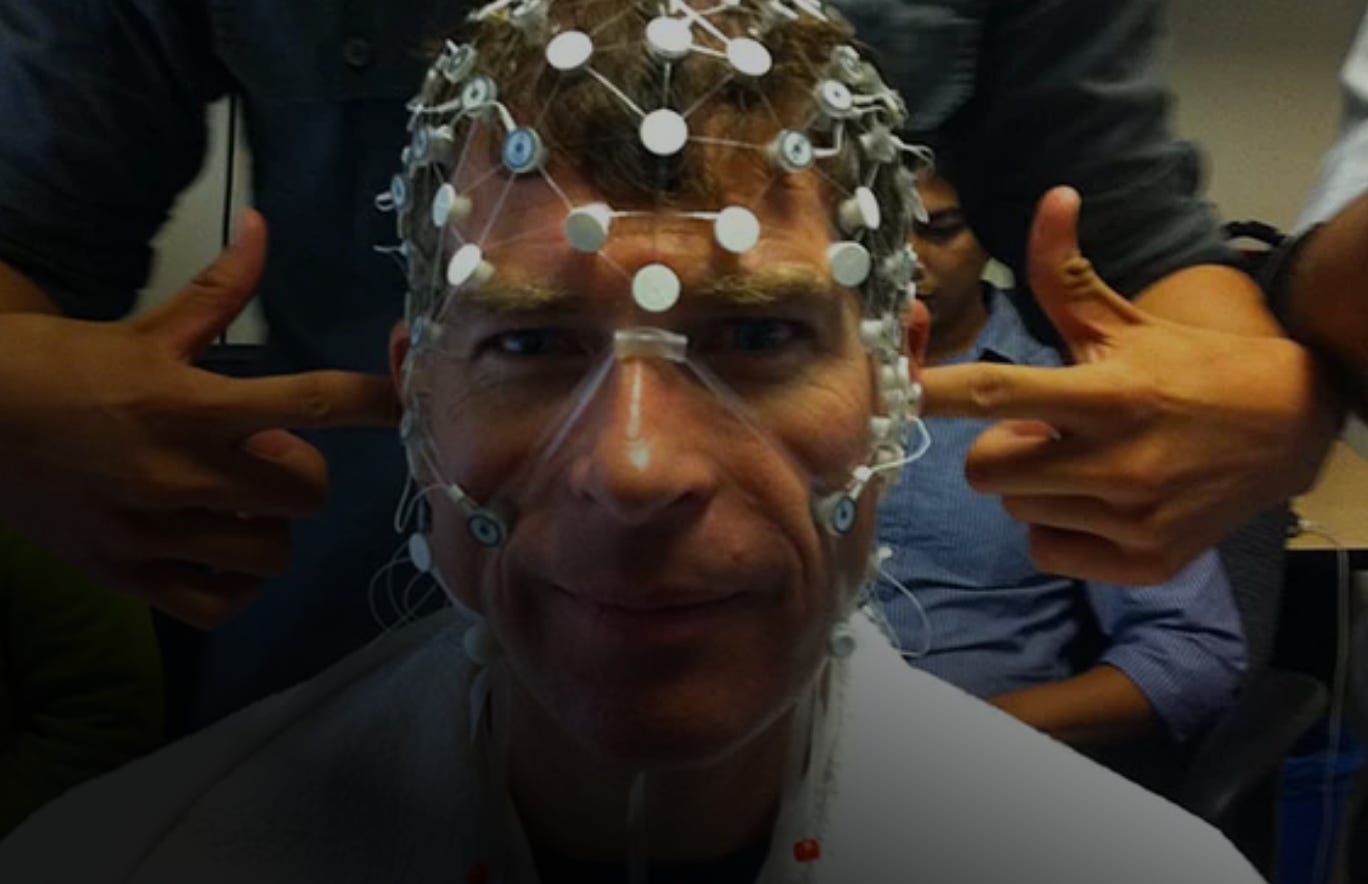
Dr. Zak ran experiments where his lab would draw blood from people before and after various experiences—learning something new, working on a puzzle, interacting with a stranger, watching a movie, seeing an advertisement. Among their findings was that a now-famous molecule called oxytocin was present in people’s bloodstreams after certain experiences. In particular: being shown a kindness by a stranger, being given a hug, and watching a video with an emotional human story.
The story thing was among the most fascinating, so Dr. Zak doubled clicked on it.
Further experiments found that people are more likely to care about charities after they see an advertisement that has a strong story arc. The brain generates more oxytocin after hearing or watching a story than it did after viewing statistics about the charitable cause. And more people donated money when they had more oxytocin.
Fast forward, and Dr. Zak’s team (and other researchers who’ve taken the neuroscientific ball and ran with it) has discovered all sorts of biological nuances around the question of, as one colleague put it, “What makes people give a shit?”
I’ve been writing about Dr. Zak’s work for more than a decade. At this point, I consider him a great friend (and more importantly, a gem of a human being). So I wasn’t surprised when he said “yes” to coming on The Art Of The Zag podcast to talk about the neuroscience of getting humans to care. But I was surprised by some of the incredible takeaways from his recent research that I hadn’t heard yet.
Brain Rot Versus Immersion
“The human brain prefers to idle,” says Dr. Zak. It’s the most energy-intensive organ. So whenever it can shift to low power mode, it will try to. Think about any time you’ve gotten home and you don’t remember your commute at all. You’ve done that journey so many times your brain went on autopilot.
On the flip side, the times when our brains are most active are the times we encode the strongest memories. When “neurons fire together” they “wire together.” And when emotional signals in our brain are strong, we decide that whatever the rest of our brain is experiencing is important.
Turns out that for millennia, artists and leaders have tapped into the ability to engage and immerse other humans’ brains through one of the world’s oldest technologies: Stories.
We’ve seen storytelling motivate people to action throughout history. Now neurobiology tells us why. Novelty and focus dance with dopamine, which lights us up. Relatability and empathy shake hands with oxytocin, which makes us care. (And more, which Dr. Zak explains in plain English in our interview, and in his excellent books Trust Factor, Immersion and The Little Book of Happiness.)
But this beautiful network in our brains can be hacked in a way that mimics immersion but doesn’t actually inspire us to do good or change. Enter the infinite feed of dopamine hits of social video, AI slop, and slot-machine-style gamification of the brain’s desire to anticipate novelty. All the tricks without the heart. Ironically, this kind of attention sustaining content pulls us away from other human beings—like I saw at brunch the other day—whereas our brains were originally wired for these neurochemicals to bring us together so we can collaborate, care about each other, and survive.
I’m encouraged by the science that’s going into this area, though. Because it makes clear that videos aren’t inherently bad. Movies aren’t inherently bad. Stories aren’t inherently good or evil. They are tools we can use to either get people to mindlessly click, or get people to deeply care.

Four Immersive Story Tips To Start With:
What does this science tell us makes the difference between stories that immerse us and bring us closer to people versus content that pulls us away? In our interview, Dr. Zak, my co-host Joe Lazer, and I, dig into a few:
It pays to “come in hot” in the first 15 or so seconds with something both unexpected and relatable. (Brainrot purveyors use this one to hook people, but instead of following up with the rest, they simply hook us with the next “hot” thing over and over.)
It pays to have anthropomorphic characters experience emotion (which we mirror, thereby firing the emotional centers of our brains).
When there’s tension, we care about the outcome of the story (and stick around to the resolution).
When we can let the rest of the brain idle, the brain puts more resources into focusing on the story (its characters, their journey, their emotions). So it pays to make people not have to think so hard. (In other words, don’t try to sound smart; try to make the journey easy.)
You’ll recall that I started this essay with a personal story about my baby. The Game of Thrones bit was unexpected. Describing how the memory brought me to tears was an emotional human experience that even those who don’t have kids can relate to. The bit about the family staring at their phones and the kid trying to get his dad’s attention created tension and invoked more emotion. These stories are all true, but I wove them into this essay on purpose. And hopefully this was all easy enough to get through that you didn’t have to invest extra brain resources by jumping out to your mental dictionary.
(BTW, for any fellow Star Wars fans who want to share a quick video on these four elements of impactful storytelling, I talk about how Baby Yoda embodies all of them here.)
At the end of the day:
If we want people to “give a shit”—about what we have to say, about the causes we care about, or even about the businesses we’re running—there’s a scientific formula. (And it gets much deeper and chewier than just what I demonstrated in that measly example.)
In this era of ubiquitous screens and SO MUCH CONTENT clamoring for our attention, it’s going to pay more and more to understand how human attention works—and how to turn attention into care, compassion, and action.
Watch the episode here to learn how you can do that, or listen on Apple or Spotify. And make a great day!
–Shane
Truly my favorite episode yet