



The word “disruptive” means something different in media and pop culture than in business strategy. We hear “ChatGPT is disruptive” and we think, “AI is game changing.”
And it is. But the term “disruptive innovation” as coined by Harvard professor Clay Christensen, has a key subtlety to it that should give us pause. And also that can help us make more strategic decisions in a world that won’t stop changing.
“Disruptive technologies [are] technologies that result in worse product performance, at least in the near-term …
Products based on disruptive technologies are typically cheaper, simpler, smaller, and, frequently, more convenient to use.”
In other words, the real definition of “disruptive innovation” is “game changing, but crappier.”
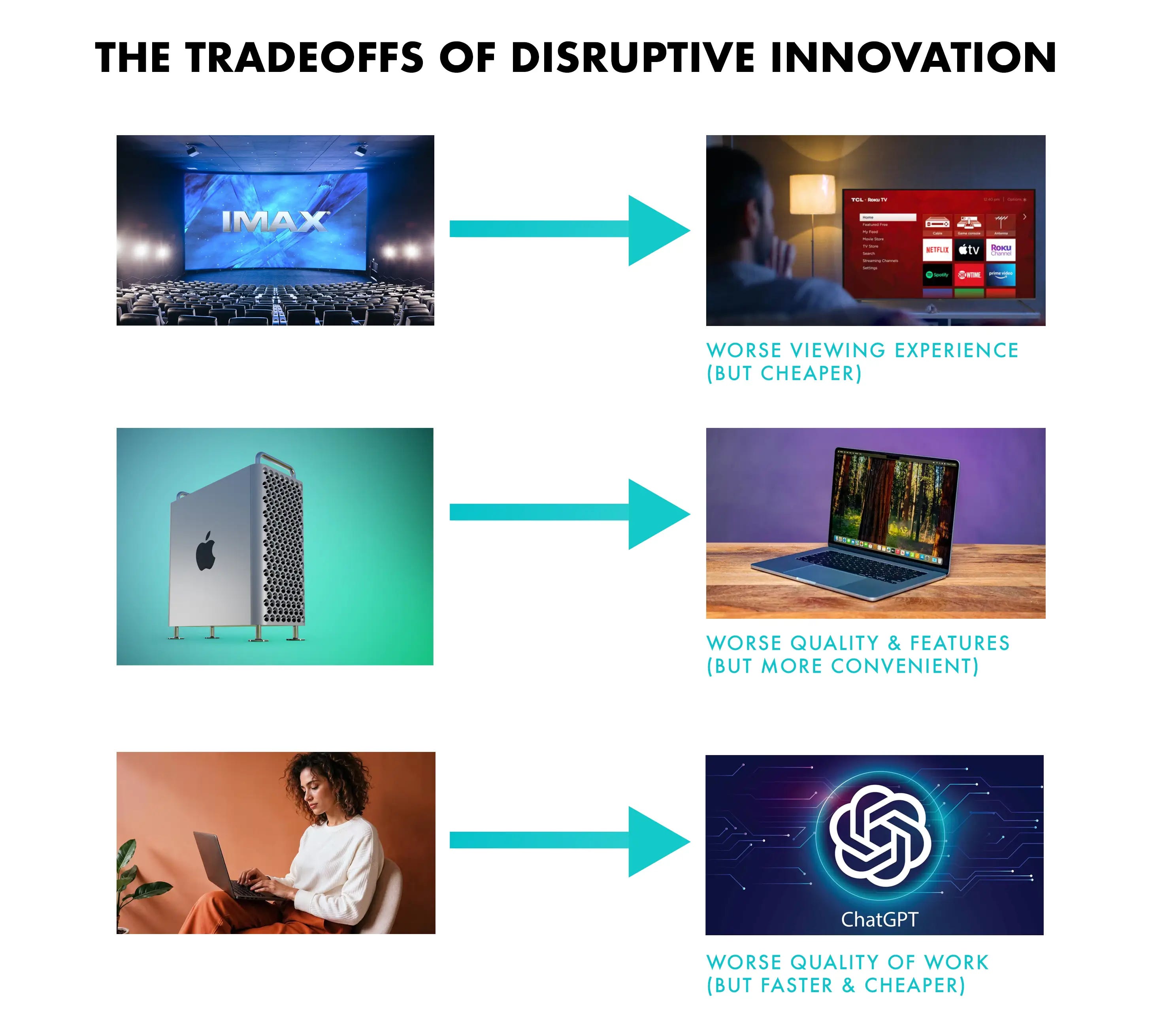
When laptops came out, they were way worse than desktop computers. But they were more convenient, so they stole market share from desktops.
When home video came out, it was a worse viewing experience than going to the movie theater. But it made it cheaper and easier to see more movies. (Same thing when Netflix came out: it made watching movies cheaper and easier than going to the theater… but still on a smaller screen and still with less immersive vibes.)
When little Honda and Kawasaki motorcycles came to market, they were so much flimsier than Harley Davidsons or BMWs. If you touched the brake wrong it would fall off.
But those babies were cheaper. And so they disrupted the American motorcycle market.
Which brings us to today: the latest in a long pattern that hasn’t changed—except to get even more extreme.
AI tools like ChatGPT and Claude are disrupting Google search. And they’re so much less reliable. They’re so much less accurate. They use so much more electricity.
But they’re more convenient. They’re easier. And they’re free or basically free.
Why does this matter?
Remembering What Disruption Really Is Helps Us Make Decisions More Deliberately
Just because a technology is new and taking off doesn’t mean it’s better. Often (usually) disruption happens with a worse product that’s cheaper and easier to use. This is what we’re seeing now with AI.
In MIT’s annual AI report this year, the authors lamented that most organizations have not adopted AI to the point of disruption. I think this may actually be a sign of prudence, rather than laggardly behavior.

If you’ve received an earful about how you or your company needs to use more artificial intelligence RIGHT NOW or you’ll be left behind, it’s important to remember that right now AI is WORSE at most things than a good human. Even those hot new enterprise tools that are being advertised at the airport and on Formula 1 cars... do a worse job than the best human beings.
And they’re cheaper and faster and easier.
This doesn’t mean don’t do what your boss is telling you. It doesn’t mean don’t try out new tools so you can understand them and see when they’re the right choice.
What it means is you should remember that this is a tradeoff.
When we remember that, we can be deliberate about how we integrate new tech like AI into our work and lives. If you can stop and ask yourself “is this an instance where the cheaper, faster solution is worth the fact that it’s worse?”, then you can avoid the holes in the road that the bandwagon falls into.
Because though sometimes the answer indeed is, “Faster is worth it,” the answer also is, sometimes: “No. Better work is worth paying for.”
Truth is, if ChatGPT cost as much as a full time employee, nobody would use it. Why pay 5 or 6 figures for a robot that hallucinates all the time and tells the dumbest person you know that their ideas are brilliant?
If you want a better result, don’t replace a better solution with a hot new one.
And yet, for $20 a month, I can have AI automate and streamline boring and time consuming things that allow me and my fellow smart humans to do higher order work. That is worth it, even if the low-level stuff gets a crappier execution.
What I’m trying to say is, if you are ok with a 10% chance that ChatGPT is wrong about that lump on your neck being fine, it’s your call.
But if that lump starts moving, please visit a human doctor.
Disruptions Don’t Stay Crappy Forever… And Yet
Now, eventually laptops did get good enough to do the job we need them to do. You don’t need a desktop anymore to answer emails or run Photoshop.
Kawasaki now makes motorcycles that are safer and don’t fall apart.
And AI is going to get more effective and accurate.
But remember: a big ol’ desktop computer is still better than even a really awesome laptop.
Harley Davidson still makes the sturdiest motorcycles.
It’s still a better experience to watch a movie at an IMAX theater than at home on Netflix.
Sometimes we want that.
Shane Snow is an author, speaker, producer, and explorer.
If you enjoyed this one, check out my keynotes and post archives:

Good stuff! AI Search is an interesting example because I'd actually argue there's not a big difference between using ChatGPT and Google right now, since Google is disrupting itself so aggressively by making AI Overviews and AI Mode (powered by Gemini) the default search experience for most informational searches.
Best thing I have read on AI to date!