

A Tale of Two Pivots
In the first few minutes of the movie The Worst Person In The World, a young protagonist named Julie explains her problem:
“Being young today is different. The pressure is heart-breaking. There’s no time to think.”

Julie is intelligent but indecisive. She shifts from focus to focus, career to career, love interest to love interest. I won’t spoil the ending but let’s just say she learns the hard way that life doesn’t give you what you want—especially when you haven’t figured out what you want.
Now let’s talk about another movie: Ocean’s 11. In contrast to Julie, this film’s protagonist Danny knows what he wants: to rob the Bellagio casino in Las Vegas.
This may make him technically a worse person than the indecisive Julie.

But Danny does something different than Julie. Something that’s especially key for us in this unprecedented era we’re living through.
Danny Ocean spends two-thirds of the movie planning his heist. He recruits a team of cognitively diverse co-conspirators. They map out the challenge of getting past guards, getting into a locked vault, and getting away. And they make backup plans on backup plans.
And here’s the thing: In both movies, things go wrong.
Not sure if it’s the right thing to do or not, Julie leaves her boyfriend… who then gets cancer. Oof.
In the middle of the heist, Danny’s ex-wife shows up as the girlfriend of the owner of the casino they’re trying to rob. Oof.
In both movies, our protagonists have to pivot. Which is what we all must do in work and life—no matter how poorly (Julie) or well (Danny) we’ve planned things out. Pivoting is so key in business there’s a massively popular podcast named for it. Its importance for our personal journeys is captured perfectly in the subtitle of my friend Jenny Blake’s book: Pivot: The Only Move That Matters Is Your Next One.
What I’m saying is... well I’m using these movies to push a metaphor, k?

Both these movie protagonists are hit with setbacks. Both pivot. But only one of them ends up getting what they want.
It’s been 24 years so I’ll spoil it and tell you that Danny Ocean’s team successfully robs the casino, Danny reconciles with his ex, and then gets the gang back together for several more heist movies.
So.
Is all I’m saying “Do more planning and you’ll do better. Duh!”??
No.
The lesson—and the metaphor here—is more subtle.
The Enemy Of Innovative Thinking
A couple weeks ago I gave a speech about “thinking differently” aka lateral thinking, for a fantastic group called Focus Financial. These folks help athletes and rock stars manage their money, among other things. To help them think a little differently about their business in today’s shifting landscape, I shared case studies of newspaper barons who redefined best practices, hospitals that made breakthroughs after studying F1 pit crews, and etc.
It was fun stuff, but after the keynote I sat down with one of the company’s leaders for a fireside Q&A, and she asked me a pointed question—something to the effect of:
“When and where is there time to think differently in the first place?”
It was a great question that I have been thinking about ever since. My answer then was this:
“You’re right. The enemy of thinking differently.. is Time.”
In other words, as Julie from the movie pointed out at the top, our biggest constraint is that “There’s no time to think.”
After thinking about this question a little more, I have an additional answer that I wanted to share in a little more depth in this essay:
Because Time is our enemy, we must deliberately shift between two Thinking Modes:
Thinking Mode 1: Think & Rethink Our Approach (Using Lateral Thinking)
Danny Ocean and his team took a lot of time to come up with a clever plan to rob the Bellagio. And even though they didn’t anticipate every twist and turn, they were prepared to pivot because they’d taken the time to think, and they’d taken even more time to rethink assumptions behind their thinking.
This is the crux of lateral thinking, and it’s what makes the difference between playing someone else’s game and reinventing the game.
But if we’re always in this Thinking Mode 1, we’ll never get anything done. You can in theory take unlimited time to gather perspectives and think and plan and plot. The opposite of “there’s no time to think” is “there’s no time to do.”
Thinking Mode 2: Execute (While Making Observations That Help Later In Mode 1)
In Ocean’s 11, there came a time to stop planning and execute. And because of the time they took in Thinking Mode 1, when in the heat of the moment, there was “no time to think,” Danny Ocean’s crew was prepared to power through and/or pivot.
I liken the two thinking modes to a factory.
There’s a time to design the assembly line (Mode 1).

And there’s a time to operate the assembly line (Mode 2).
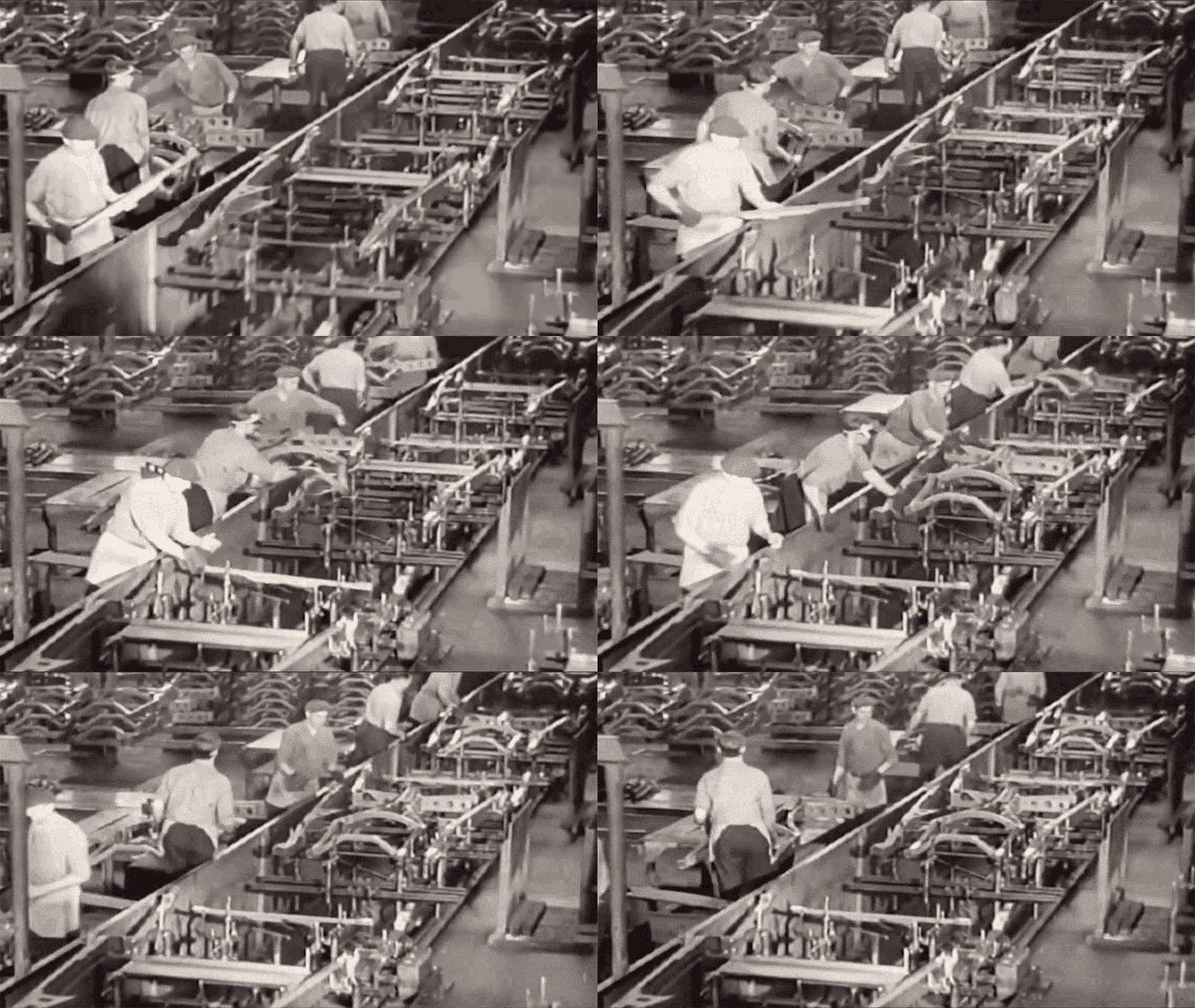
Now, if you’re operating the assembly line, you should still be making Observations that can help improve the assembly line—or reinvent it altogether—when it’s time to shift to Mode 1.
But when you’re operating, you’re in Mode 2, and that’s ok. In fact, it’s important to deliberately stick to Mode 2. We don’t want to be like Julie from The Worst Person In The World and change our approach willy-nilly.
This is the crux of the virtue of intellectual humility, in fact: To be willing to adapt and change, while knowing when not to.

Why being deliberate about the two thinking modes is especially important today:
We’re living through a time of whiplash. New AI tools come out every week and either threaten to upend our approaches, or they open up opportunities for us to rethink how we do things. But it’s all happening so quickly that it can feel like “there’s no time to think.”

In a recent Harvard Business Review article called “How To Lead When Things Feel Increasingly Out Of Control,” authors Eric Solomon and Anup Srivastava recommended something that’s stuck with me on this front:
“Protect leadership vision time like a critical asset,” they wrote.
“When every hour becomes crisis time, strategy suffers. Leaders must rethink their workdays to allow time for strategic thinking.”
In our ultraconnected world of “pings and dings” (as Indistractible author Nir Eyal puts it) clamoring for our attention, we often find ourselves with no time to think—just time to execute.
But when we care about a goal, our best friend and biggest enemy is Time.
To do the work we were meant to do, we need to make a habit of carving out Time to think.
And more importantly, to rethink.
—Make a great day!
Shane
An award-winning business journalist and Tony-winning producer, Shane Snow is the bestselling author of Dream Teams and a renowned speaker on leadership, innovative thinking, and storytelling.
If you liked this post, you may also like my keynotes and courses on working smarter:

Great stuff! I'd add one more thought: Writing is thinking. Leaders who take the time to write strategic memos and articulate their thoughts have a huge advantage.
This is so smart. And the best recommendation for a friend's book I have every read. Just ordered Pivot!