



I’m writing this newsletter while working from Mexico City, where 50 years ago something tragic happened.
In June 1971, 120 university students who were protesting in the streets, along with a 14-year-old boy, were killed.
The killers: a government trained pseudo-military group called Los Halcones.
The Halcones were made up in large part by young adult men who’d been recruited with promises of nice pay in order to serve their country rooting out invasive people and ideas.
On June 10, 1971, the Halcones were sent in by the government to disrupt a student protest. They were directly instructed to bring bamboo poles to beat up journalists and smash cameras—specifically targeting anyone who could document the fact that the protest was peaceful. Things got out of hand (to put it mildly), and Halcones eventually pulled out pistols and rifles and shot students to death.
The most chilling part? After the massacre, Mexican newspaper headlines said things like this:
“Scuffle of Students”
“Student March Halted By Riot Police”
“Shots And Blows: Divergent Factions Responsible”
The major newspapers at the time were influenced (or directly controlled) by the Mexican government. Immediately after the massacre, a coordinated information campaign from the administration painted the killings as anything but. Protesters were called “agitators” and blamed for starting a riot that resulted in their own deaths.
The President of Mexico, Luis Echeverria, specifically said that “left wing agitators” had caused it.
Fortunately, a few journalists and photographers survived the massacre with their cameras intact. Photos eventually came out, showing what really happened.
Once the photos came out, Mexico’s President still cast himself as a victim, claiming that both “left wing and right wing” extremists had done this, despite his own desire for peace. Even though it was his own government who created and directed the Halcones.
A few people in the Mexican government got ceremoniously sacked after the photos came out, but history shows us what really happened, and that the administration itself was complicit despite its campaign to manipulate the media.
This is a 50-year-old story.
But does it sound more current?
I normally focus on business here. I wish today’s post could be about the uplifting storytelling this weekend in our new musical Jo in London. But in light of current events in my home country, I’m hoping to do my part to help folks think a little differently about the stories we’re fed. This post is specifically about tragic killings in Mexico and Minneapolis, but the takeaways here can help us out in our everyday lives as well—both in our relationships with media and other people.
Story manipulation is a playbook that repeats itself.
I’m 2,000 miles from Minneapolis right now, but I’ve wanted to throw up all week.
Watching the video of federal agents shooting ICU nurse Alex Pretti to death in broad daylight has given me insomnia. But having spent years studying media manipulation in history (from communist propaganda to modern Russian state media to the CIA’s pioneering of fake news in Latin America), watching the media manipulation of Alex’s killing has put a rock in my stomach.
(Here is video of a meticulous reconstruction of what happened. Warning: it’s graphic.)
We’re experiencing a moment where—right now—not pushing back when we’re being manipulated may very well lead to 1984. We regular people (and our institutions) have power; it’s our choice whether we give that power up.
“But how do we know who’s telling the truth?” This is a common refrain I hear from friends and family back home who get their news entirely from Facebook. I will text people about something bad that’s been reported in the news, and they’ll say, “Are you sure?” or repeat an intellectually dishonest talk radio line that starts with, “Well what about…”
To avoid falling into the manipulation trap when consuming media, I like to remind myself of the first two tenets of journalism ethics:
Seek the truth as fully as possible
Seek to minimize harm
Anyone who isn’t doing these things isn’t performing ethical journalism.
More practically, when someone tells you a story, look for an attempt to fulfill these two elements—seeking the truth as fully as possible, and seeking to minimize harm. If you don’t see it, you should be skeptical of what you’re being fed. And you should use it as a trigger to employ extra critical thinking.
There are lots of ways to manipulate people with storytelling. But there are three big ones right now in mainstream news and social media that, once you start noticing them, you’ll have more power to see when you’re being manipulated—and hopefully, help others see too.

Manipulation Tactic 1: Telling you the story before they know the story.
Something happens. People react. And then what?
We all make up stories in our heads. The more information we have—ideally, objective observations—the more accurate the story. But with limited information, our brains fill in the story with our best guesses. Or with wishful thinking. This is human nature.
But when someone tells you what the story is before they have all the information, they’re manipulating you.
The day after 120 students were beaten and shot to death in Mexico City, the Mexican government declared it was the students’ own fault. There was no time for a proper investigation. These were the days when it took hours to develop a photo. Twelve hours later when the headlines came out, there were few journalists at the scene who were alive or unhospitalized to reconstruct a murder scene.
And yet the conclusion of what happened and whose fault it was had already be “reached” by the government.
Mere moments after Alex Pretti was executed in the street in Minneapolis, the US government did a similar thing:

Border commander Greg Bovino gave this statement before he knew the story. Before any investigation. Before a review of video footage of the event.
This is classic media manipulation. And it can work on us when we don’t get any further information.
Fortunately for the truth’s sake, we have video showing what happened.
Video doesn’t show us who Alex was. Video doesn’t let us read his mind. But it helps us understand that we’re being lied to in this case. Just as photos showing the Halcones murdering students in Mexico eventually turned the public eye to the truth in 1971.
We shouldn’t have to say this, but: Before you tell the story… you need the information.
The same thing happened with the killing a few weeks ago of Renee Good. Immediately after the killing, and before an investigation, Homeland Security labeled the slain woman a “terrorist.”

Renee Good was not someone on a watch list. This was someone Homeland Security had never heard of. How did they possibly know the story yet?
As more information has come out about who Alex Pretti was—including irrefutable video showing what happened—it’s impossible to believe that the White House’s pre-emptive story is true.
But we shouldn’t even need the video to be able to say, “Wait, they haven’t investigated yet, and yet they’re telling us what the story is… are we being manipulated?”
As an aside: It will be tempting for some folks reading this to say, “You’re writing this article before we know the whole story!” But here’s the thing: I’m not saying don’t tell the part of the story that we have evidence for already. I’m saying don’t make the leap into the part of the story we don’t know yet. There is a big difference. Whereas we should always keep the door open to updating our conclusions in light of new information, we also shouldn’t decline to talk about things just because we only know the first part of the story. We have video and a coroner’s report. We should talk about it.
Upshot: When someone tells you a story before the facts have come out, be skeptical and seek more information.
Manipulation Tactic 2: Telling you the story of what’s in someone’s heart or mind.
This one is where the real tricky human psychology happens.
Something happens. It makes someone look bad. Perhaps it’s morally indefensible. (Like shoving a man onto the ground, taking his legal, holstered weapon away from him, then shooting him in the back 10 times.)
A manipulator will often seek to defend the indefensible position by telling you a story that gets you to not trust the victim.
Specifically, the thing to watch for is when they tell you what is in that person’s heart. They are a bad person inside. They have bad intentions. This way, no matter whether what happened is legal or wrong, it’s ok because this person is bad on the inside.
Hours after Pretti’s shooting, and before any investigation, a powerful figure said this:

White House advisor Stephen Miller said this before we knew anything about Alex Pretti. But instead of defending his agency’s executing a man without a trial, he climbs into the victim’s head to claim he was “an assassin” who “wanted to do maximum damage.”
Because Stephen Miller can read minds.
As I’ve written here and here, psychology shows that when humans decide to trust one another, we subconsciously look for evidence of benevolence above all else. Consciously, we try to suss out ability and integrity, but if we believe someone is not benevolent, we’ll never trust them. We recoil.
If we believe someone is benevolent, we’ll forgive their shortcomings.
Note what Miller and his colleagues don’t bring up: the fact that Pretti was an ICU nurse. At a hospital for military veterans. If they shared that information, you might believe that this man was a benevolent person.
But that would undermine the manipulative story.
So if you want people to believe that someone “deserved it”, or that your actions were actually morally okay despite being legally wrong, paint that person as having bad intentions.
Hence Stephen Miller claiming he somehow knows that Alex was a violent terrorist planning to do ill to good people.
Similarly, when you see things like this…

… you’re also seeing this classic manipulation tactic: Get people to believe that a whole group of people have evil in their hearts, so you can justify doing bad things to them.
(As an aside, I chose to use Stephen Miller’s own words as examples for this one because he specifically tells people what he thinks about all this. So we don’t have to read his mind.)
Here’s another, more subtle example:
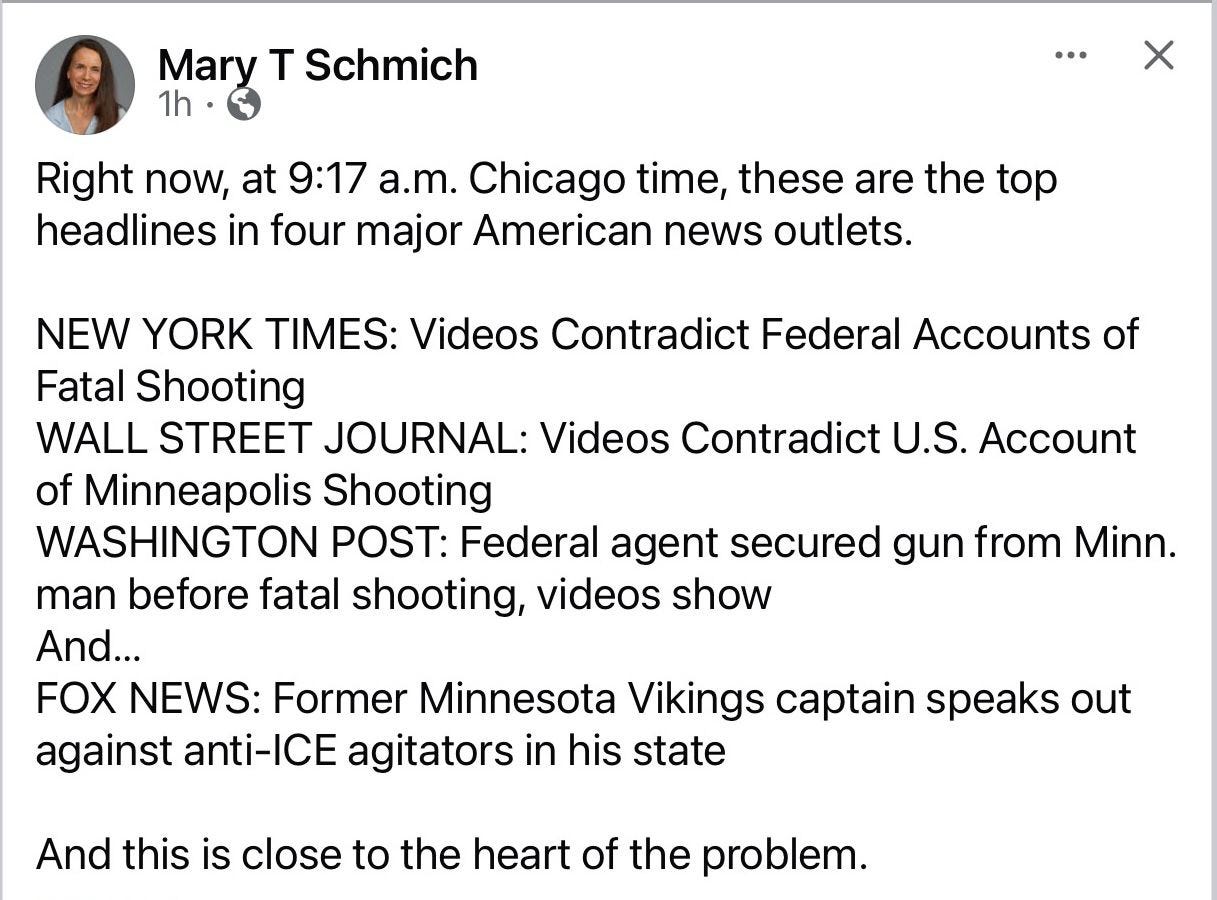
You can see that Fox News, the one outlet in the list that’s avoiding the issue, uses its headline to paint protestors as “agitators.” This is exactly the same tactic the Mexican government used in 1971.
You can’t ask a dead man what’s in their heart. This is exactly why dictators like Fidel Castro can turn people like Camilo Cienfuegos and Che Guevara into martyrs (after sending them to their death) to use in self-serving media campaigns. And it’s how people in power in America right now are trying to get away with murder: declare that the dead person was evil inside.
The good news: By leading with the story about Alex Pretti’s “bad intentions” before they knew anything about him, Homeland Security/ICE/WH actually created a major backfire. Similar to Echeverria’s government getting murdery egg on their face after photos of the Halcones killing students came to light, as soon as people saw the video of Pretti’s killing and learned that his job is literally to save lives, they gained trust in Pretti’s benevolence and lost trust in the manipulative story about him.
Upshot: Whenever a story paints someone’s intentions as bad, assume you’re being manipulated into not trusting someone—and possibly that you’re being distracted from facts. When you see this, seek more information.
Manipulation Tactic 3: Amping up the story with big adjectives.
As much as it can be infuriating to see news outlets report things neutrally, such as the New York Times headline “Videos Contradict Federal Accounts of Fatal Shooting”—when video clearly shows an unarmed man being shot in the back (why not come out and say “executed”?)—what you can take away from this kind of reporting is the newsroom is trying to stay away from manipulation.
We can talk later about journalistic responsibility that comes from having great power, and how some newsrooms are neutering their reach in the battle against sensationalist headlines. But for the purposes of this essay, the takeaway is when you see this kind of story you can assume that the author wants you to come to your own conclusion.
But when you hear stories with amped up adjectives, you can assume that the author is trying to manipulate your thinking (by manipulating your emotions). By painting such an extreme picture, the manipulative authors also set an anchor that makes it difficult to bring things back to reality.
You can see good examples of this in a typical press conference with White House Press Secretary Karoline Leavitt.
On the mayor of LA: “Mayor Bass embarked on one of the most outrageous campaigns of lies this country has ever seen…” (The most outrageous the country has ever seen?)
On the governor or Minnesota: “Tim Walz does NOT believe in law and order… Under the incompetent leadership of Tim Walz, Minnesota oversaw massive fraud schemes…” (Also note the mind-reading and painting of lack of benevolence.)
From my pal, Claude: here’s a quick analysis of some of Leavitt’s favorite words when answering difficult accusations:
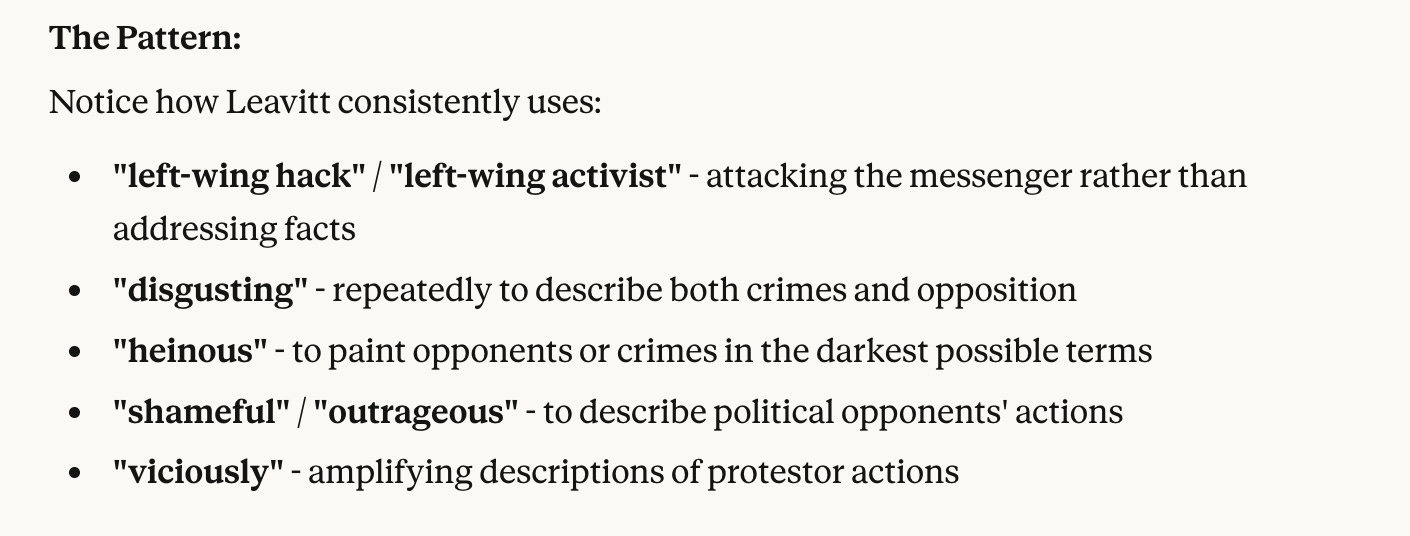
Anytime you hear these, you can assume that someone is trying to emphasize a strong point—and that you should seek more information to uncover the substance behind the exaggeration.
This is once again not anything new. When you look at the manipulative stories Echeverria’s government fed the 1971 Mexican people, you see these kinds of adjectives all over.
Now, I want to make clear what I’m NOT saying: I’m not saying, “adjectives mean something is false.” We need adjectives to communicate. And some true events are best described with strong adjectives. What I am saying is when you see strong adjectives, look closer before you believe it all.
Upshot: When a headline or quote is filled with strong adjectives, say to yourself, “Doth they protest too much?” and seek more information.
In summary:
Ask yourself these 3 questions to cut through story manipulation:
Preventing ourselves from being manipulated by others’ stories is an ongoing battle. But a good starting point is to ask yourself these:
“Does the story being told make any leaps that we don’t yet have observations about?”
“Can this storyteller read minds?”
“Does this storyteller’s adjectives protest too much?”
If the answer to any of the above is, “yes,” that should be a trigger to dig deeper and find more information.
We all contribute to the teams and communities we’re part of by peeling back our stories and aligning on facts.
Let’s use our power to do more of that.
I hope you’ll make a great day—despite the chaos swirling around us.
–Shane
P.S. For anyone reading this who says, “But you’re a Democrat…” I want to stop you right there. First of all, I’m an Independent. Second of all, please read the points above carefully (making up a story, reading my mind, painting my intentions). Same thing goes for anyone who skims the subheads and gets excited to comment about how this post does the things it says not to do. :) I’m sure this will have more unsubscribes than usual. So on your way out the door: thanks for reading, and I hope you’ll think extra hard about the stories you’re fed from here on.
Further reading:
Nothing Is True And Everything Is Possible (a very good book on modern state media manipulation in Putin’s Russia)
The Literally Unbelievable Story of the Original Fake News Network (a crazy true story)
On a lighter note, this post on boiling down of observations vs stories is a great habit to use at work and in decision-making in general.
Fantastic essay, Shane! Loved this one.
One of the best articles I have read, thank you!