


In elementary school in Idaho, they taught me that the pilgrims who built the American colonies came for religious freedom. The part my teachers left out is that they came here because religion in England wasn’t strict enough.
What kind of people would be crazy enough to cross a perilous ocean and build cities from scratch in frigid New England? And all so they could make people be more religious?
People who thought they could beat the odds, that’s who.
The charismatic preacher Roger Williams is a perfect example of this. He showed up in Boston early on and took over as Pastor… and then proceeded to tell those freezing zealots that even they weren’t righteous enough. People called him “divinely mad” for the verve with which he played prophet. He left Boston for Salem, where he tried and failed to get witch-burning Jesus-lovers to be even more pious. Then he went to the even more religious Plymouth, where he built a following around being “the really strict guy.” (not an actual quote, but accurate)
Plymouth eventually kicked him out.
(This photo below is called “The Banishment Of Roger Williams”)
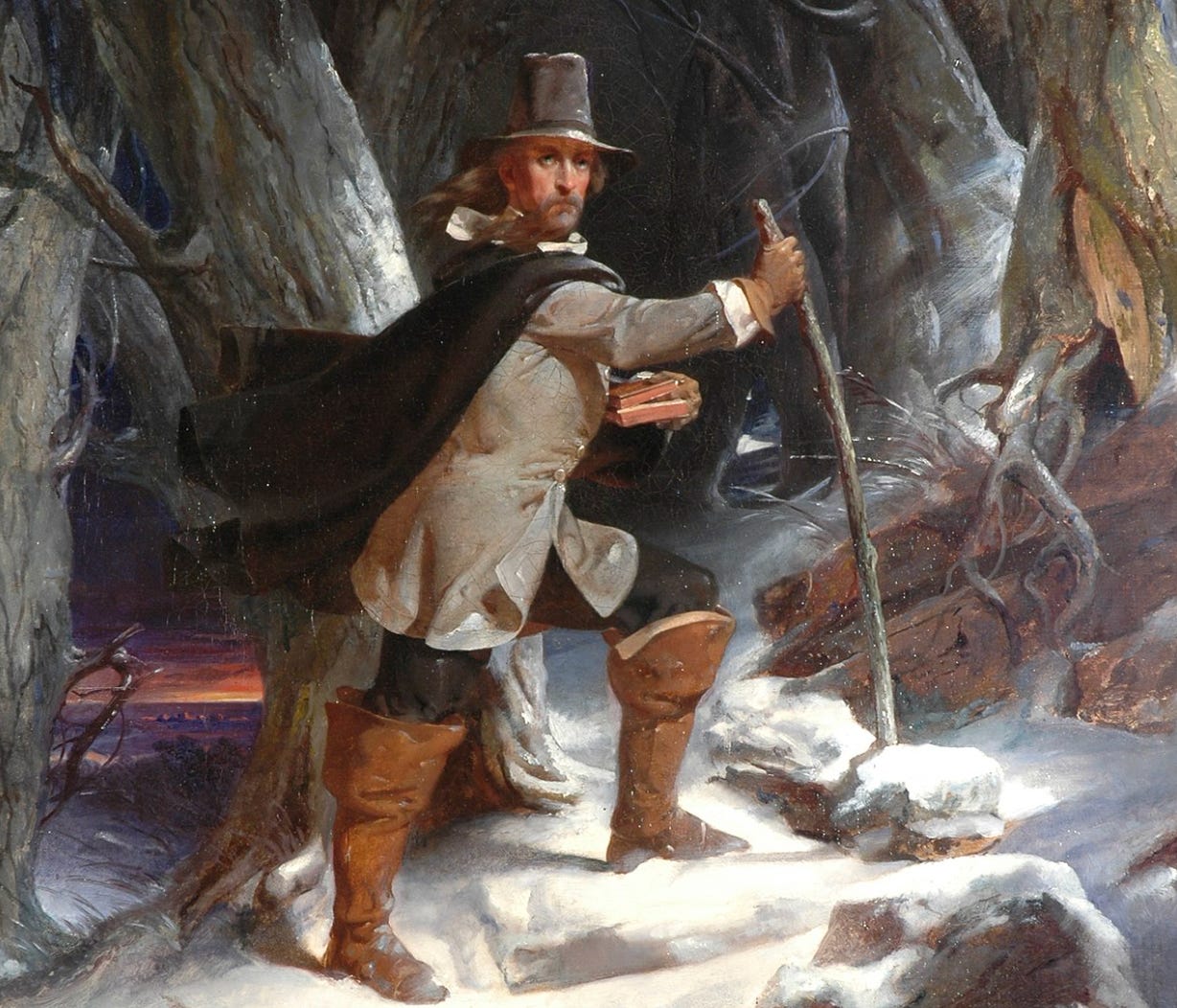
Renowned Psychologist Dr. John Gartner describes Williams’ personality as “combination of extreme zeal, odd ideas, and poor judgment” as “the classic presentation of the hypomanic.”
I’d been in the middle of reading about the nutjobs like Roger Williams who built the American Colonies in Dr. Gartner’s book The Hypomanic Edge when I re-listened to this week’s episode of my podcast The Art Of The Zag, and something fascinating clicked for me.
This week’s podcast guest is Mario Gabriele, creator of The Generalist. And whereas I’m not comparing him to the loony preacher Roger Williams per se, Gabriele is a bit of a prophet to Silicon Valley and Wall Street. The Generalist is a thriving tech industry publication built on Substack, and it breaks all the rules of the media business. If you’re interested in the media biz (as a creator, a brand doing content, or at the higher industry level) this interview is absolutely fascinating.
Mario wields a ton of influence as primarily a team of one. Not as an influencer peddling quick hits of dopamine. But by writing 12,000 word mega articles that economic chess players can’t get enough of.
And I believe that Gabriele’s is the kind of intrapreneurship we badly need in today’s AI / TikTok / doomscroll environment.
Listen on Spotify or Apple, or watch here:
But the reason Mario Gabriele’s story clicked for me with the story of America’s manic founders is because of a particular phrase Gabriele used to describe why The Generalist succeeded:
“The Right Amount Of Delusional”
Most businesses fail. Most startups lose all the money. Most pilgrims who crossed the Atlantic to settle America died doing so. (More than 80 percent of the Jamestown colonists died in the first year!)
What kind of personality does it take to believe you can beat the odds and not freeze to death at Plymouth Rock?
What does it take to believe that your business will succeed when most don’t?
That your novel idea will work when the rest of the world thinks a different way?
Mario Gabriele says it may have been his naivete about the media industry and how hard it is to do something different that led him to email busy executives mega-articles in an era when everyone says 60-second video reels are the only way to get attention.
“I was probably ignorant enough,” Gabriele says, “that I imagined, well I don’t know what the standard is but I bet I could do something… better?”
He adds:
“Probably it was helpful to be so ignorant because it did allow me to be the right amount of delusional.”
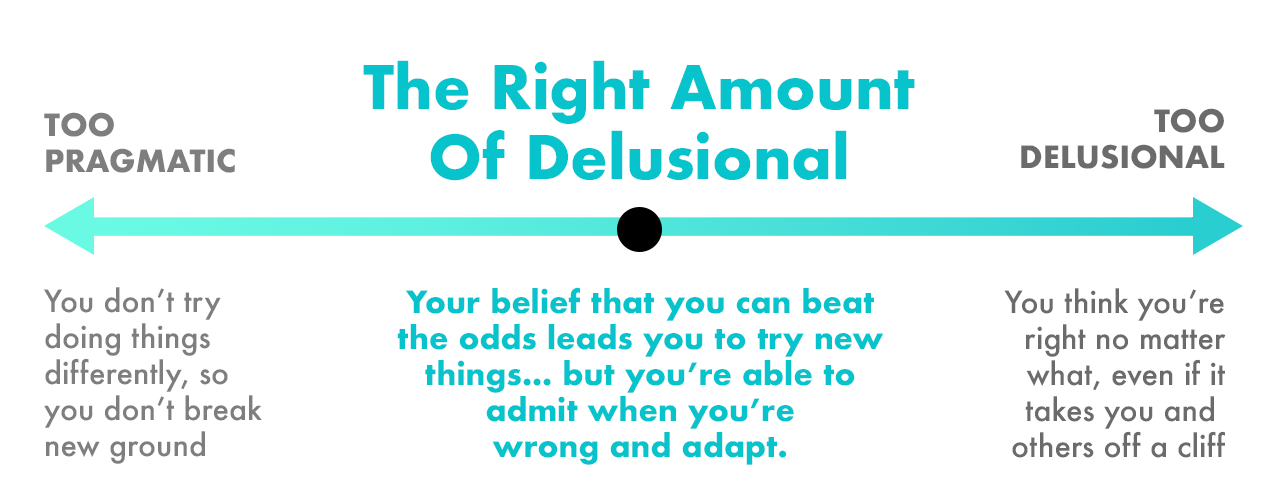
Another way to get the “right amount of delusional,” according to Dr. Gartner, is to be at a particular point on the manic spectrum called hypomania. Early American settlers, prophets like Williams, statesmen like Hamilton, and entrepreneurs like Carnegie showed symptoms of hypomania: manic energy, odd ideas, and a pinch of recklessness—but not to the point of insanity.
You can chart this out similarly to how I (over)explain virtues like courage and patience in my mega treatise on wisdom and values here.
“The Instrumental Value Of Hope”
The behavior afoot with both hypomanics and naive entrepreneurs has to do with the psychology of hope. Hope can drive us to make breakthroughs specifically when people aren’t optimistic about our chances of success. Psychologists call it “the instrumental value of hope“—which is to say that having a small chance of success against poor odds can motivate us to think and work differently to overcome those odds.
After all, if the odds are against you, you’re not going to succeed by doing things the “usual” way. You have to use lateral thinking.
The key is to be just delusional enough that you try what others think is impossible—which forces creativity…. while also not going so far that you fall off the cliff. People who are too delusional start wars in the Middle East thinking they’ll be over in two weeks. People who are the “right amount of delusional” try ideas that others think are crazy, and then, crucially, they exercise intellectual humility and adapt whenever things aren’t working.
“The Business Has Changed Many Times”
In our interview with Gabriele, he explains that the secret formula to his success is not just taking a different approach than the rest of the crowd (zagging!) but by also changing the approach frequently.
When my co-host Joe Lazer pushed Gabriele on why he thought The Generalist’s zaggy strategy would work from the beginning, Gabriele pushed back. “Oh no,” he said. “The business has changed many times.” Gabriele pivoted business models over and over until something worked. (And worked well!)
People who are truly delusional tend to hang on to their ideas too tightly. It’s all entwined with their own ego / sense of identity. But people with “the right amount of delusion” that they can beat the odds are motivated to find a new path regardless of whether it’s the first path the Muses pop into their head. It’s the ol’ “stubborn on vision, flexible on strategy”.
“High Intention Work”
The pivot that ended up working for The Generalist is, like many great ideas, only obvious in retrospect. Rather than chasing mass attention—which is the prevailing model in media today—Gabriele started providing very exceptionally deep value for a small group of people.
Influencer culture has us all convinced that being as popular as possible is the “way it’s done” in media today.
But The Generalist embodies a counter-narrative: It may seem delusional to put in a lot of effort to help a few people, but in the long term this is how we build sustainable value for human beings. (This part of the interview at 20:04 goes into depth on this insight.)
Substack itself is the one social media platform that’s built on this philosophy. (You can hear about it from Substack founder Hamish McKenzie himself on The Art Of The Zag here!)
What Gabriele calls “high intention work” builds—keyword builds—value for people that bets the high frequency transactions of the attention economy. And in an era where AI is enabling high frequency content at unimaginable scale, I believe that the future of media is in this zag of building value for humans with high intention.
Rhode Island Wasn’t Built In A Day
Fun fact about the preacher Roger Williams. After trying to make the adherents of Boston, Salem, and Plymouth fit his extreme vision of righteousness, he moved to a place called Providence to start his own colony.
Again… delusional.
But this new colony was different. Williams decided to found it on a contrarian principle: all are welcome regardless of their beliefs.
Whereas the other colonies were about conforming to strict versions of religiosity, this new colony was a complete 180. Roger Williams was willing to adapt his worldview, his approach, and his tolerance for people not like him, and in the process he ended up giving a generation of outcasts, misfits, and free thinkers a home. Williams ultimately succeeded because he was change-able, deeply intentional, and only so delusional.
And his colony, Rhode Island, is the reason we teach elementary school kids that America was founded on religious freedom.
If you liked this post, I’d love if you shared it. And check out my books and keynote speaking videos!
Make a great day,
–Shane
Outstanding Shane - I was just telling my son today to think big and I was sharing the many amazing things I have learned in the book Beyond Belief by Nir Eyal and it fits exactly into the framework of being "the right amount of delusional"
This is great. Just the motivation I needed today to blow up a pitch deck and find a way to stand out.