


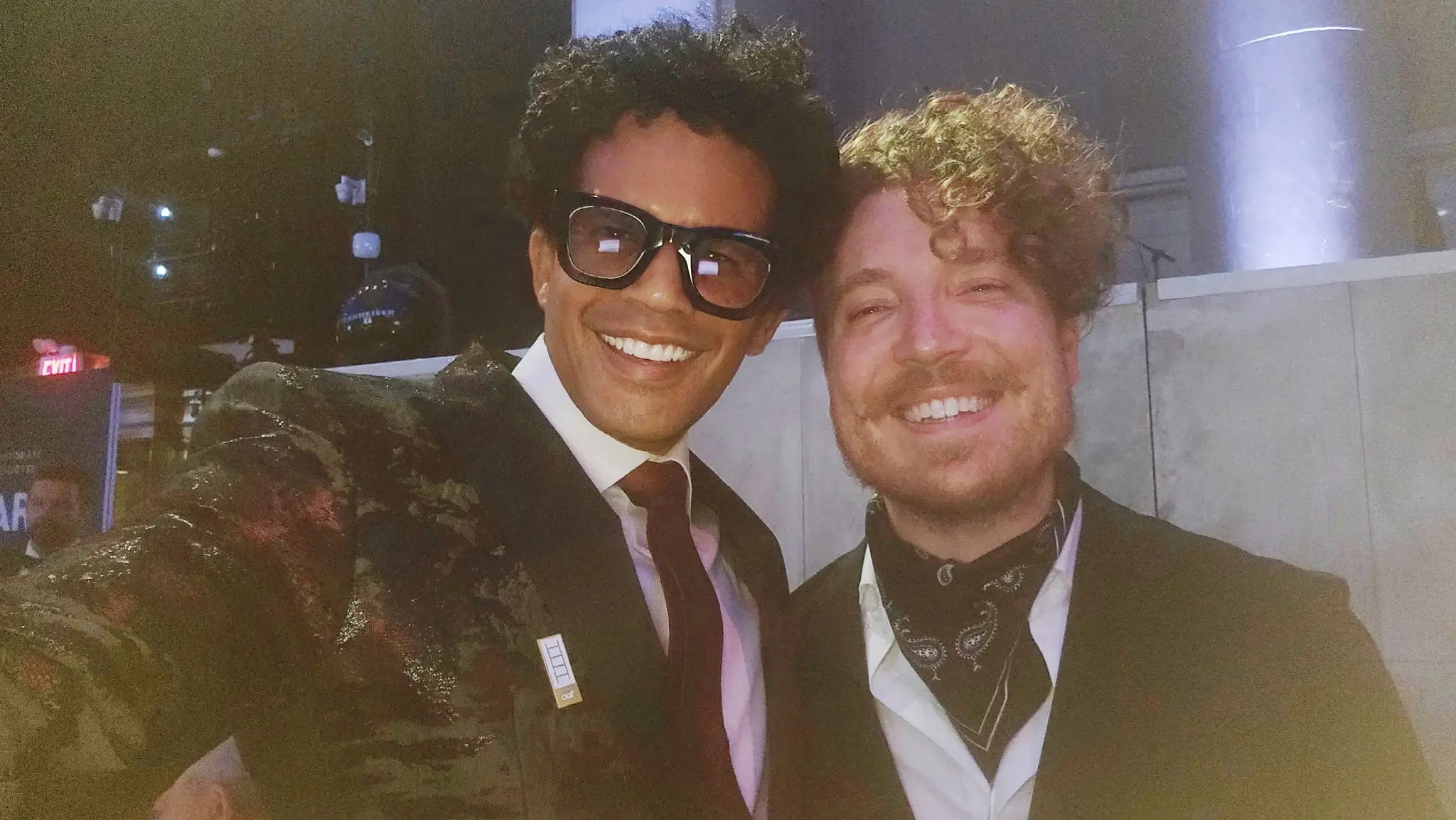
Every month this year, I’m sharing a full chapter from my 2018 book Dream Teams. To kick it off, below is the Foreword to the book, by Aaron Walton, an activist, model, and founding partner of Walton Isaacson (the award-winning creative agency and one of my favorite companies on the planet). Here we are together at the American Advertising Federation gala, where he was recently inducted into the Hall of Fame.
But first…
If you’re a regular reader of this Substack, you’ll notice that I often sign off with some variation of “Make a great day” instead of “Have a great day.”
I picked up this habit from an old colleague who had contagiously good energy. It’s an example of the subtle but awesome power of linguistic priming. In non-science speak: the words we say to ourselves can change our behavior, whether we realize it or not.
Whether we “have a great day” may very well come down to external factors. Things that happen to us or around us. Waking up a few days ago to the news that my country had once again overthrown one of our Latin American neighbors was an event that I had no control over, but which weighed on me all day.
Externalities often affect the “day” we “have.” But within this complicated world of surprises and troubles, we still have agency to make the best of what’s in front of us.
That’s why I like wishing people, “make a great day.”
And that’s why Aaron’s words in the Foreword to Dream Teams still touch me years later.
After all, what is the point of becoming teams that exceed the sum of our parts if we don’t use that power to “make” the world, rather than “have” the world that’s handed to us?
I hope you enjoy. (And make a great start to 2026!)
–Shane

FOREWORD
by Aaron Walton
Activist, model, and Founding Partner of Walton Isaacson
When I was in third and fourth grade, my grandfather used to ask me, “What will you do today to make the world a better place?” Every morning when I saw him, I knew that’s what he was going to ask me.
Growing up as a gay black kid in Massachusetts in the 1960 and 70s was not the easiest. I was in Roxbury, a rough part of Boston.
But every single time I saw him, Pops asked me the exact, same thing.
Not: “What will you do today to make your life better?”
But: “What will you do today to make the world better?”
And I’ve got to tell you, I remember thinking, “That’s part of my job.”
On my journey, I became very aware of the massive power that working as a team has to make something something bigger and better than just myself. Because of how I grew up, I have always felt the need to be a leader and to help move things along, but I also realized that progress is not a solo journey.
That philosophy has been how I’ve approached everything.
For example, when I started my latest company, my partner Cory and I sat down with an ambitious mission: “What if we wanted to create the planet’s most interesting agency?” we said.
When we sat down and mapped it out, the first thing that we worked on was not what clients we would go after, or what creative work we would do. Those are the typical things agencies start with.
Instead, the question we asked ourselves was, “What team of people will be able to reach this vision?”
We decided that if we got the right kinds of different people in the room—and we tapped into their unique points of view—that would be what got us there.
We believed that ideas could be pushed forward in a more productive and innovative way if you have a team of people with diverse backgrounds. And not just culturally diverse, but also by discipline. I knew the research that shows that teams like these can be more successful because different people have to work harder to get their points across. When we’re with people who aren’t like us, we have to marshal more resources, brain power to help convince other people of why a different direction might be the right direction. And this helps us break through.
Over the years, we put this into practice. And we’ve built a team that is truly different, and truly does some of the planet’s most interesting work, furthering social causes while building businesses at the same time. When we’ve pitched and won a Super Bowl campaign, for example, the success of why we won was not just the idea. When we made a viral video showcasing Hispanic Americans taking pride in their work and heritage, it didn’t go viral just because of the concept itself. There are a billion great ideas. It was how our team worked together that made these things happen. It was about how we brought that great idea to life by tapping into the zeitgeist of the people in our group.
Real innovation comes from our differences. Ideas get better when we challenge each other.
But here’s the thing.
It’s not comfortable. It’s messy. It’s like a Pollock painting—it looks like chaos. As humans we want to avoid conflict. The tension points between us makes us better. But getting it to work right is hard.
That’s why I’m excited about this book: Dream Teams.
I think we’re much stronger collectively than we are individually. If you think about every great breakthrough that’s ever happened in the world, it’s genuinely been when people have been working as a team, when we have been thinking about, “What can we do that’s going to make life better for someone else?”
Am I naïve to think that that’s the way the world should work?
We’re all trying to get to our mountain top. And once we get to it, we’re looking for another mountain to climb. To make that journey we need each other.
The answer to my grandfather’s question will be different every day for each of us. The fact that we will need to do it together will not.
And when we win, we’ll all win.
–Aaron Walton (follow him here)