


This week’s Snow Report is an essay on Intellectual Dishonesty & The AI Detection Freakout, based on our recent episode of The Art Of The Zag on how it turns out, yes, people really do care whether something was done by AI or not.
Intellectual Dishonesty & The AI Detection Freakout
1.
I hate Saturdays. When I was a teenager, I hated Saturdays more.
Because Saturday was when I had to mow the lawn. We had this loud, heavy, push-start mower that you had to pull a string to get started. Some of my current hearing loss may be due to this f***ing lawnmower.
For 2 hours every Saturday I pushed this f***ing mower back and forth while horseflies swarmed my face. Then by the next Saturday the Idaho crabgrass had grown back.
My brother (who switched front lawn vs back lawn with me each week) and I begged my dad to buy a riding lawnmower.
2.
If you have a riding lawnmower, God bless you. I have no malice in my heart for you whatsoever. My heart’s malice is reserved for that f***ing push mower.
3.
If you lived in Southeast Idaho circa 1998 and had a nicely mowed lawn, my brother and I would likely notice. Lawn game respect lawn game.
If you’d told us that you had used a riding lawnmower, we’d be jealous but not upset.
If you told us that you used a heavy ass mother f***ing push mower to mow that nice lawn… and then we found out you actually used a riding lawnmower… my brother and I would have egged your house. Our rage would have known no bounds.

4.
Writing is hard. Many people hate it.
(Of course, some people love it. For my recent birthday I took a week “off” to write. Some people do actually enjoy pushing a lawnmower.)
If you use an A.I. tool to write something… fine. Especially if you hate writing or tend to be slow at it.
But if you secretly actually used a riding lawnmower and are now actively pretending you didn’t… you are being dishonest.
And that is the problem.
But wait—what about the people using push mowers who are being accused of using riding lawnmowers?
5.
A few weeks ago, when writers’ rage against “AI detection tools” like Pangram was flooding my feeds, I got swept up.
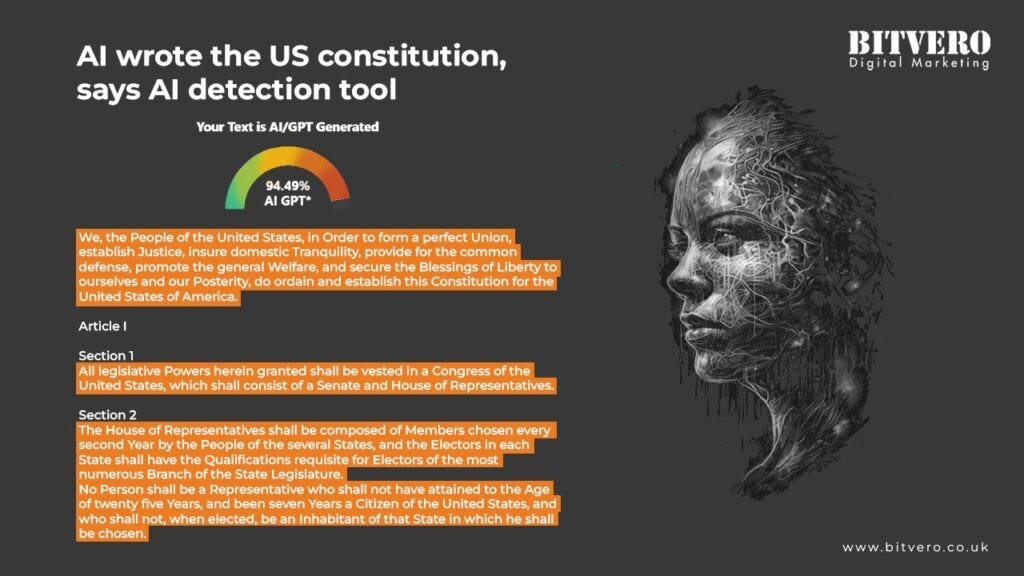
Screenshots of the U.S. Constitution being flagged as “Written by AI” were being posted by marketers and going viral on LinkedIn. Posts, about writers whose work was stolen to train LLMs and who now were being forced to jump through hoops to prove they’re human, were destroying on Substack.
As someone with “writer” at the core of my identity, I hate the idea of some AI tool falsely claiming that I had used AI to write something I’d written myself. Especially when the AI was trained on my books without my permission. (I’m actually part of the class-action lawsuit against Anthropic about this.)
So I set out to show just how bad the problem was. Similar to an experiment I did years ago on “Writing Level,” which went moderately viral, I decided to put my and a bunch of other authors’ books through Pangram and show who was more “falsely AI” than others. I was going to chart this all out. And then I was going to ride the wave of fury and sooo many new people would subscribe to my Substack. It was the perfect plan.
And the results were… absolutely zero flags for AI. Zero false positives. All these books were 100% human.
I then threw my crappiest blog posts and newsletters into the detector. Also human.
Disappointing for my viral Substacking aspirations, but it turns out that Pangram, today’s leading AI detector tool, is not flagging real writers as AI. It isn’t even AI itself, like people keep saying. It’s more of a traditional techy algorithm. And it’s so accurate that the CEO of Pangram has offered a bounty to anyone who can show them actual human-written content that is falsely flagged as AI.

Notably, people aren’t showing up to claim this bounty.
I put out some calls for examples of false AI flags myself. Nobody could show me anything.
But a few people privately showed me why they were scared to be forthright about their AI use.
One friend emailed me saying that their ideas were their own human ideas, but that they had always had a hard time writing. Using ChatGPT to turn their ideas into sentences that people could easily consume had changed their life and bolstered their career.
So my question was: “Why not say that?”
A freelance journalist friend of mine helpfully shared a bunch of examples of their writing and how Pangram had handled the % AI detection. After some follow up questions, it turns out that this writer was writing first drafts themselves and then having Claude edit them. Pangram successfully detected the AI edits.
Note that this writer is not claiming to not be using AI. The writer’s complaint was that they weren’t getting as much credit for the human work they had done, and that Pangram was giving AI more credit than was due. Any sentence that was touched by Claude at all was flagged as 100% AI, even if some of its words were first typed by a human.
I sympathize with this. But it’s not not using AI. Which makes it a different case than the U.S. Constitution thing.
6.
I did some research on the U.S. Constitution thing. The viral screenshot that keeps recirculating is from 2022. It’s from an early AI detection tool that is well known to be a piece of shit.
I put the U.S. Constitution into Pangram in 2026. Guess what it said?
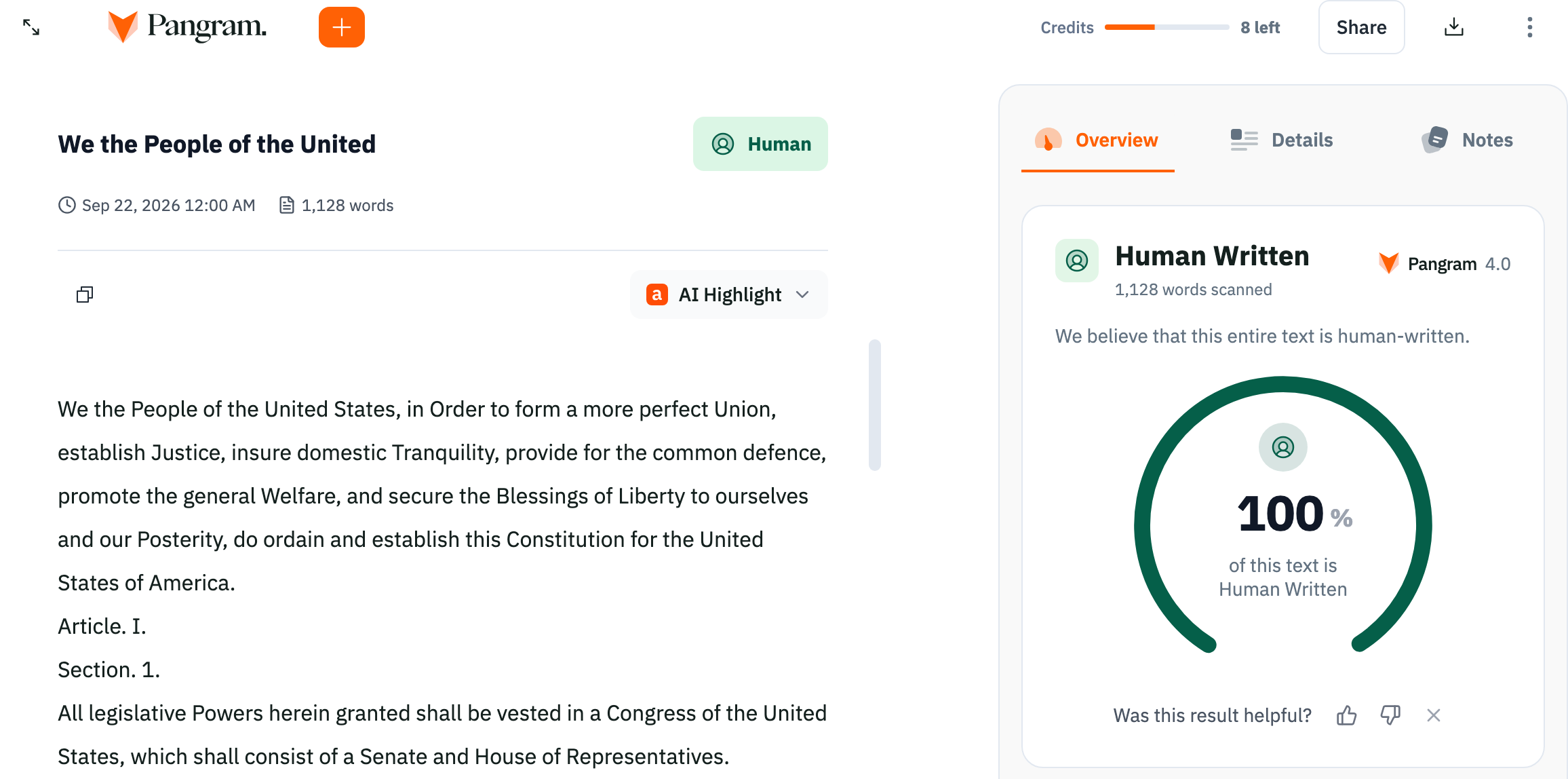
I’m a little depressed that so many journalists who posted about this didn’t bother to do any homework on this one… I’ll decline to share cynical theories for now.
7.
As far as I can tell, the people who are mad about AI writing detection fall into three camps:
Camp A: People who have no qualms with using AI to write for them but don’t want to be publicly shamed for it.
Camp B: People who don’t use AI in their writing and don’t want to be falsely accused of lying.
Camp C: People who are being intellectually dishonest with themselves.
Writers in Camp A need to stop lying. Just say you used the riding lawnmower. Give your reason if you need to. My brother and I are happy for you and your nice lawn.
Fellow Writers in Camp B: we’re going to be OK. Pangram is not going to break into your house and abduct your child and turn the toilet paper roll upside down so it unrolls too much when you pull it.
If you’re worried about getting snapped up in the 0.001% of false positives or whatever even smaller number it is by the time I hit publish, run your work through Pangram before you publish. Edit to get rid of the false positive. (And collect a bounty!)
But also, here’s what comforts me the most personally: The best test of whether someone has actually written their own work is to ask them to talk about their writing process. The independent publisher Bona Books put out a fascinating report in which they describe interviewing authors about their novel-writing process; in the course of doing so, it became easy to spot people who didn’t do their own work. Their answers to questions about the writing process were vague; their answers can be inconsistent with what’s in the actual book; their answers sounded more like them recalling their prompts than recalling a drafting process.
This fantastic essay about Bona’s report makes the point very well: anyone who has actually written something meaningful will be able to talk about the work and their process in a way that makes it impossible to conclude it’s not theirs. And vice versa.

If you’re at some point dragged in front of The Committee to defend your writing, if you’re being honest and it is your work, you will be able to talk about it longer and more detailed than they will have the attention span for.
Camp C is where things get muddy, and interesting.
Examples of Camp C statements include:
“These are my ideas, and having ChatGPT organize them is no different than an author having a ghostwriter.” (To which I say: Ask a ghostwriter if they consider their client the “writer” of their books?)
“I didn’t use AI to write this. Just to edit this.” (To which I say: writing is editing, and editing is writing. But more importantly, why not just say this?)
“I just had AI do the first draft, then I rewrote it.” (To which I say: if the AI detector picks it up, then you didn’t rewrite that much of it. But thank you for being honest.)
“AI detection is unfair to non-native speakers or people with dyslexia.” (To which I say: are you ESL or dyslexic yourself? Or are you deflecting?)
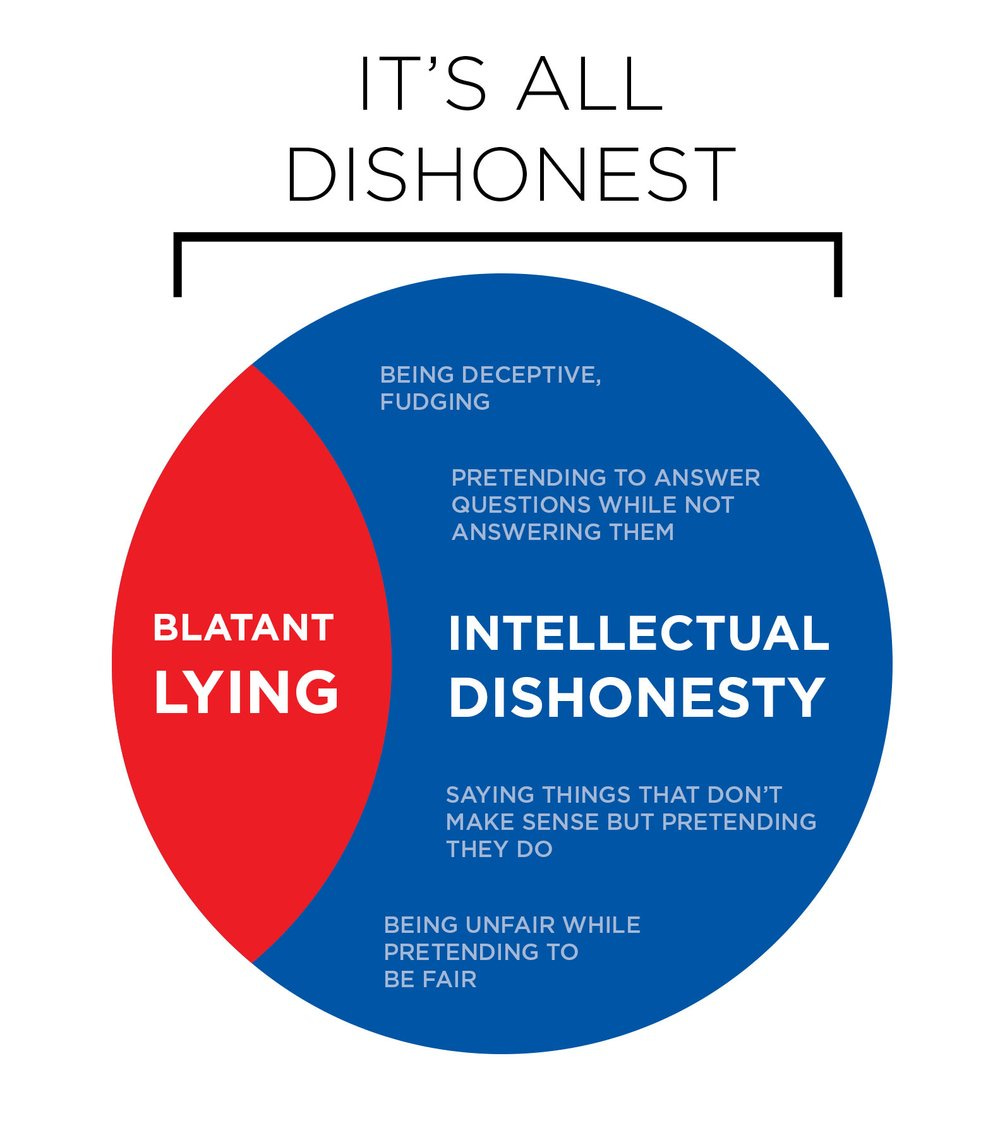
In each of the Camp C cases, what’s afoot is intellectual dishonesty. Which is a fancy way of saying, “you’re telling kinda-sorta technical truths because of your careful wording, but you’re actually being deceptive.”
Intellectual dishonesty is a tricky thing, because it’s often based on self-deception. You believe you’re a good person, and you can make an argument based on a technicality that supports what you’re saying, so you rationalize it all in your head.
But then you don’t tell people the whole truth. And why is that?
8.
If you are dyslexic, and use AI to write or rewrite your ideas so it doesn’t take 10 hours to write something that takes someone else 1 hour… that’s ok! You know what, you should tell people this outright. If you walk with a cane, especially nobody is going to beat you up for using a riding lawnmower. Shoot, they’ll probably praise you for mowing the lawn at all.
If English is not your first language and you tag the end of your LinkedIn fable with “English is not my first language, so I used Claude to clean up my writing for this.”... you will get support from people who appreciate that you’re making efforts to communicate with them in their language. And you will nullify any jerks who are ready to point out that this sounds like AI.
If you are a freelance writer, but in this economy you cannot afford to pay an editor to catch your mistakes… you should use AI as your editor. AND SAY SO. Lord knows, your plight resonates.
(And if you really don’t want to trip Pangram, you can always ask AI to flag editing problems and then you go fix them yourself. This is what my journalist friend told me their conclusion was.)
I recently ran an audience data collection effort for a musical I’m producing. Organizing survey responses, cross-tabulating data, and writing up a report on what it all means is something I was not looking forward to doing by hand. (Not the kind of writing I take my birthday week off for.)
So I fed the data to Claude to make the report. I checked Claude’s work, of course. We went back and forth a few times. But just because I put in some effort didn’t mean I did it all by hand.
So when I sent the report to my team, I added “Claude helped me put together this report on the survey results.”
Nobody said, “Hey this report looks a little AI generated…” or “How dare you call yourself a writer, forsooth!”
(Though now that I see that, I think I might start saying it to people…)
Making a habit of just pointing out whenever you used AI either solves the problem, or it forces you to be honest with yourself and do the work without shortcuts when it’s the proper thing to do.
9.
People don’t like when “what you get” is misaligned with “what you paid for.” The cognitive dissonance often breeds anger.
It feels fair to pay more for a hand-painted painting than a print.
It feels unfair to pay hand-painted price for a hand-painted item and then find out it was actually a print.
If what you want is a print and you pay for a print and what you get is a print… you don’t tend to freak out.
If what you want is a report on survey results and what you get is a report on survey results—cool.
If what you want is a mindless romance novel like the last one and you don’t care who wrote it and it costs you $0.99 in the Kindle store—ok.
If what you want is a personally-penned novel from a unique human with a unique human backstory and you’re willing to pay a $2 million advance cuz millions of people are gonna pay 30 bucks a pop at Barnes & Noble for this shit, and what you realize you’re going to get instead is something secretly co-authored by Gemini—which any human with a keyboard can have as their co-author too—you’re going to withdraw that advance.
10.
The problem is not A.I. It’s dishonesty.
Humans don’t like feeling betrayed.
Humans don’t like when people get credit for things they didn’t do.
Humans don’t like feeling like things are unfair to them.
Humans also don’t like being called out on their dishonesty.
That’s why the AI detection freakout conversation has gone so viral.
(That and outrage gets hella shares these days.)
My biggest conclusion from trying and failing to get Pangram to falsely accuse me and all my author friends of writing with AI is not that using technology as a means to an end is bad and all of us who happen to enjoy writing words are so great blah blah blah.
My conclusion is that AI technology particularly enables humans to be intellectually dishonest.
Think about it. AI isn’t just good at letting you take credit for work you didn’t do. It’s good at fibbing itself. It’s good at telling you what you want to hear, and reframing what you want to argue, based on technicalities or slanted perspective. It’ll do that for you with no qualms.
In other words, as we wrestle with the question of “what makes us human” as the artificially intelligent gets more life-like, perhaps one thing to add to the list is: Honesty.
And being honest with ourselves.
Shane Snow is a business journalist, producer, and a keynote speaker focusing on human behavior, teamwork, lateral thinking, and storytelling.
Watch Shane & Joe discuss the AI Writing Vibe Shift on Art Of The Zag:
LOVE the intellectual dishonesty angle to the Pangram backlash. Spot on.
Great citations -- that Bona report is really interesting and it should be on more people's radars. Thanks for sharing it.